
Britain Is Rebuilding Defence Manufacturing. Can the Supply Chain Keep Up?
Jobs supported by defence expenditure in UK weapons and ammunition manufacturing rose by 51% in 2024/25, according to figures published by the Ministry of Defence.
The MOD’s estimates also point to a wider year-on-year increase of 26,000 defence-supported roles across UK industry. That broader figure includes direct manufacturing employment and indirect jobs throughout the supply chain.
These numbers suggest growing industrial activity, but they also raise a more difficult question. Does the UK defence manufacturing supply chain have the depth, capability and control needed to meet the demand now being placed upon it?
Increased expenditure only becomes useful capability when equipment can be engineered, manufactured, integrated, inspected, tested and delivered. That work extends far beyond major defence contractors. It depends on direct suppliers, subcontractors and specialist engineering businesses working together.
Available production capacity will matter as demand grows. But capacity without repeatability, traceability, documentation and dependable delivery will not be enough.
The Numbers Show How Quickly Demand Is Changing
The MOD’s employment estimates place the 51% increase within a wider rise in defence-related employment. The estimated growth of 26,000 roles spans direct manufacturing and indirect supply-chain work.
In July 2026, the Government also announced that approximately £8.4 billion had been committed to begin Dreadnought Delivery Phase 4. This is the fourth major production phase of the Dreadnought Class submarine programme. The £8.4 billion should not be treated as a single contract. The announcement identifies a £5.9 billion contract with BAE Systems within the wider commitment, with further investment intended for Rolls-Royce Submarines and the broader UK supply chain.
The wider Defence Nuclear Enterprise supports around 47,000 UK jobs and a supply chain containing more than 6,000 UK companies. These figures relate to the enterprise as a whole, not solely to Dreadnought.
PRV Engineering is not being linked to Dreadnought or any other named programme. The announcement is relevant because it demonstrates the scale of industrial activity that major defence commitments can generate.
The real measure of UK defence manufacturing growth is not expenditure alone. It is whether the industrial base can turn that investment into controlled, repeatable output.
Defence Primes Cannot Manufacture Everything Themselves
Major defence contractors sit at the visible end of the industry, but they depend on extensive supply chains. Smaller engineering companies may contribute through subcontracted manufacturing, development work or specialist packages without contracting directly with the MOD. Their contribution should not be judged only by the number holding direct Government contracts.
The MOD says it already works with around 12,000 SMEs through its supply chain. Approximately 25% of current MOD spending with SMEs is delivered through direct contract awards, while the remaining 75% flows through the wider supply chain.
This creates a layered industrial structure. Prime contractors depend on direct suppliers, which in turn may rely on specialist manufacturers for particular processes or components.
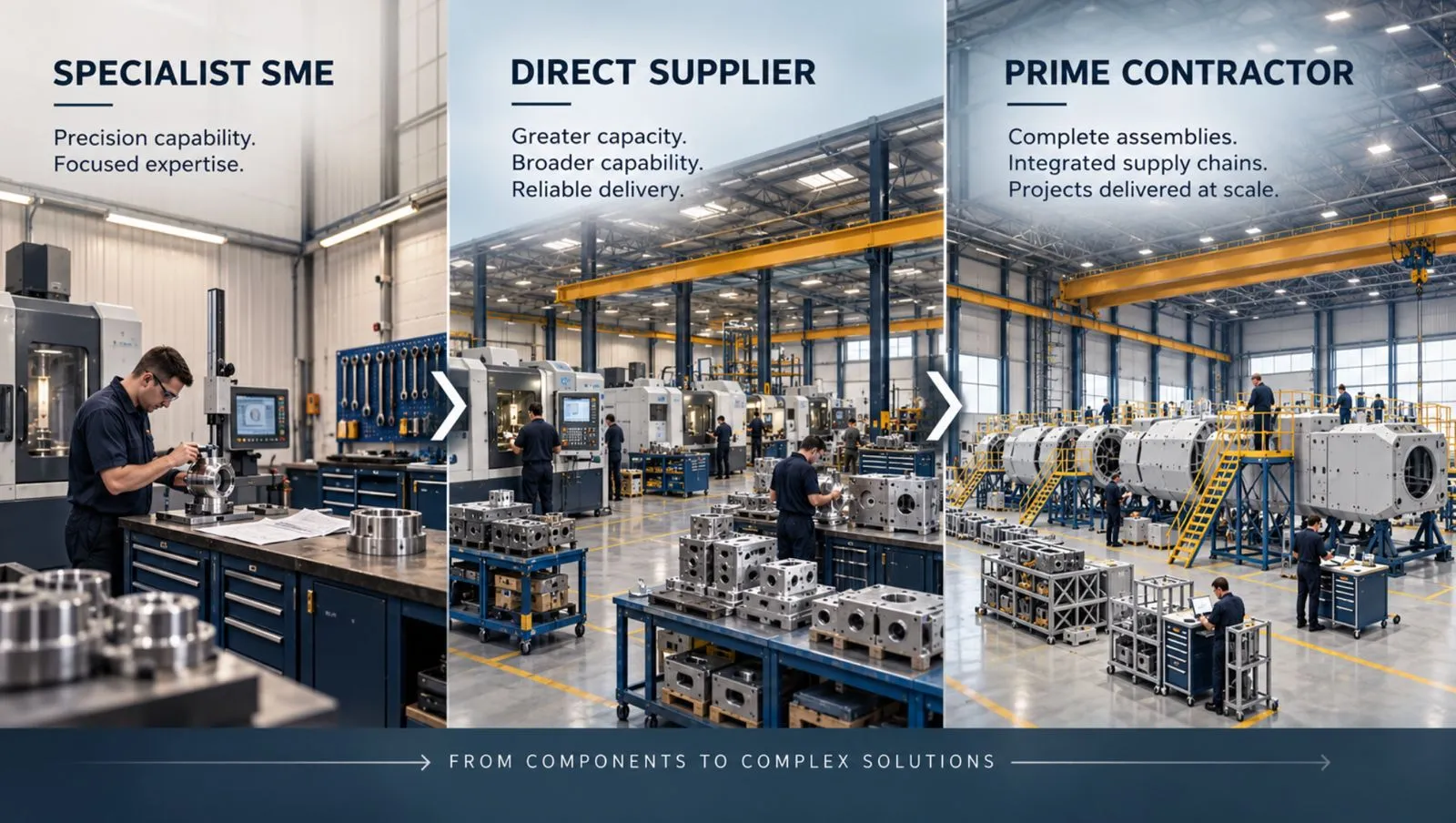
As demand grows, performance must be sustained across that entire network. Major programmes cannot remain on schedule if essential suppliers lack the people, systems, equipment or capacity to deliver their respective packages consistently.
Capacity Alone Is Not Enough
When demand increases, the first question is often how much spare production capacity is available. Machine hours matter, but they are only one part of the answer.
A company may be able to manufacture an initial component successfully without being ready to support sustained production. Genuine capability means repeating the result while maintaining control over materials, processes, inspection and documentation.
- Traceability helps provide that control. Manufacturers may need clear records of the materials used, production stages completed and inspections performed. Documentation must remain accurate throughout the work rather than being reconstructed at the end.
- Engineering changes also need to be controlled. Drawings, specifications, quantities and schedules may evolve during development or production. Suppliers must identify the correct information and prevent outdated requirements from moving forward.
- Equipment creates capacity, but skilled engineers, machinists, fabricators, inspectors and project personnel convert that capacity into reliable output. Confidentiality matters too, particularly where customer and programme details cannot be discussed publicly.
- Capacity is therefore about how much work a business could theoretically accept. Capability is whether it can deliver that work repeatedly with the required control and confidence.
The Hidden Problem: Fragmented Manufacturing
Complex components and assemblies may pass through several operations before delivery. Depending on the requirement, these could include cutting, machining, fabrication, welding, specialist finishing, inspection and assembly.
Specialist suppliers are often necessary. Some processes require equipment or knowledge that it would not be practical for every manufacturer to maintain.
The problem arises when a manufacturing package is divided between more organisations than necessary. Each additional hand-off can create another transport movement, schedule, communication route and documentation interface.
Fragmentation can also make engineering changes harder to manage. If revised information must pass through several businesses, each supplier needs the correct version and a clear understanding of how it affects its work.
Reducing supplier numbers does not automatically produce lower costs or shorter lead times. However, where one capable company can manage more of an appropriate package, fewer unnecessary interfaces may make production easier to coordinate.
Where PRV Engineering Fits
PRV Engineering is an example of an established UK engineering SME working within demanding and confidential areas of the defence sector. PRV has worked in the industry for nearly a decade. Its involvement began when the company was approached to assist with new-product development, and it now works routinely across several parts of the sector.
Specific customer and programme information may be confidential and should not be inferred. PRV should not be described as a weapons manufacturer or connected to any named programme without confirmation. Approved examples of its work include armour-plated products and components, mounts, electrical components including busbars for power or data within vehicles, fabricated assemblies and ancillary items.
PRV can manufacture from completed drawings and specifications where requirements are already established. It can also become involved earlier through prototyping and practical input on materials, coatings, functionality and manufacturability. That earlier involvement can help connect design intent with manufacturing reality before a product moves towards repeat production.
PRV’s experience in defence engineering and manufacturing support is not based on one isolated process. Its relevance lies in supporting different stages of a manufacturing package while maintaining clear responsibility and practical communication.
One Supplier Doing More Can Support Resilience
A component may require several operations, but those operations do not always need to be coordinated through a long chain of separate suppliers. PRV’s integrated workflow can include waterjet cutting, CNC machining, fabrication, assembly, coatings and finishing. Busbar manufacturing and other specialist work can also be included where relevant. For more information on all of our services visit the PRV website.
Waterjet cutting is one element of that sequence, rather than the central story. The stronger point is how different processes can be coordinated within a wider manufacturing workflow.
Keeping appropriate stages under one supplier’s responsibility can reduce unnecessary hand-offs, transport movements and separate schedules. It may also simplify communication when drawings or requirements change. Integration can support continuity from prototype to production because knowledge gained during development is retained as the work progresses.
This does not mean one supplier should perform every process, nor does it guarantee lower costs or faster delivery. Its practical value is clearer responsibility and fewer avoidable interfaces across a suitable manufacturing package.
The Opportunity For UK Engineering SMEs
The current direction of defence policy creates opportunities for capable UK engineering SMEs, but it also brings higher expectations. According to the MOD’s SME Action Plan, Defence spends around £5 billion with SMEs each year. The Government has set a target to increase that annual spending by £2.5 billion by summer 2028, a planned 50% rise over the existing baseline. This is a target rather than a completed result or a guarantee of work for individual businesses.
The plan also aims to simplify processes from concept to contract, reduce unnecessary barriers and improve the diversity and resilience of the defence supply chain. It recognises that SMEs may work directly with Defence or contribute through larger suppliers.
For manufacturers, this means opportunities may emerge through prime contractors, strategic suppliers and established subcontracting routes. Winning an initial order, however, is different from demonstrating sustainable long-term capability. Suppliers must be able to deliver repeatedly, respond to change and maintain control as requirements evolve. They also need to assess opportunities realistically because defence work may require investment in people, equipment, systems or capacity.
The SMEs best placed to build sustainable positions will combine practical manufacturing capability with reliable delivery, clear documentation and an understanding of where they fit within the wider supply chain.
Britain’s Ambitions Depend On Manufacturing Depth
The increase in defence-supported jobs, major programme commitments and planned growth in SME spending all point towards greater industrial demand. But national ambition must still be converted into physical output. That requires major contractors, direct suppliers and specialist manufacturers to operate as parts of a controlled and dependable system.
Integrated engineering businesses such as PRV may become increasingly valuable where they can absorb appropriate manufacturing packages and reduce unnecessary hand-offs. Their role is to provide reliable capability within the wider network, not replace every specialist or claim involvement in named programmes.
Britain’s defence ambitions will not be delivered by prime contractors alone. They will depend on the depth, resilience and performance of the UK defence manufacturing supply chain behind them.
Recent Comments