Tag Archives: Waterjet Cutting

11 Sep 2026
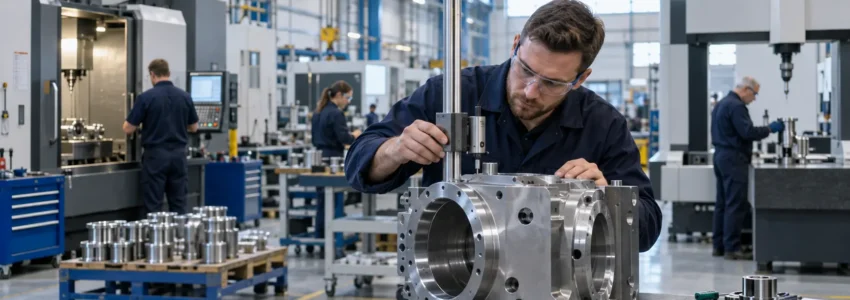
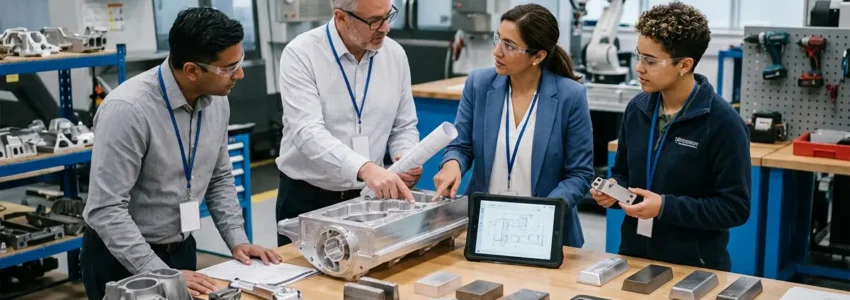
Engineer inspecting a precision-machined metal component in a modern UK manufacturing facility.

Britain Is Rebuilding Defence Manufacturing. Can the Supply Chain Keep Up?

Jobs supported by defence expenditure in UK weapons and ammunition manufacturing rose by 51% in 2024/25, according to figures published by the Ministry of Defence.

The MOD’s estimates also point to a wider year-on-year increase of 26,000 defence-supported roles across UK industry. That broader figure includes direct manufacturing employment and indirect jobs throughout the supply chain.

These numbers suggest growing industrial activity, but they also raise a more difficult question. Does the UK defence manufacturing supply chain have the depth, capability and control needed to meet the demand now being placed upon it?

Increased expenditure only becomes useful capability when equipment can be engineered, manufactured, integrated, inspected, tested and delivered. That work extends far beyond major defence contractors. It depends on direct suppliers, subcontractors and specialist engineering businesses working together.

Available production capacity will matter as demand grows. But capacity without repeatability, traceability, documentation and dependable delivery will not be enough.
14 Aug 2026
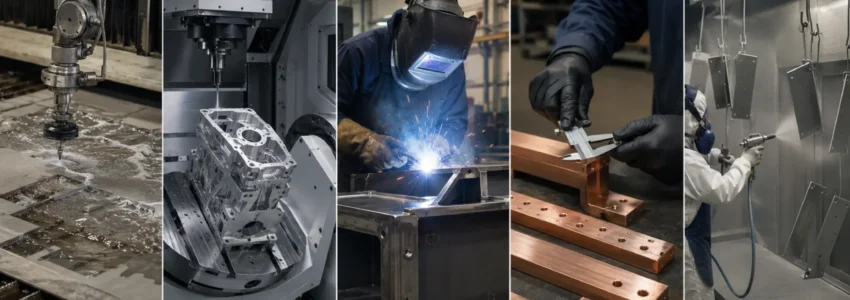
Integrated engineering processes showing waterjet cutting, 5-axis machining, metal fabrication, busbar manufacture and finishing.

Why Complex Components Rarely Rely on One Manufacturing Process

A finished engineering component may look simple. The route taken to manufacture it often is not.

A plate may begin on a waterjet cutting machine before moving into CNC machining. A fabricated assembly can require cutting, welding, machining and finishing. An electrical component may need accurate profiling followed by plating to achieve the required conductivity and protection.

That is why modern subcontract engineering is increasingly about combining the right processes, rather than finding one machine capable of doing everything.

At PRV Engineering, those processes include hydro-abrasive waterjet cutting, CNC turning and milling, 5-axis machining, metal fabrication, welding, busbar manufacture and specialist finishing.

So, what are they actually used for?

19 Jun 2026
Engineers reviewing multiple versions of a component manufactured using different processes, highlighting the importance of manufacturing process selection in modern engineering.

The Best Engineering Solution Isn’t Always The Simplest

Most people assume engineers are trying to find the fastest, cheapest or simplest way to manufacture a component.
In reality, they are often trying to avoid problems that have not happened yet.

A decision made during the earliest stages of design or production planning can affect everything that follows. Distortion, premature wear, assembly issues, machining challenges, quality concerns and project delays can often be traced back to a manufacturing decision made weeks or even months earlier.

This is why manufacturing process selection remains one of the most important decisions in engineering.

Whether producing a defence component, industrial assembly, electrical busbar or automotive part, the process used to manufacture a component can have a significant impact on cost, performance, lead times and reliability.

The challenge is that there is rarely only one correct answer.

4 Mar 2026
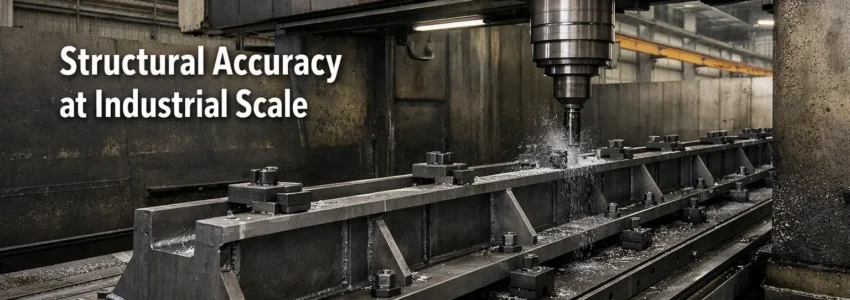
High-resolution industrial photograph inside a large CNC machining bay showing a 2 metre fabricated rail mounting frame secured on machine bed

How Large Format Machining Maintains Accuracy at Industrial Scale

Large format machining refers to the precision machining of oversized or heavy components that exceed the capacity of standard CNC equipment. It typically involves large bed or gantry machines capable of handling long structural sections, thick plate, fabricated assemblies or complex welded frames.

Unlike small-part machining, scale introduces additional engineering variables. Tool deflection increases. Thermal movement becomes measurable across longer spans. Workholding becomes more complex. Maintaining positional accuracy over extended travel distances requires structural rigidity, careful sequencing and controlled datum strategy.

In sectors such as rail infrastructure, where components must align over metres rather than millimetres, large format machining becomes a structural necessity rather than a capability upgrade.

It is not simply machining at a bigger size. It is machining under different physical constraints.

28 Nov 2025
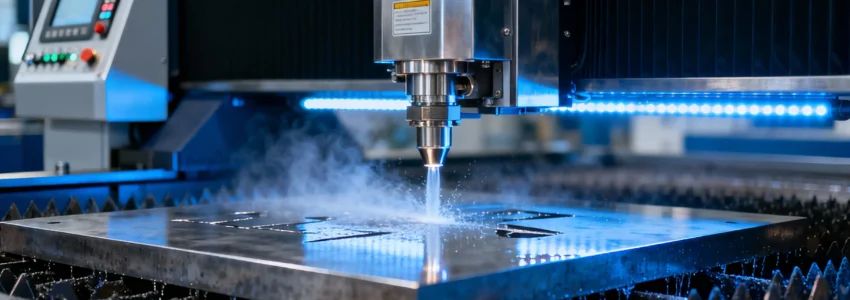
Modern waterjet cutting machines slicing metal with a high-pressure abrasive jet in an engineering workshop.

The Evolution of Waterjet Cutting Machines

Waterjet cutting machines have become one of the most critical tools in modern engineering, valued for their accuracy, versatility, and ability to cut materials without generating heat or distortion. As industries move towards smarter, cleaner, and more automated production methods, the evolution of waterjet cutting machines tells a much bigger story; one of innovation, precision, and the future of manufacturing itself.

17 Jun 2025
waterjet cutting services in the UK

When failure isn’t an option and accuracy defines success, waterjet cutting ensures the highest quality results without compromising your materials or your reputation. Every manufacturing decision matters. Your reputation and your client’s trust, rests on the quality of every component that leaves your facility. That’s why choosing the right custom fabrication partner and technology isn’t just about meeting specifications; it’s about exceeding expectations when it matters most.

At PRV Engineering, we understand the weight of that responsibility. Our waterjet cutting services represent more than just advanced technology—they’re your pathway to manufacturing confidence, delivering the precision and reliability that complex projects demand.

29 Apr 2024

The introduction of abrasive waterjet cutting into the manufacturing industry marked a pivotal advancement in how materials are processed. This technology, distinguished by its precision and efficiency, offers a non-thermal, water-driven method to cut a wide range of materials, from metals to composites, without altering their intrinsic properties.

5 Sep 2023

Waterjet cutting has revolutionised the manufacturing industry, offering a myriad of advantages over traditional cutting methods. Among them, hydro-abrasive waterjet cutting stands out as a superior choice for a range of materials, including metal, stone, and glass. In this article, we take a look at the intricacies of this advanced technique, shedding light on its principles, advantages, applications, and comparisons with other cutting methods.

22 Dec 2022

How Hydro-Abrasive Waterjet Cutting Compares to Traditional Methods

Hydro-abrasive waterjet cutting is a precision cutting technique that uses a high-pressure stream of water mixed with an abrasive substance to cut through materials. It is a versatile process that can be used to cut a wide range of materials, including metals, composites, glass, stone, and ceramics. In this article, we explore the advantages of this advanced process and some of its applications across various sectors.

25 Apr 2022

CNC Waterjet cutting is a specialised manufacturing process that uses a high-pressure jet of water to cut or shape various types of materials. The power of the CNC waterjet cutting machine comes from a pressurising pump that uses a small precision nozzle. As the water exits the nozzle, it delivers a supersonic stream of water, about three times the speed of sound.

Recent Comments

    Events

    October 2026
    M T W T F S S
     1234
    567891011
    12131415161718
    19202122232425
    262728293031