
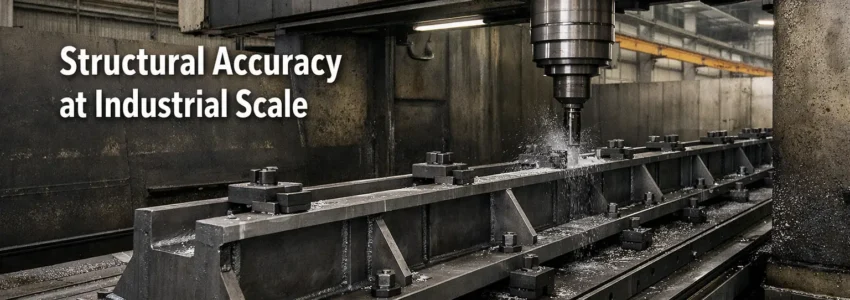
How Large Format Machining Maintains Accuracy at Industrial Scale
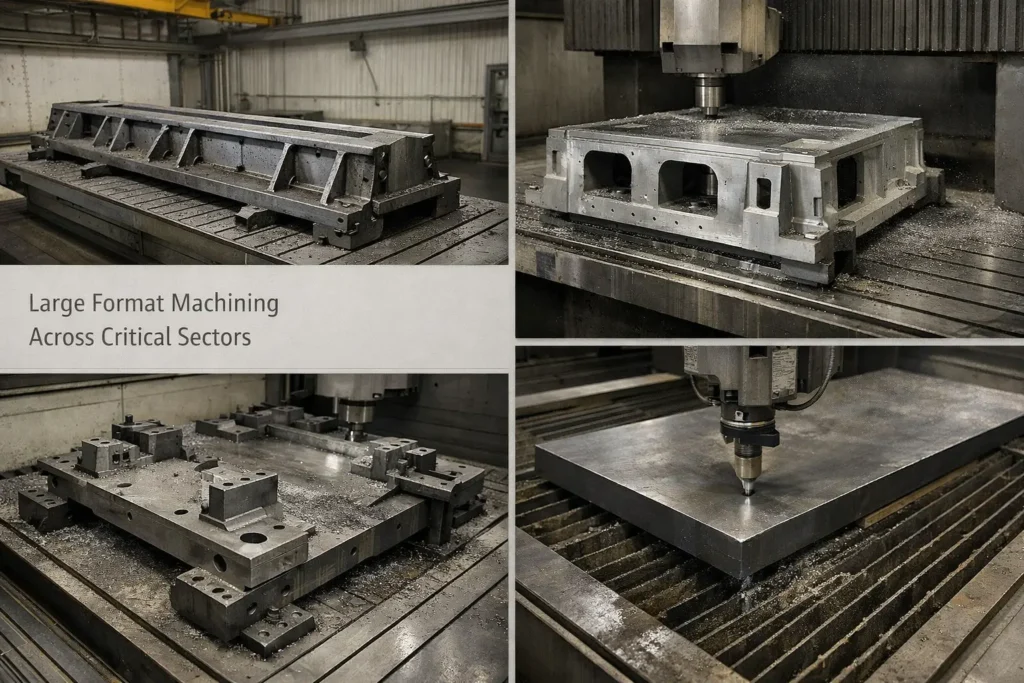
Large format machining refers to the precision machining of oversized or heavy components that exceed the capacity of standard CNC equipment. It typically involves large bed or gantry machines capable of handling long structural sections, thick plate, fabricated assemblies or complex welded frames.
Unlike small-part machining, scale introduces additional engineering variables. Tool deflection increases. Thermal movement becomes measurable across longer spans. Workholding becomes more complex. Maintaining positional accuracy over extended travel distances requires structural rigidity, careful sequencing and controlled datum strategy.
In sectors such as rail infrastructure, where components must align over metres rather than millimetres, large format machining becomes a structural necessity rather than a capability upgrade.
It is not simply machining at a bigger size. It is machining under different physical constraints.
Why Scale Changes the Physics of Machining
As component size increases, the physics governing machining behaviour changes.
A long rail mounting plate or fabricated base frame does not behave like a compact billet. It can flex under clamping pressure. It may carry residual stress from welding. It expands and contracts over its length in response to ambient temperature.
These variables influence:
- Tool path stability
- Surface flatness
- Positional accuracy
- Repeatability across operations
Over long travel distances, even minor spindle or gantry deflection can accumulate into measurable deviation. Maintaining geometric integrity requires machine mass, structural stiffness and controlled feed strategy.
Large format machining therefore demands more than capacity. It demands rigidity.
Rail Infrastructure and the Engineering Reality of Size
Rail components provide a practical example of why scale matters.
Structural brackets, equipment housings, mounting plates and fabricated assemblies must often maintain alignment across extended spans while withstanding vibration, environmental exposure and long service lifecycles.
PRV’s work within the railway industry demonstrates how dimensional accuracy at scale directly influences performance in service. Misalignment in mounting faces or datum surfaces can affect installation tolerances and long-term system stability.
Rail is not unique in this requirement, but it illustrates it clearly. When a component interfaces with infrastructure, cumulative tolerances matter.
Preparing Large Components Without Distortion
Before machining begins, material preparation plays a critical role.
Thermal cutting methods can introduce heat-affected zones and localised distortion, particularly in thicker plate. When working with large components destined for precision machining, edge integrity and flatness are significant.
Hydro-abrasive waterjet cutting offers a cold-cutting process that avoids metallurgical change and reduces distortion risk.
For oversized rail plates or structural profiles, this preparation method helps maintain flatness before the part reaches the machining stage. Reduced distortion at cutting stage simplifies subsequent datum control and improves repeatability.
In large format machining, stability begins long before the first spindle engagement.
Rigidity, Workholding and Datum Strategy
Workholding becomes more complex as component mass increases.
Large fabricated structures rarely present uniform geometry. Clamping pressure must stabilise the part without inducing additional stress. Poor workholding can introduce temporary distortion that disappears when unclamped, leaving dimensional inaccuracy.
Maintaining rigidity involves:
- Multi-point clamping strategy
- Controlled support under long spans
- Stable fixture design
- Consistent datum referencing
Datum selection is equally critical. Establishing reference surfaces early and maintaining consistency throughout the process reduces cumulative error.
Where five-sided access is required, 5-axis machining capability supports complex geometries while preserving alignment. Large format machining often combines scale with geometric complexity. Managing both simultaneously requires structural discipline.
Managing Residual Stress in Fabricated Assemblies
Many large components begin life as welded fabrications.
Welding introduces residual stress. When machining removes material from one face of a stressed structure, redistribution can occur. The component may move during or after machining.
Managing this behaviour may involve:
- Stress-relief processes
- Balanced material removal strategy
- Sequential machining passes
- Controlled inspection between stages
This approach is particularly relevant in rail engineering projects, where fabricated frames must interface precisely with other structural elements. PRV’s broader work supporting UK rail projects highlights the importance of integrated process control across fabrication and machining stages.
Large format machining must account for the history of the material, not just its final geometry.
Tolerance Stability Across Extended Travel
Maintaining tight tolerances over long travel distances is a defining challenge. On a large machine envelope, axis movement spans significantly greater distances than on compact CNC equipment.
Over these lengths:
- Thermal expansion of machine structure becomes measurable
- Tool wear may affect surface finish consistency
- Spindle alignment must remain stable
Machine mass and structural design reduce vibration and deflection. Controlled environmental conditions further support stability.
Standards governing dimensional tolerances and geometric product specification provide guidance for inspection and verification. The British Standards Institution offers detailed frameworks for tolerance control and quality management.
While standards define allowable deviation, achieving consistency at scale depends on machine integrity and disciplined process control.
Integrating Large Format Machining With Finishing Processes
Large components rarely leave the machine as finished parts.
Rail infrastructure assemblies often require surface protection to withstand environmental exposure. Protective finishing processes must account for:
- Machined surface quality
- Coating thickness allowances
- Masking of critical datum faces
- Adhesion across large surfaces
Maintaining flatness across wide machined faces improves coating consistency and long-term durability. Coordination between machining and finishing stages reduces rework and ensures compliance with specification. Where scale is involved, process integration reduces variation.
Large Format Machining Beyond Rail
While rail provides a clear illustration, similar challenges arise in defence platforms, energy infrastructure and heavy industrial equipment.
In defence applications, structural housings and mounting systems must maintain dimensional integrity under load and vibration. In energy installations, large frames and base plates support mechanical systems where alignment affects efficiency and reliability.
Across sectors, large format machining enables:
- Structural stability
- Accurate interface alignment
- Controlled tolerance stacking
- Predictable assembly integration
It supports components that cannot be divided into smaller machined segments without compromising strength or alignment.
Where Accuracy at Scale Defines Performance
Large format machining is not simply an increase in machine envelope. It is a response to the structural realities of oversized components.
Scale introduces deflection, thermal movement and stress redistribution. Rail infrastructure and heavy engineering projects demonstrate how these factors influence long-term reliability.
By combining distortion-controlled preparation, rigid machining platforms, disciplined datum strategy and integrated finishing, dimensional stability can be maintained across large assemblies.
In practical terms, the size of a component does not reduce the expectation of accuracy. It increases the consequences of inaccuracy.
Large format machining ensures that structural scale and precision coexist, allowing complex infrastructure components to perform as designed long after installation.
Recent Comments