Blog

17 Apr 2026
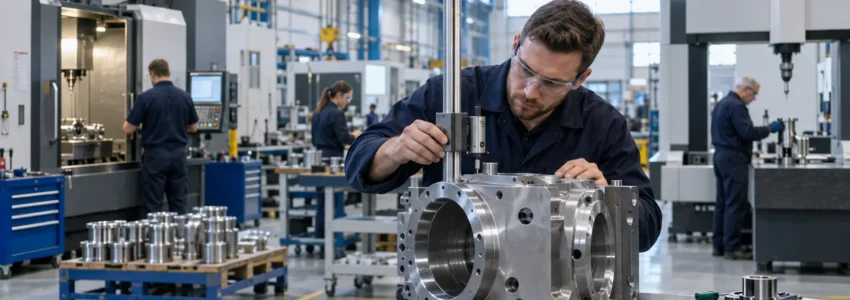
Abstract collage of precision-engineered components with subtle blueprint overlays and geometric linework, representing hidden processes behind reliable engineering

Why the Best Engineering Is Often Invisible

Some engineering gets attention because it looks futuristic, dramatic, or headline-worthy. A new supercar. A hypersonic aircraft. A fully automated factory. These are the projects that attract attention and headlines.

But most real engineering value doesn’t look like that.
It’s quieter. Less visible. And often only recognised when something goes wrong.

9 Apr 2026
Armour-grade steel component in a defence engineering facility with traceability tag and industrial scanner in use

Material Traceability in Engineering: The Centre of Project Risk and Compliance

Material traceability in engineering refers to the ability to track and verify the origin, composition, and processing history of materials used throughout a project. It is no longer a documentation exercise; it is a core requirement for compliance, quality assurance, and operational accountability.

Across sectors such as defence, energy, transport, and infrastructure, traceability in engineering is becoming a baseline expectation rather than a value-added feature. Regulatory pressure, supply chain complexity, and the consequences of failure have shifted traceability from a back-office function to a critical part of project delivery.

For decision-makers, this change is not theoretical. It directly affects supplier selection, project timelines, and long-term liability.

1 Apr 2026
Hydro-abrasive waterjet cutting thick armour-grade steel plate in a defence engineering facility, with partially assembled armoured vehicle structure in the background

How Waterjet Cutting Services Support Modern Defence Engineering

Waterjet cutting services have become increasingly important in defence-related engineering because they eliminate one of the most common and underestimated risks in manufacturing: heat-induced material distortion. For contractors, project directors and procurement teams, this has direct implications for reliability, compliance, and long-term cost.

In defence manufacturing, the margin for error is effectively zero. Components are expected to perform under extreme conditions, over long operational lifecycles, and often within tightly controlled tolerances. In this environment, the choice of cutting process is not just a production decision but a performance decision.

24 Mar 2026
Inspection of a machined component using precision measurement equipment to verify engineering tolerances and material performance.

Material Selection in Engineering: Where Good Designs Go Wrong

Material selection in engineering rarely gets the attention it deserves.

Most discussions focus on design geometry, tolerances or manufacturing processes. But even the most well-designed component can underperform, or fail entirely, if the material isn’t right for the job.

Two parts can look identical on a drawing and still behave very differently in the real world. Heat, load, corrosion and fatigue all act on materials in ways that aren’t always obvious at the design stage.

That’s why material selection isn’t just a specification decision. It’s a performance decision; one that can determine whether a system lasts for years or begins to degrade far sooner than expected.

17 Mar 2026
Precision inspection of a machined aerospace component using a coordinate measuring machine to verify engineering tolerances.

How Engineering Tolerances Affect Performance, Safety and Reliability

Engineering tolerances are often treated as a detail on a drawing, but in reality they define whether a component performs as intended once it leaves the machine.

Every engineered system relies on controlled variation. No component is manufactured to a perfect dimension, so tolerances exist to define the acceptable limits within which parts can function correctly. When those limits are exceeded, even slightly, the consequences can range from reduced efficiency to complete system failure.

In many industries, tolerance issues are not immediately visible. Components may assemble correctly, pass initial inspection and even operate for a period of time before problems begin to emerge. This makes poor or inconsistent engineering tolerances one of the more difficult issues to diagnose in complex systems.

12 Mar 2026
Split-scene image showing safe aerospace CNC machining on Earth and a realistic orbital semiconductor manufacturing module in low Earth orbit.

Microgravity Is Changing Advanced Materials in Space Manufacturing

Space manufacturing is rapidly moving from theoretical research into a serious engineering discussion.

For most of the space age, manufacturing has taken place almost entirely on Earth. Satellites, spacecraft components and instruments are designed, machined and assembled in terrestrial facilities before being launched into orbit.

But engineers are beginning to question whether some materials might actually be produced more effectively in space.

In microgravity environments, liquids behave differently, crystal structures can form more uniformly and impurities do not settle in the same way they do under Earth’s gravity. These changes may allow scientists and aerospace engineers to manufacture certain materials with properties that are difficult to achieve in conventional factories.

What once sounded like science fiction is now becoming a practical area of aerospace engineering research.

4 Mar 2026
High-resolution industrial photograph inside a large CNC machining bay showing a 2 metre fabricated rail mounting frame secured on machine bed

How Large Format Machining Maintains Accuracy at Industrial Scale

Large format machining refers to the precision machining of oversized or heavy components that exceed the capacity of standard CNC equipment. It typically involves large bed or gantry machines capable of handling long structural sections, thick plate, fabricated assemblies or complex welded frames.

Unlike small-part machining, scale introduces additional engineering variables. Tool deflection increases. Thermal movement becomes measurable across longer spans. Workholding becomes more complex. Maintaining positional accuracy over extended travel distances requires structural rigidity, careful sequencing and controlled datum strategy.

In sectors such as rail infrastructure, where components must align over metres rather than millimetres, large format machining becomes a structural necessity rather than a capability upgrade.

It is not simply machining at a bigger size. It is machining under different physical constraints.

25 Feb 2026
Industrial workshop showing a shot blasted steel component on a coating line while a technician measures coating thickness with a digital gauge.

How Surface Treatment Improves Performance, Durability and Compliance

Surface Treatment is the engineering process of modifying a material’s outer layer to improve its corrosion resistance, conductivity, wear performance, or environmental durability.

In modern engineering applications, surface treatment directly affects how long a component lasts, how it performs under load and whether it complies with industry standards. It is no longer a cosmetic afterthought. In sectors like defence, rail, automotive and energy, surface treatment determines structural protection, electrical stability and long-term reliability.

Without effective surface treatment, even precision-machined components can degrade prematurely in harsh environments. The surface is the first point of contact with moisture, chemicals, vibration and electrical load. As a result, it has become a core engineering decision rather than a final finishing step.

20 Feb 2026
Automotive editorial photograph of a narrow four-wheel tilting microcar driving on a Paris boulevard at golden hour

How the Tilting Microcar Is Redefining Urban Automotive Engineering

Most cars resist leaning. The tilting microcar does the opposite. Its engineered to lean on purpose.

In cities where road space is shrinking and emissions rules are tightening, simply making cars smaller is no longer enough. Stability becomes the limiting factor. A narrow vehicle can reduce congestion and improve efficiency, but narrow geometry increases rollover risk.

A tilting microcar solves that problem mechanically. It is a lightweight electric vehicle that leans into corners in a controlled manner, shifting its centre of gravity inward to maintain stability. It combines aspects of motorcycle dynamics with automotive structural engineering.

Developed by AEMotion in France, the AEMotion vehicle applies this leaning car design within Europe’s quadricycle category. As AutoEvolution reports, it represents a different way of approaching urban electric mobility, not by shrinking the conventional car, but by rethinking its balance.

This article examines how the tilting microcar works, the structural and control challenges behind it, and what it signals for European automotive engineering and supply chains.

13 Feb 2026
Waterjet Cutting Services from PRV Engineering | Close-up of a waterjet cutting machine

When Waterjet Cutting Services Are the Right Choice for Industrial Projects

Choosing the right cutting process is rarely about preference. It is about material behaviour, thickness, tolerances, finishing requirements, and downstream performance.

Waterjet cutting services are often selected when thermal cutting methods introduce risk. While laser and plasma systems have their place in modern manufacturing, hydro-abrasive waterjet cutting offers a fundamentally different approach; one that removes heat from the equation entirely.

Understanding when to choose waterjet cutting services over alternative methods can significantly influence cost, quality, and long-term performance.

Events

April 2026
M T W T F S S
 12345
6789101112
13141516171819
20212223242526
27282930