

Could the JetZero Z4 Change the Shape of Commercial Aviation?
A brief comment underneath a recent PRV Engineering post caught our attention and led us to explore the JetZero Z4:
“Our plans at Archon are similar.”
It came from Archon Aerospace, a company publicly developing its own unconventional flying-wing aircraft concepts.
The original post concerned the JetZero Z4, a proposed 250-passenger blended wing body aircraft. JetZero says the aircraft could travel up to 5,000 nautical miles while using as much as 50% less fuel per passenger mile than comparable conventional aircraft.
Those figures remain development targets rather than proven airline performance. However, the programme is beginning to attract the investment, government support and airline involvement needed to move beyond the concept stage.
That is what makes the Z4 worth following.
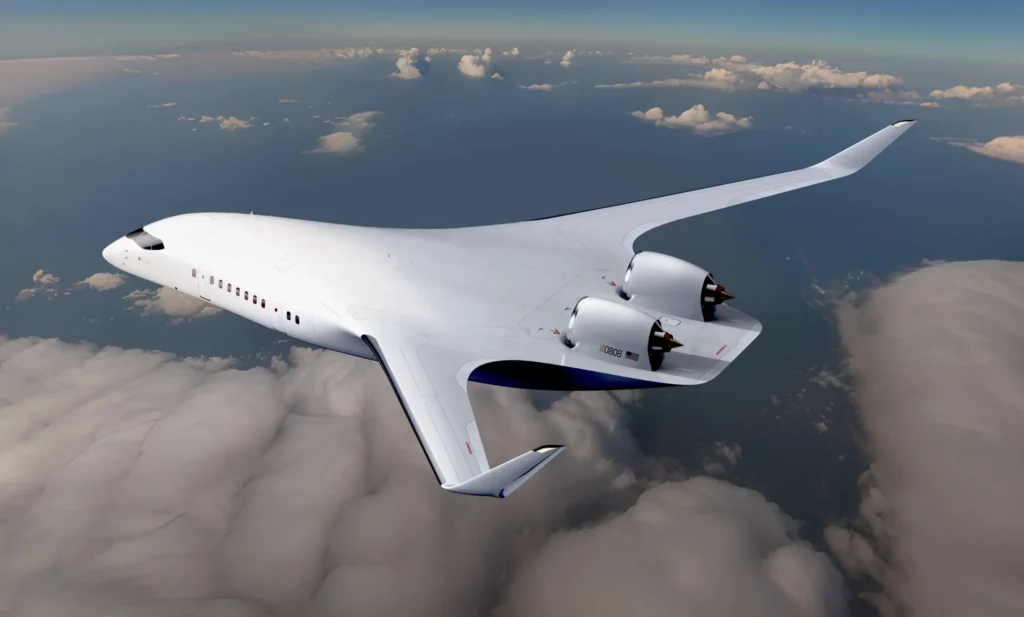
Note: The featured image used with this article is an AI-generated concept illustration of a blended-wing aircraft and is not an official JetZero rendering.
What Is the JetZero Z4?
The JetZero Z4 is a proposed commercial aircraft that combines the fuselage and wings into one broad lifting structure.
Conventional passenger aircraft use a cylindrical fuselage attached to separate wings. A blended wing body allows more of the aircraft itself to generate lift, potentially reducing drag and improving fuel efficiency.
The aircraft is sometimes described as a flying wing, although blended wing body is the more accurate term. It still includes a substantial central section for passengers, cargo and aircraft systems.
The initial Z4 is expected to use conventional turbofan engines. Its proposed efficiency gains therefore depend primarily on the airframe rather than an unproven propulsion technology. This reflects a wider shift in aircraft design, where aerodynamic performance increasingly depends on precision modelling, advanced materials and manufacturing accuracy.
Why the JetZero Z4 Is Being Taken Seriously
Blended wing aircraft are not a new idea. NASA, Boeing and the US Air Force have studied similar configurations for decades, including through the X-48 flight-test programme.
What has changed is the scale of commitment behind JetZero. In 2023, the US Department of the Air Force selected JetZero to develop a full-scale blended wing body prototype, supported by planned Department of Defense investment of $235 million over four years..
The US Department of the Air Force selected the company to develop a full-scale demonstrator, supported by a programme valued at up to $235 million. Its first flight is currently targeted for late 2027.
Commercial airlines are also becoming involved. United Airlines has invested in the company, while Japan Airlines and Gulf Air announced agreements connected to the Z4 during the 2026 Farnborough International Airshow.
None of this guarantees that the aircraft will enter service. It does show that serious organisations are now examining the concept as a possible operational aircraft rather than an interesting research project.
Efficiency Is Only Part of the Challenge
A more aerodynamically efficient shape does not automatically make a commercially successful airliner.
The Z4 must still operate from existing runways, taxiways and airport gates. It must accommodate passengers comfortably, allow rapid evacuation and provide practical access for maintenance and ground handling.
Its unusual shape also changes the internal cabin layout. Instead of one long narrow fuselage, passengers may be distributed across several wider cabin areas.
That could create more usable space and improve boarding. It also introduces new questions around seating arrangements, emergency exits, passenger movement and structural design.
The aircraft therefore has to work as part of the wider aviation system, not only perform efficiently in flight.
Building the JetZero Z4
The manufacturing challenge may prove just as significant as the aerodynamic one.
Commercial aircraft production is built around mature methods for manufacturing cylindrical fuselage sections and conventional wings. A blended wing body changes the geometry of the aircraft’s largest structures and the way forces are distributed through them.
Large composite components, precision tooling and digital manufacturing and processes such as 5-axis machining, are likely to play important roles. These structures must remain lightweight while surviving pressurisation, fatigue and decades of operational use.
Greater structural integration can reduce weight and the number of joints. However, it can also make components more difficult to manufacture, inspect, transport and repair. Every design decision must therefore balance aerodynamic performance with production reality.
What the JetZero Z4 Means for Suppliers
New aircraft programmes create opportunities across the aerospace supply chain, but they also raise the standard expected from manufacturers producing precision aerospace engineering components.
Producing an individual part accurately is not enough. Manufacturers must demonstrate repeatability, traceability, process control and reliable inspection.
Components may pass through cutting, machining, fabrication, finishing and assembly before delivery. Each transfer between disconnected suppliers creates another potential delay or quality risk.
PRV Engineering’s hydro-abrasive waterjet cutting capability demonstrates one part of this wider manufacturing principle. The process can cut specialist materials without introducing a heat-affected zone.
Parts can then move into CNC machining, fabrication or finishing as part of a more integrated workflow. No single process builds an aircraft. What matters is whether the entire manufacturing sequence remains controlled.
Certification Will Decide What Happens Next
The full-scale demonstrator will allow JetZero and its partners to test more than flight performance. The programme must provide evidence covering structural integrity, stability, passenger evacuation, systems resilience and long-term maintainability.
Airline involvement should help identify practical challenges early. Japan Airlines, for example, is expected to contribute operational knowledge covering maintenance, cabin services, ground handling and airport integration.
This matters because certification is not a final administrative stage added after the aircraft has been designed.
Materials, manufacturing records, inspection routes and repair methods must all support the certification case from the beginning. In aerospace, quality control and inspection are part of the engineering strategy, not simply checks carried out before delivery.
Why Archon Aerospace Recognised the Direction
Archon Aerospace publicly presents several flying-wing aircraft concepts using electric, hybrid, hydrogen and conventional propulsion.
Its comment should not be treated as an endorsement of the Z4 or evidence that the companies are working together. The programmes are separate and at different stages of development. The significance lies in the shared direction. Both companies are questioning the assumption that future passenger aircraft must retain the conventional tube-and-wing layout used today.
Archon recognised the engineering thinking behind the PRV post because it is considering related questions itself: how can the aircraft structure generate more lift, reduce drag and accommodate future propulsion systems?
That is a more meaningful reaction than a simple compliment from a general aviation account.
From Concept Aircraft to Industrial Programme
The JetZero Z4 remains an ambitious aircraft facing major technical, regulatory and commercial hurdles.
However, the programme is no longer supported by aerodynamic theory alone. It now includes a full-scale demonstrator, government funding, airline partnerships and plans for a major manufacturing facility in North Carolina.
The most important question is therefore not whether the aircraft looks futuristic. It is whether JetZero can turn that unconventional shape into something that can be certified, manufactured repeatedly, maintained efficiently and operated reliably by commercial airlines.
That is the point where aerospace ambition becomes engineering reality. It is also why the reaction from Archon Aerospace carried genuine weight. Someone working on a related aircraft philosophy recognised that blended wing designs are beginning to move from speculative concepts towards credible engineering programmes.
Recent Comments