
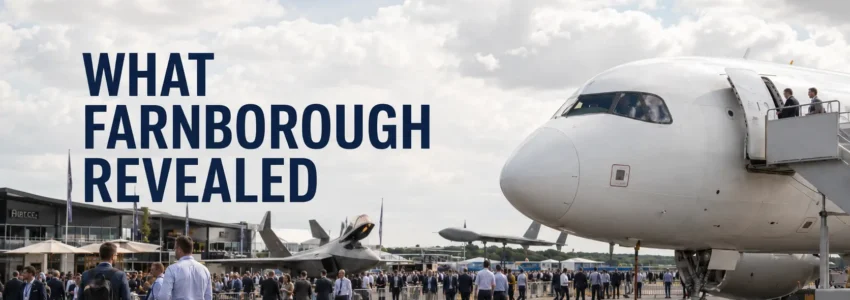
What Farnborough Revealed About The Future Of Aerospace
The Farnborough International Airshow has always combined spectacle with serious business.
Aircraft perform overhead while manufacturers, airlines, governments, investors and engineering businesses negotiate what the industry will build next. The flying displays attract attention, but many of the most important developments happen inside exhibition halls and private meeting rooms.
Farnborough Airshow 2026 took place from 20 to 24 July, bringing together the aerospace, aviation, defence and space industries. Organisers described it as the largest and most ambitious event in the show’s 78-year history, with a sixth exhibition hall added to meet demand.
There was no shortage of aircraft orders, technical announcements or ambitious concepts. Yet the bigger story was not simply what the industry wants to build.
It was whether manufacturers and their supply chains can produce, support and continuously improve everything being promised.
Farnborough Was Bigger Than Aircraft Orders
Major airshows are often judged by the value and volume of commercial aircraft orders announced during the week.
Boeing and Airbus secured around 327 firm and preliminary aircraft orders between them at Farnborough 2026. Boeing finished slightly ahead in what Reuters described as a comparatively low-key order contest. The individual agreements were still substantial.
- SMBC Aviation Capital placed a firm order for 100 Airbus A320neo-family aircraft.
- Philippine Airlines committed to as many as 20 Boeing 787 Dreamliners.
- Uganda Airlines placed its first Boeing order for four 737-8s and four 787-9s.
- MSC Air Cargo also purchased five 777-8 Freighters.
Those figures confirm that long-term demand for commercial aircraft remains strong. They also reveal only part of the situation.
The Industry Has Demand. Delivery Is Harder
Aircraft manufacturers are not struggling to find customers.
They are managing deep order backlogs while trying to increase production in supply chains that remain constrained by shortages of engines, components, materials and experienced people.
This changed the tone at Farnborough. Orders still mattered, but delivery capability mattered more than it once did. Airlines can announce ambitious fleet plans, but those plans depend on manufacturers converting order books into completed aircraft.
Reuters noted that delivery slots are largely committed well into the next decade. That means attention is increasingly shifting from how many aircraft can be sold to how reliably manufacturers can build and deliver them.
For the wider manufacturing sector, that is perhaps the most commercially important message from Farnborough Airshow 2026.
Strong demand does not remove production risk. It magnifies it.
Defence Took A Much Larger Share Of The Show
Farnborough has always included military aviation, but defence had an unusually strong presence in 2026.
Around half of the show’s record 1,600 exhibitors represented defence-related technology, compared with roughly 40% historically. Uncrewed aircraft, autonomous systems, air defence, surveillance and lower-cost combat capability were prominent throughout the event.
This reflected the obvious geopolitical backdrop, but it also showed how quickly defence procurement priorities are changing.
Armed forces still require highly capable crewed aircraft. They are also looking for systems that can be developed faster, produced in greater numbers and deployed without placing a pilot inside every platform.
The result is a growing market for collaborative and autonomous aircraft that can work alongside conventional fighters.
Brontanax Became One Of The Biggest Talking Points
One of the show’s most significant British announcements came from BAE Systems.
The company unveiled Brontanax, described as the UK’s first British-designed uncrewed autonomous Collaborative Combat Aircraft. It is intended to complement existing and future crewed aircraft by adding frontline capability at a lower cost.
BAE Systems says the aircraft was built at Warton by British engineers and supported by businesses across the UK supply chain. The company’s announcement described Brontanax as evidence that Britain retains “the skills, the technology and the determination” required to develop advanced combat-air systems.
The aircraft is important in its own right. The wider point is that defence aerospace is moving towards mixed fleets in which crewed and uncrewed platforms operate together.
That requires new aircraft, but it also requires manufacturing systems capable of producing sophisticated technology in meaningful quantities.
Boeing Brought The Ghost Bat To Farnborough
Boeing’s MQ-28 Ghost Bat made its Farnborough debut as another example of collaborative combat aircraft moving towards practical deployment.
The uncrewed aircraft has been developed in Australia and is intended to work alongside crewed military platforms. Boeing used Farnborough to highlight additional international partnerships around the programme.
The presence of both Brontanax and the Ghost Bat made the direction of travel difficult to miss. Autonomy is no longer confined to small experimental drones.
Manufacturers are developing larger, more capable aircraft intended to become an integrated part of future air forces.
That will place new demands on design, electronics, communications, testing and production. It will also create opportunities for the specialist manufacturers supporting these programmes further down the supply chain.
Airbus Looked Beyond The Current Generation
Commercial aviation also provided one of the show’s most interesting engineering announcements.
Airbus confirmed a new flight-test programme for its Wing of Tomorrow research. Full-scale high-span wing extensions will be designed, manufactured and tested on an A321neo as Airbus explores technologies for the next generation of single-aisle aircraft.
Longer wings can improve aerodynamic efficiency, but they create problems around airport gates and ground clearance. Folding outer sections may allow future aircraft to gain more wingspan in flight while continuing to use existing infrastructure.
We explored that specific manufacturing challenge in PRV’s previous article on folding aircraft wings.
At Farnborough, however, it formed part of a broader discussion about what will eventually replace today’s bestselling narrow-body aircraft.
The answer is unlikely to depend on one breakthrough. It will involve wings, propulsion, materials, manufacturing and airport practicality developing together.
Sustainability Became More Technically Specific
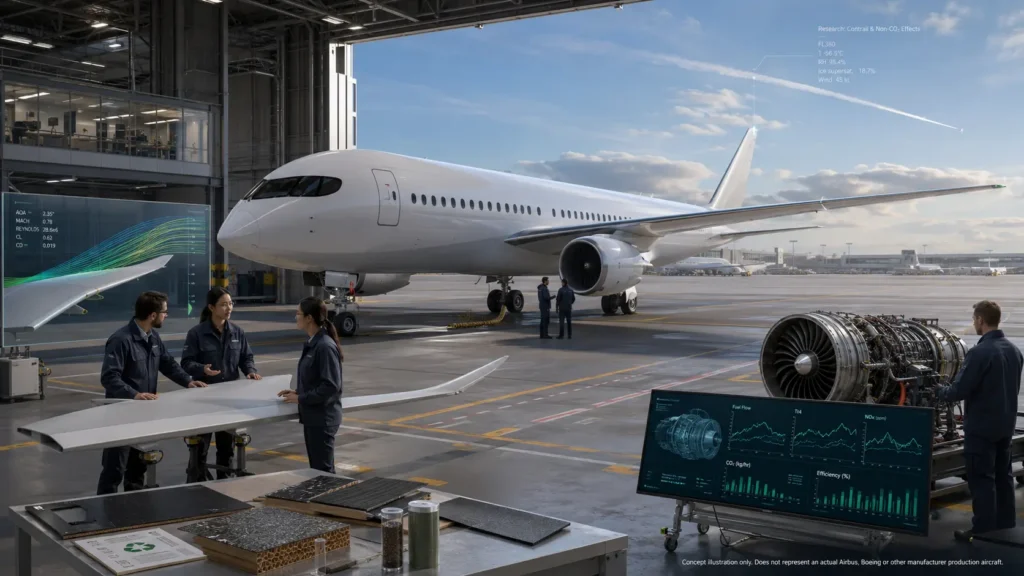
Sustainability remained an important theme, but some of the most interesting work went beyond the familiar conversation about fuel consumption.
Chief technology officers from Boeing, Airbus, Dassault, GE Aerospace, Rolls-Royce, RTX and Safran presented research into aviation’s non-carbon-dioxide effects.
These include contrails, nitrogen oxides, aerosols, sulphur and soot. Their environmental effects are more complicated to measure than direct carbon emissions, but they remain an important part of understanding aviation’s total climate impact.
This work suggests that the next stage of sustainable aviation will require more detailed scientific understanding.
More efficient engines and lower-carbon fuels remain important. So do the conditions in which aircraft operate and the atmospheric effects they leave behind.
It is a less immediately dramatic subject than a new aircraft unveiling, but potentially one of the most consequential.
Support And Maintenance Became Part Of The Competition
Another significant Farnborough discussion concerned who controls the long-term servicing of aircraft and engines.
Aircraft manufacturers and engine companies are competing for a greater share of maintenance, repair and aftermarket revenue. As modern aircraft remain in service for decades, the commercial value of supporting them can rival the original sale.
For airlines, the issue is not only cost. It concerns access to parts, technical data, repair capacity and the ability to keep aircraft operational without excessive delays. This mirrors a wider industrial reality.
The value of an engineered product does not end when it leaves the factory. Long-term performance depends on replacement components, repair knowledge, technical support and supply-chain continuity.
Farnborough showed that manufacturers increasingly see service capability as part of the product itself.
Britain Put More Money Behind Aerospace Manufacturing
The UK Government used the show to announce a £600 million package supporting British aerospace innovation.
The package included £500 million for aerospace research and technology projects, alongside a £100 million fund intended to strengthen the aerospace supply chain. The stated ambition is to help double the value of the UK aerospace sector by 2035.
That supply-chain element is particularly important. Funding major research programmes may produce new designs and technologies. Those ideas still require businesses capable of making components, developing production methods and moving projects from demonstration into repeatable manufacturing.
A strong aerospace sector cannot consist solely of aircraft designers and major manufacturers. It depends on the network of specialist engineering businesses beneath them.
Skills May Be The Most Difficult Constraint
Farnborough also exposed a challenge that cannot be solved simply by purchasing more machinery.
Aerospace companies are competing for engineers, software specialists and other technically skilled people at a time when sectors such as artificial intelligence are drawing heavily from the same talent pool.
Airbus responded to part of that challenge by launching a new UK helicopter training academy at Oxford Airport. More than 400 pilots, engineering technicians and aerospace leaders are expected to pass through the academy each year.
The industry needs young engineers and technicians, but it also needs experienced people who understand materials, manufacturing, inspection, maintenance and the realities of production.
Technology may change quickly. Building the judgement required to use it well still takes time.
Farnborough Was Also About The Next Generation
The final day included Pioneers of Tomorrow, Farnborough’s public programme for families, students and people considering careers in aerospace.
Tickets sold out before the event, reflecting strong public interest in aviation and space. That may sound less significant than a multi-billion-pound aircraft order, but it addresses one of the sector’s most persistent concerns.
The aircraft and systems announced in 2026 will require people to design, manufacture, test, operate and maintain them for decades. Inspiring those people cannot begin when a skills shortage has already reached crisis point. It has to begin long before they enter the workforce.
What Really Stood Out At Farnborough Airshow 2026?
Farnborough offered plenty of spectacle, from advanced military aircraft to commercial flying displays and ambitious future concepts.
Yet the strongest impression was of an industry being pulled in several directions at once. Airlines want more aircraft, but manufacturers must improve delivery.
Governments want greater defence capability, but they also want it produced faster and at a sustainable cost. Aviation needs greater efficiency, but new technology still has to work within existing airports and operating systems.
Companies want to automate, digitise and innovate, but they remain dependent on skilled people and dependable physical manufacturing. The announcements may have covered very different parts of aerospace but the underlying challenge was remarkably consistent.
The industry must become better at turning ambition into repeatable production.
Why Farnborough Matters To PRV Engineering
The event matters to PRV because it provides a clear view of the industries the company supports and the pressures shaping them.
PRV works across aerospace and aviation, as well as defence, automotive, motorsport, rail, energy and specialist industrial engineering. Across all of these sectors, the expectations are similar: accurate components, suitable materials and finishes, consistent production and dependable delivery.
Farnborough celebrates the aircraft, systems and ideas that capture attention. Behind them sits a much wider manufacturing network that turns those ideas into real, reliable products.
Recent Comments