
Archives

Automotive

28 May 2026
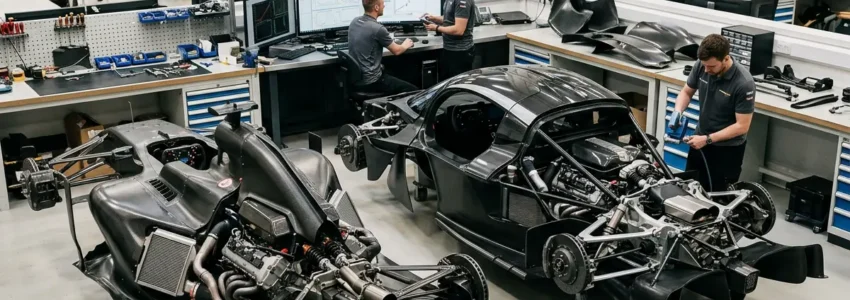
Engineers developing a Formula 1-inspired performance car chassis inside an advanced automotive engineering facility.

From The Racetrack To The Road: How Formula 1 Technology Shapes Modern Cars

For most people, Formula 1 exists in a completely separate world from everyday driving.

The cars are faster, lower, louder and engineered to extremes that appear almost impossible to apply to a production vehicle. Yet many of the technologies now considered normal in modern road cars either originated in Formula 1 or were accelerated by it.

Paddle-shift gearboxes, hybrid systems, advanced aerodynamics, carbon fibre structures and energy recovery technologies all spent years being developed under Formula 1’s intense engineering environment before finding their way into production vehicles.

What makes Formula 1 particularly interesting is that it no longer functions purely as motorsport. It has become one of the automotive industry’s most advanced research and development laboratories.

The performance figures attract the attention. The engineering transfer behind them is arguably the more important story.

22 May 2026
Engineers inspecting advanced carbon fibre and titanium components during hypercar development.

From the Bugatti Tourbillon to the McLaren W1: The Manufacturing Challenge Behind Modern Hypercars

Modern hypercars have become some of the most ambitious engineering projects ever attempted.

When Bugatti unveiled the Tourbillon, attention naturally focused on its naturally aspirated 8.3-litre V16 and 1,800-horsepower hybrid powertrain. Ferrari’s new F80 and McLaren’s W1 generated similar excitement, each showcasing a different approach to performance, electrification and lightweight design.

What makes these cars fascinating isn’t simply how fast they are.

Modern hypercars reveal how dramatically manufacturing has evolved. Advanced materials, hybrid systems, aerodynamic complexity and increasingly demanding tolerances are forcing engineers to solve challenges that barely existed a decade ago.

The performance figures grab the headlines. The manufacturing behind them is just as impressive.

20 Feb 2026
Automotive editorial photograph of a narrow four-wheel tilting microcar driving on a Paris boulevard at golden hour

How the Tilting Microcar Is Redefining Urban Automotive Engineering

Most cars resist leaning. The tilting microcar does the opposite. Its engineered to lean on purpose.

In cities where road space is shrinking and emissions rules are tightening, simply making cars smaller is no longer enough. Stability becomes the limiting factor. A narrow vehicle can reduce congestion and improve efficiency, but narrow geometry increases rollover risk.

A tilting microcar solves that problem mechanically. It is a lightweight electric vehicle that leans into corners in a controlled manner, shifting its centre of gravity inward to maintain stability. It combines aspects of motorcycle dynamics with automotive structural engineering.

Developed by AEMotion in France, the AEMotion vehicle applies this leaning car design within Europe’s quadricycle category. As AutoEvolution reports, it represents a different way of approaching urban electric mobility, not by shrinking the conventional car, but by rethinking its balance.

This article examines how the tilting microcar works, the structural and control challenges behind it, and what it signals for European automotive engineering and supply chains.

12 Dec 2025
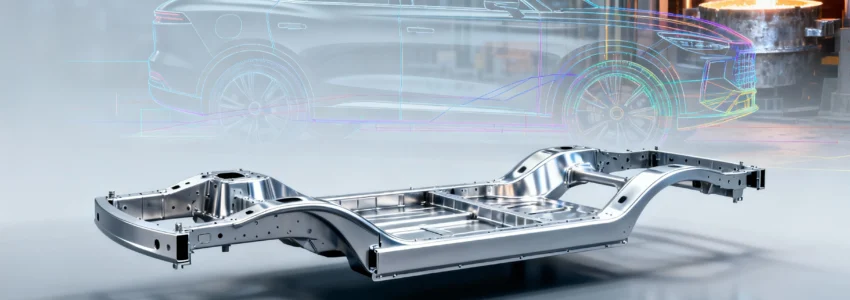
Aluminium Aluminium Automotive Engineering | BYD Single-Cast Frame (AI Image)

How China Is Reshaping Aluminium Automotive Engineering With a One-Piece EV Frame

China has just taken a major leap forward in aluminium automotive engineering. Hantek, a specialist in lightweight aluminium chassis systems, has developed the world’s first true one-piece aluminium EV frame; a breakthrough already making waves across the global automotive industry.

This innovation, recently highlighted by Interesting Engineering in 2025, is not simply another incremental upgrade. It fundamentally changes how electric vehicles can be designed, manufactured, strengthened and scaled. (Source: Interesting Engineering)

The technology debuts in BYD’s flagship SUV, the Yangwang U8L, marking a new chapter in smart automotive design—and giving China a significant engineering advantage.

7 Nov 2025
A central modular vehicle (based on Toyota’s kit cars concept), surrounded by three blended vignettes

Are Modular Kit Cars the Future of Automotive Engineering?

The idea of kit cars isn’t new, but how it’s being reimagined by companies like Toyota might just be revolutionary.

Once a niche favourite among hobbyists and car lovers, car building kits are now stepping into the spotlight. Toyota is taking the concept mainstream with a bold new idea: modular car kits that buyers can assemble themselves; either at home or in local workshops. It’s a blend of personalisation, sustainability, and next-gen engineering.

And this isn’t just about style or savings. It’s about rethinking production itself.

13 Oct 2025
ATOR N1200 Amphibious All-Terrain Vehicle (AI) | Original Image India Times

Redefining Amphibious All-Terrain Vehicle Design in India

In the world of amphibious all-terrain vehicle design, innovation often begins where ordinary engineering stops. India’s newly developed ATOR N1200 is a striking example of a homegrown machine built to navigate floodwaters, mud, snow, and rugged landscapes with equal confidence.

Developed by JSW Gecko Motors, part of the JSW Group, the ATOR N1200 represents more than just a mobility solution. It’s a symbol of India’s growing capability to engineer advanced defence and rescue vehicles using indigenous fabrication and materials expertise.

27 Aug 2025
Toyota Corolla - Automotive Engineering Excellence
16 Jul 2025
TheElectric Motor Innovation

Rethinking the Industry: Electric Motor Innovation from the Next Generation

Electric motor innovation doesn’t always come from a lab—sometimes it’s a 17-year-old in a garage. Let’s go back in time to 2022. Then 17-year-old inventor Robert Sansone sparked global attention with a breakthrough electric motor design that worked without rare-earth magnets.

Built using 3D-printed parts and simple materials, his prototype achieved 39% more torque and 31% greater efficiency than traditional designs. Now, as the automotive industry continues to battle resource scarcity and cost pressures, Sansone’s innovation is being re-examined as a symbol of what’s possible when fresh thinking meets engineering fundamentals.

25 Apr 2025
The Real-World Disruption of EVs with New Hydrogen Combustion Engine Technology

Toyota’s Hydrogen Combustion Engine vs EVs: Is the Market About to Change?

While the automotive world seems fully committed to electric vehicles, Toyota has made a bold move with their new hydrogen combustion engine that could disrupt the trajectory of clean transportation. This recent announcement has sent shockwaves through the industry, with claims that their hydrogen combustion engine may outperform and potentially “destroy” the current EV market.

But what makes this innovation so significant? And could it really challenge the dominance of battery electric vehicles? This article explores the key technology, what problems it aims to solve, and the broader implications for the future of mobility.

10 Apr 2025
Jet Engine Technology | Zenvo V12

When it comes to high-performance automotive engineering, the internal combustion engine isn’t dead yet—in fact, it’s evolving. Enter Jet Ignition Technology (JTI), a revolutionary advancement designed to boost efficiency and reduce emissions in powerful engines. And leading this innovation is the Zenvo Aurora, a Danish hypercar packing a bespoke, quad-turbocharged V12 engine that rewrites the rulebook.

Events

June 2026
M T W T F S S
1234567
891011121314
15161718192021
22232425262728
2930