
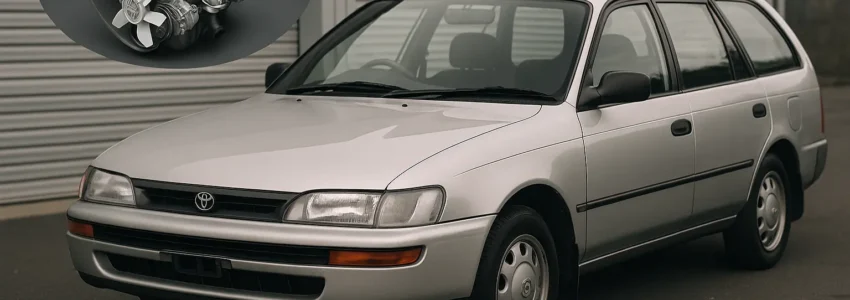
Automotive Engineering at Its Best: The 1-Million Mile Corolla
In a world where planned obsolescence often wins out over durability, one humble Toyota Corolla has defied the odds—and the odometer. This is a story of exceptional automotive engineering, maintenance, and longevity.
New Zealand newspaper delivery driver Graeme Hebley has driven the same 1993 Toyota Corolla for over 2 million kilometres (that’s more than 1.24 million miles), using its original engine and transmission. Hebley logs around 5,000 km per week, relying on fortnightly services since purchasing the car second-hand in 2000.
This astonishing figure isn’t just an anecdote—it’s a real-world case study in automotive engineering, reliability, and the impact of consistent care. (Source: CarBuzz article on the 2M KM Corolla)
Interestingly, Hebley’s Corolla wasn’t even originally sold in New Zealand. It was a grey market import from the UK—legally brought into the country but not through Toyota’s official NZ network. Despite being far from its birthplace, the vehicle’s British roots and Japanese engineering proved a winning combination for long-term reliability. If anything, this makes the achievement even more impressive: a global car, maintained by a local, and still going strong after 2 million kilometres.
Why the Toyota Corolla Is Synonymous with Reliable Cars
The Toyota Corolla has long been a global symbol of automotive dependability. First introduced in 1966, the Corolla has consistently ranked among the best-selling vehicles in the world, with over 50 million units sold globally by 2021.
What sets it apart?
- Simple, robust design
- Low-stress engines tuned for efficiency, not speed
- High-quality components with tight manufacturing tolerances
- Proven platforms refined across generations
While many modern vehicles prioritise cutting-edge tech and performance, the Corolla’s appeal lies in its longevity, fuel efficiency, and low maintenance costs—hallmarks of well-executed automotive engineering.
Longevity in Automotive Engineering: More Than Just Mileage
Achieving 2 million kilometres on original parts isn’t just about the car—it’s about the engineering discipline that makes such a feat possible. Consider:
- Engine architecture: The 1.8L 7A-FE engine used in many 90s Corollas is known for durability thanks to its non-interference design, simple SOHC layout, and cast iron block.
- Transmission quality: Toyota’s A245E automatic transmission was overbuilt for the vehicle’s power output, contributing to longevity.
- Material selection: From valve guides to bearings, high-quality alloys and consistent tolerances reduce wear over time.

In short, Toyota didn’t cut corners. The car was engineered for real-world reliability—not just showroom specs. Speaking of the automotive sector, a lot has happened in materials engineering. Read more about it here.
The Role of Maintenance in Long-Term Performance
Of course, even the best automotive engineering needs proper care. Hebley’s Corolla has benefited from fortnightly servicing over the past two decades—something most drivers would find excessive.
But this case proves a key point: Preventive maintenance protects performance.
Oil changes, fluid checks, filter replacements, and inspections prevent small issues from becoming catastrophic. Regular servicing also reduces the cumulative stress on mechanical systems, allowing parts to last far beyond expectations.
According to recent data from London Loves Business, some of the most common causes of breakdowns in the UK include incorrect engine oil levels and timing belt failure—both issues that regular servicing can prevent. Notably, timing belt failure often results from oil degradation or low oil, highlighting how essential routine maintenance really is.
Automotive Engineering in the Real World
The Corolla’s story isn’t just nostalgic—it’s a living example of how practical, durable engineering still matters.
In an era obsessed with new tech and flashy features, the fundamentals of good automotive engineering—reliable powertrains, robust design, and precision manufacturing—still carry the most weight when it comes to longevity.
According to the Society of Motor Manufacturers and Traders (SMMT), the UK car parc (the number of vehicles on the road) hit a record 35.4 million in 2023. More notably, the average age of UK vehicles is now over 9 years, reflecting improved build quality and better maintenance practices across the board (Source: SMMT 2023 Vehicle Data Report).
And yet, maintenance is often the deciding factor. RAC data shows that around one-third of breakdowns are due to preventable issues like battery failure, worn tyres, and incorrect oil levels—problems that consistent servicing could catch early.
This echoes what makes Graeme Hebley’s 2-million-kilometre Corolla so special: fortnightly servicing, timely part replacements, and a driver who knew how to treat his car. No advanced onboard diagnostics or predictive maintenance apps—just simple, regular upkeep and a car engineered to last.
Reliable Cars: Still Possible in the 21st Century?
The story of Hebley’s Toyota offers a gentle challenge to modern drivers: Could your car last 2 million kilometres? Maybe not without the same rigorous service schedule, but the lesson is clear—engineered reliability and consistent care still pay off.
It also raises a question for the automotive industry: Are we building for endurance—or just for the next sale?
As manufacturers explore modular vehicle platforms, software-driven performance, and even solid-state battery designs, this old Corolla reminds us that engineering fundamentals still matter—durability, simplicity, serviceability.
Closing Thoughts
Automotive engineering isn’t just about the newest tech or fastest lap times. It’s about creating machines that serve real people for real lifespans—like one man’s 2-million kilometre Corolla delivering newspapers across New Zealand for nearly three decades.
At PRV Engineering, we’ve seen firsthand how precision fabrication, bespoke busbar systems, and high-tolerance machining contribute to performance and longevity in demanding sectors—including automotive, aerospace, and rail. Explore more about PRV’s precision engineering work here.
If that isn’t a masterclass in automotive engineering longevity, what is?
Recent Comments