
Archives

Manufacturing

2 Jul 2026
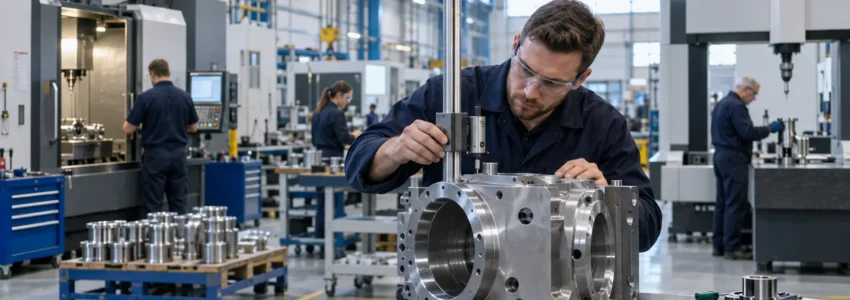
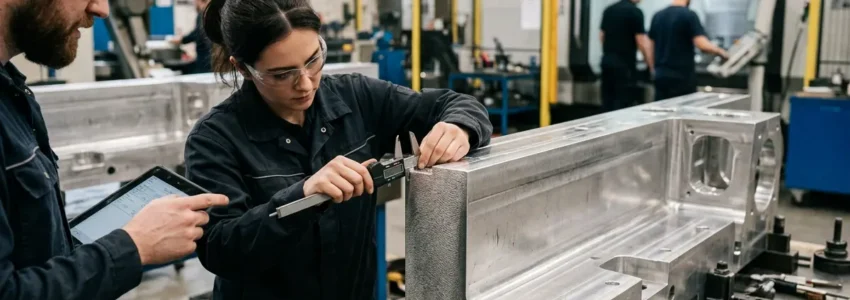
Engineer reviewing a precision aluminium component alongside CNC machining equipment, illustrating how early manufacturing decisions influence production quality.

Every Precision Component Has A Starting Point

Waterjet cutting is often viewed as a manufacturing process in its own right. In reality, it’s frequently the beginning of a much larger engineering journey.

Whether a component is destined for a defence vehicle, an electrical power system or a piece of industrial machinery, the first manufacturing decision can influence everything that follows. Material selection, production efficiency, machining time and even the long-term performance of the finished component are often shaped long before the first hole is drilled or the final surface is machined.

That’s why experienced engineering teams don’t simply ask how a component should be manufactured. They consider the entire production workflow from the outset, selecting manufacturing processes that work together rather than in isolation.

Waterjet cutting has become an important part of that approach. Far more than simply cutting material to shape, it often creates the starting point from which every subsequent manufacturing operation becomes more efficient.

26 Jun 2026
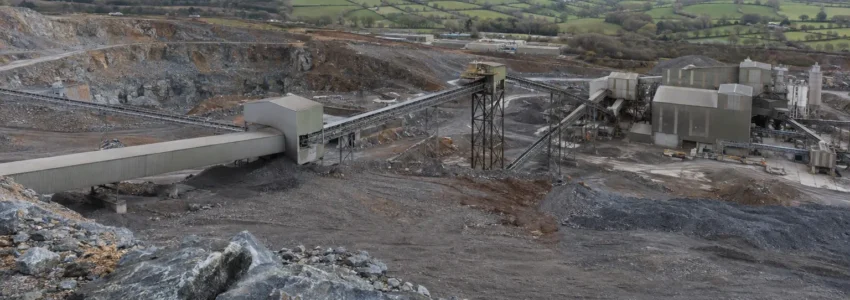
Engineers inspecting a precision-engineered aluminium component after hydro-abrasive waterjet cutting and before CNC machining operations.

The Difference Between A Great Design And A Great Product

Design for manufacturability is one of the most important principles in modern engineering, yet it’s often overlooked until production begins.

Every engineer has seen it. A component looks perfect on the CAD model. Every dimension is correct and every feature has been carefully considered. The design meets the specification and performs exactly as intended but then somebody tries to manufacture it and suddenly, questions begin to appear.

19 Jun 2026
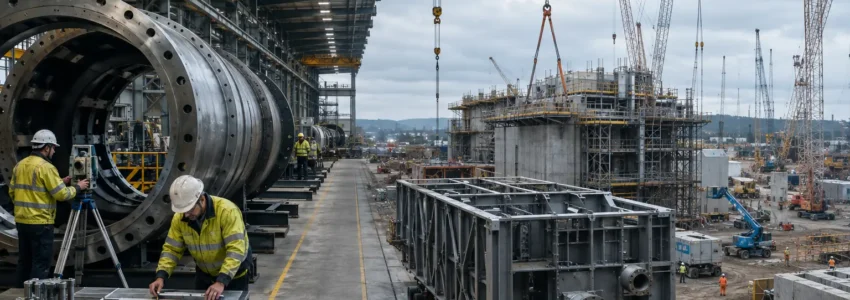
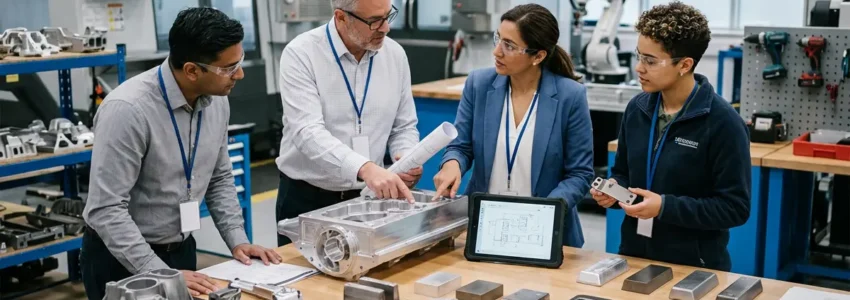
Engineers reviewing multiple versions of a component manufactured using different processes, highlighting the importance of manufacturing process selection in modern engineering.

The Best Engineering Solution Isn’t Always The Simplest

Most people assume engineers are trying to find the fastest, cheapest or simplest way to manufacture a component.
In reality, they are often trying to avoid problems that have not happened yet.

A decision made during the earliest stages of design or production planning can affect everything that follows. Distortion, premature wear, assembly issues, machining challenges, quality concerns and project delays can often be traced back to a manufacturing decision made weeks or even months earlier.

This is why manufacturing process selection remains one of the most important decisions in engineering.

Whether producing a defence component, industrial assembly, electrical busbar or automotive part, the process used to manufacture a component can have a significant impact on cost, performance, lead times and reliability.

The challenge is that there is rarely only one correct answer.

14 May 2026
Editorial-style manufacturing scene showing humanoid robotics integrated into a modern industrial environment alongside traditional engineering and precision-machined components

Could Humanoid Robots Change the Future of Engineering and Manufacturing?

Humanoid robots have moved from science fiction into real-world manufacturing discussions surprisingly quickly.

Over the past year, videos of walking, lifting, and task-performing robots from companies like Tesla and Figure AI have generated huge attention online. Some see them as the next industrial revolution. Others see them as expensive demonstrations that are still far from practical use.

The reality is probably somewhere in the middle.

Humanoid robots are advancing rapidly, and manufacturing companies are paying attention. But while the technology is impressive, there is still a significant gap between controlled demonstrations and large-scale industrial adoption.

8 May 2026
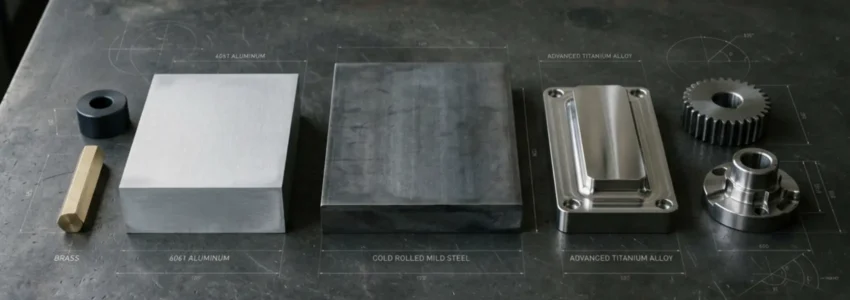
Arrangement of different engineering materials including aluminium and steel components on a dark surface, highlighting variations in texture, finish and material properties

What This Supposed Aluminium Discovery Means for Engineering Materials

A recent wave of headlines suggests that aluminium, one of the most widely used engineering materials, could begin replacing expensive metals like platinum and palladium in certain applications.

On the surface, that sounds like a major breakthrough. Lower costs. More accessible materials. New possibilities for manufacturing.
But as with most developments in engineering, the reality is more nuanced.

Let’s take a closer look.

25 Jun 2025

How Private 5G Networks Are Powering Smart Factories – Not Mind Control

Private 5G networks are quietly reshaping the future of British industry. From predictive maintenance to real-time robotics, this ultra-fast, low-latency connectivity is giving rise to a new generation of smart factories in the UK. But with every new technology comes a wave of misinformation. While conspiracy theories about 5G mind control swirl online, engineers and manufacturers are using industrial 5G to drive innovation, not surveillance.

In this article, we’ll explore the real-world applications of private 5G networks in industrial settings, why they matter to UK engineering and manufacturing, and why the science says there’s no secret agenda—just smarter, faster, safer systems.

27 May 2025
Edge Computing in Manufacturing

Edge computing in manufacturing is rapidly becoming the driving force behind smarter, faster decision-making on the factory floor. In an industry defined by speed, precision, and competitiveness, manufacturers must constantly seek smarter ways to operate. Traditional systems that rely heavily on cloud computing for data analysis are rapidly giving way to a more dynamic solution: edge computing in manufacturing. This approach brings data processing closer to where it is generated—on the factory floor itself.

But what exactly is edge computing, and how does it benefit manufacturers?

19 May 2025
Large Format Machining in the UK

Large format machining plays a crucial and impressive role in heavy-duty engineering. Spanning industries like aerospace, defence, rail, construction, and energy, this process enables the precise fabrication of large, intricate components. It is essential for driving industrial progress, ensuring structural stability, and maintaining the safety of complex systems.

At PRV Engineering, we specialise in large format machining services that deliver tight tolerances, high accuracy, and exceptional finish quality, regardless of the project size. But why does this process matter so much, and what makes it a cornerstone of modern manufacturing?

12 Feb 2025
Precision Manufacturing: PRV Engineering Spotlight
3 Sep 2024

The industrial landscape is continuously changing and the integration of artificial intelligence (AI) and machine learning in manufacturing is transforming production and quality control. As manufacturers strive to remain competitive, the adoption of these advanced technologies is not just a trend but a necessity for optimising operations and ensuring much-improved quality control.

Recent Comments

    Events

    August 2026
    M T W T F S S
     12
    3456789
    10111213141516
    17181920212223
    24252627282930
    31