

Could Humanoid Robots Change the Future of Engineering and Manufacturing?
Humanoid robots have moved from science fiction into real-world manufacturing discussions surprisingly quickly.
Over the past year, videos of walking, lifting, and task-performing robots from companies like Tesla and Figure AI have generated huge attention online. Some see them as the next industrial revolution. Others see them as expensive demonstrations that are still far from practical use.
The reality is probably somewhere in the middle.
Humanoid robots are advancing rapidly, and manufacturing companies are paying attention. But while the technology is impressive, there is still a significant gap between controlled demonstrations and large-scale industrial adoption.
Why Everyone Is Suddenly Talking About Humanoid Robots
Part of the interest comes from how quickly the technology appears to be improving.
Tesla’s Optimus project has showcased robots walking, carrying objects, and interacting with factory-style environments. Meanwhile, Figure AI has partnered with BMW to explore how humanoid robots could operate within real manufacturing settings.
Unlike traditional industrial robots, which are usually fixed in place and designed for one repetitive task, humanoid robots are intended to operate in spaces built for humans.
That flexibility is what makes them interesting.
In theory, a humanoid robot could move around a facility, carry components, operate tools, inspect parts, or assist with repetitive handling tasks without requiring an entirely redesigned production line.
For manufacturers facing labour shortages or increasing operational pressures, that possibility is attracting attention.
Why Manufacturing Is Interested
Manufacturing environments already use automation extensively. Robotic arms, CNC systems, automated conveyors, and machine vision systems are well established across many sectors.
So why the interest in humanoid robots specifically?
One reason is adaptability.
Traditional automation is highly efficient, but often highly specialised. A robotic welding cell might perform one task exceptionally well, but changing or reconfiguring it can be expensive and time-consuming.
Humanoid robots, at least in theory, offer more flexibility. Instead of building an entire process around a machine, the machine could potentially adapt to the environment already designed for human workers.
This could be useful in areas such as:
- Material handling
- Warehouse logistics
- Inspection and monitoring
- Repetitive assembly tasks
- Hazardous or physically demanding environments
For industries where labour availability is becoming a growing challenge, that flexibility has obvious appeal.
The Reality Check
Despite the excitement, humanoid robots are still in a relatively early stage of development. Most public demonstrations happen under controlled conditions. Real manufacturing environments are far less predictable.
Factories are dynamic. Components vary. Conditions change. Unexpected situations occur constantly. Humans are exceptionally good at adapting to those situations in ways robots still struggle with.
There are also practical considerations:
- High development and deployment costs
- Reliability under continuous operation
- Safety around human workers
- Maintenance and downtime
- Energy consumption
In many cases, existing forms of automation are still faster, cheaper, and more reliable for specific tasks.
This is why many manufacturers remain cautious. Interest is growing, but large-scale implementation is still limited.
Where Humanoid Robots Could Actually Make Sense
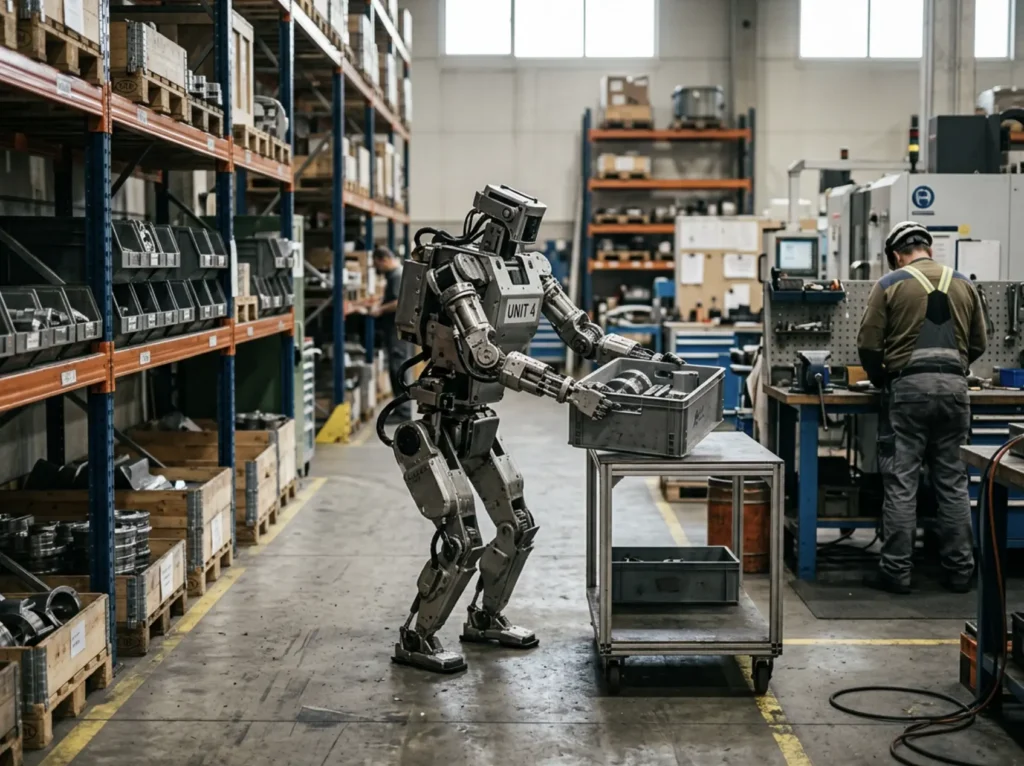
That does not mean the technology lacks value.
There are environments where humanoid robots could become genuinely useful over time, particularly where flexibility matters more than outright speed.
Potential applications include:
- Logistics & Material Movement: Moving components or tools between workstations without requiring fixed automation systems.
- Hazardous Environments: Supporting operations in areas involving heat, chemicals, confined spaces, or repetitive strain risks.
- Inspection Tasks: Using sensors, cameras, and AI systems to monitor equipment, identify faults, or support quality control processes.
- Variable Production Environments: Facilities where layouts or workflows change regularly and rigid automation becomes less practical.
In these situations, adaptability may become more valuable than raw production speed.
What Probably Won’t Change
While humanoid robotics may evolve rapidly, many aspects of manufacturing are unlikely to disappear anytime soon.
Precision engineering still depends heavily on:
- Skilled machining
- Fabrication expertise
- Material understanding
- Process control
- Real-world engineering judgement
Advanced automation can support these processes, but it does not automatically replace them.
At companies like PRV Engineering, manufacturing capability still relies on combining technology with practical engineering experience across sectors including defence, aerospace, rail, construction, and oil and gas.
Processes such as 5-Axis machining and advanced fabrication work continue to require precision, consistency, and engineering oversight that goes beyond simple automation.
The same applies to material selection and handling, particularly when working with advanced materials such as titanium, Inconel, Hastelloy, aluminium, and specialised steels.
The Bigger Shift Behind the Headlines
The rise of humanoid robots is part of a broader trend within manufacturing.
AI, automation, machine vision, and intelligent systems are becoming increasingly integrated into industrial environments. The conversation is no longer about whether automation will increase, it already is.
The real question is how these technologies will integrate with existing workforces and engineering processes.
For some tasks, automation will become more capable. For others, human expertise will remain essential.
Most likely, the future of manufacturing will not be fully human or fully robotic. It will be a hybrid environment where technology supports people rather than completely replacing them.
Final Thoughts on Humanoid Robots in Manufacturing
Humanoid robots are no longer just a futuristic concept. They are beginning to enter real manufacturing discussions and pilot environments. But there is still a considerable difference between promising demonstrations and widespread industrial adoption.
The technology is evolving quickly, and there are genuine opportunities for it to improve flexibility, safety, and efficiency in certain areas of manufacturing.
At the same time, real-world engineering remains grounded in practical realities: reliability, precision, materials, process control, and delivery.
For now, humanoid robots are best viewed not as a replacement for manufacturing expertise, but as another tool that may eventually become part of it. And like any tool in engineering, their real value will depend on where, when, and how they are used.
Recent Comments