
How Existing Factories Are Being Rebuilt for Advanced Manufacturing
Britain’s next manufacturing era will not necessarily begin with an empty plot and a completely new factory. Some of the capacity needed for future aircraft, propulsion systems and complex components is being developed at established sites, where investment is changing what can be made and how production is organised.
For UK advanced manufacturing, this raises a practical question: how do you turn an existing industrial site into a facility capable of delivering different work reliably? A new machine may provide an essential operation, but its value depends on the environment around it, from component handling and operator knowledge to inspection and production planning.
Airbus’s Broughton conversion and Rolls-Royce’s investment programme illustrate different aspects of that transition, while Isembard’s London factory offers another perspective on bringing manufacturing and its supporting functions together.
Giving an Aircraft Factory a New Purpose
Airbus is converting its former A380 wing production facility at Broughton into an A321 wing production line. The conversion is expected to be completed by the end of 2026, with six wing production jigs, an equipping line and a paint shop forming part of the facility. This is a change in wing manufacturing, rather than a new line assembling complete aircraft.
Airbus also says operators contributed directly to the design and construction of the manufacturing environment, helping shape ergonomics and technology integration. Their involvement provides a useful reminder that the people carrying out production work have knowledge that matters when a factory is redesigned.
Giving a building a new purpose requires more than finding enough floor space. For any product change, planners need to consider how components are positioned, which operations happen in sequence and how people reach the work safely and consistently.
An operator may identify an awkward working position or an unnecessary handling step that is less obvious on a layout drawing. Incorporating that experience into planning can help the finished environment support the work it is intended to perform.
What Rolls-Royce’s Investment Actually Covers
Rolls-Royce has announced a £300 million investment in UK manufacturing and engineering facilities, covering Derby, Bristol, Inchinnan near Glasgow, Rotherham and Ansty in Warwickshire. The programme combines new facilities, upgrades and machinery investment, rather than consisting entirely of existing-building conversions.
Derby is receiving new engineering and manufacturing services facilities, while Bristol’s programme includes facility improvements, IT infrastructure and increased maintenance, repair and overhaul capability. Machinery investment at Inchinnan will enable new engine components to be manufactured, while Rotherham’s Advanced Blade Casting Facility and machinery at Ansty are also being developed.
The range of work matters because UK manufacturing investment has to address different constraints at different locations. One site may need equipment for a new component, while another needs improved supporting infrastructure or more effective engineering workspaces.
These investments suggest a broader view of capability: production equipment, specialist processes and the environment in which people work all contribute to delivery. Treating modernisation as a single equipment purchase can overlook the changes needed elsewhere to make that purchase useful.
A Different Perspective From Isembard’s London Factory
Isembard has opened a Southwark headquarters and precision manufacturing facility, bringing a working factory together with its software and robotics engineering teams.
The factory includes three-axis and five-axis milling machines, turn-mills and wire electrical discharge machines, alongside a climate-controlled metrology laboratory. Its offices overlook the factory floor, giving engineers a direct view of production while developing the company’s software and robotics technology.
This arrangement offers a different perspective on advanced manufacturing facilities. Measurement and software development sit alongside production, making the relationship between the machinery and its supporting functions visible.
For a manufacturer considering investment, the useful question is how those functions connect in practice. A component has to move through a controlled route, with suitable information and measurement available at the points where they are needed.
Changing a Factory While Keeping Work Moving
Where production must continue during an upgrade, factory modernisation becomes a sequencing problem as well as an installation project. Existing orders still need to progress while equipment arrives, work areas change and services are connected.
A practical plan needs to account for how machinery reaches its intended position, where installation work takes place and whether access routes remain available for production. Temporary arrangements may be needed, but they also require thought about component identification, storage and safe movement.
Equipment services are another consideration. Depending on the process, planners may need to assess electrical supply, extraction, compressed air, cooling or other requirements, together with suitable access for maintenance. Handling arrangements must also suit the components and tooling that will pass through the area.
The layout should be considered as a production route, rather than a collection of machines placed wherever space is available. If work repeatedly crosses the factory or waits in locations that are difficult to manage, additional equipment can create more movement without improving delivery.
These are general planning considerations for operational factories, rather than reported problems at the sites described above. They explain why installing a machine and preparing a factory to use it are related but distinct pieces of work.
Making New Processes Work With People and Systems
New equipment can change the knowledge required to carry out a job, including setup methods, tooling choices, handling and inspection. Training therefore needs to relate to the production task as well as the machine controls.
Operators need usable instructions that reflect the intended process, while supervisors and planners need to understand how the operation affects the wider schedule. A revised method may also change when a component is checked, how a result is recorded or which information accompanies the work.
Airbus’s operator involvement illustrates the value of bringing production experience into the design stage. That principle is relevant wherever a new process changes the practical demands on the people using it.
Integration also extends to the information supporting production. Drawings, job instructions, scheduling and inspection records need to describe a consistent route, so that introducing equipment does not leave people working from conflicting assumptions.
For example, a new operation might remove a handling stage or introduce an additional check. If the planning system and work instructions still describe the previous method, the factory can carry the confusion into subsequent jobs. Establishing a repeatable process requires the physical operation and its supporting information to develop together.
Why Machinery Alone Does Not Guarantee More Capacity
A machine’s ability to complete an operation is only one part of a factory’s ability to deliver finished, conforming components. Preparation, tooling, handling, inspection and finishing all influence how much usable output reaches the customer.
Consider a hypothetical machining operation that becomes faster after an equipment upgrade. If inspection cannot process the additional components at the same rate, work may accumulate before measurement, delaying release even though machining time has improved.
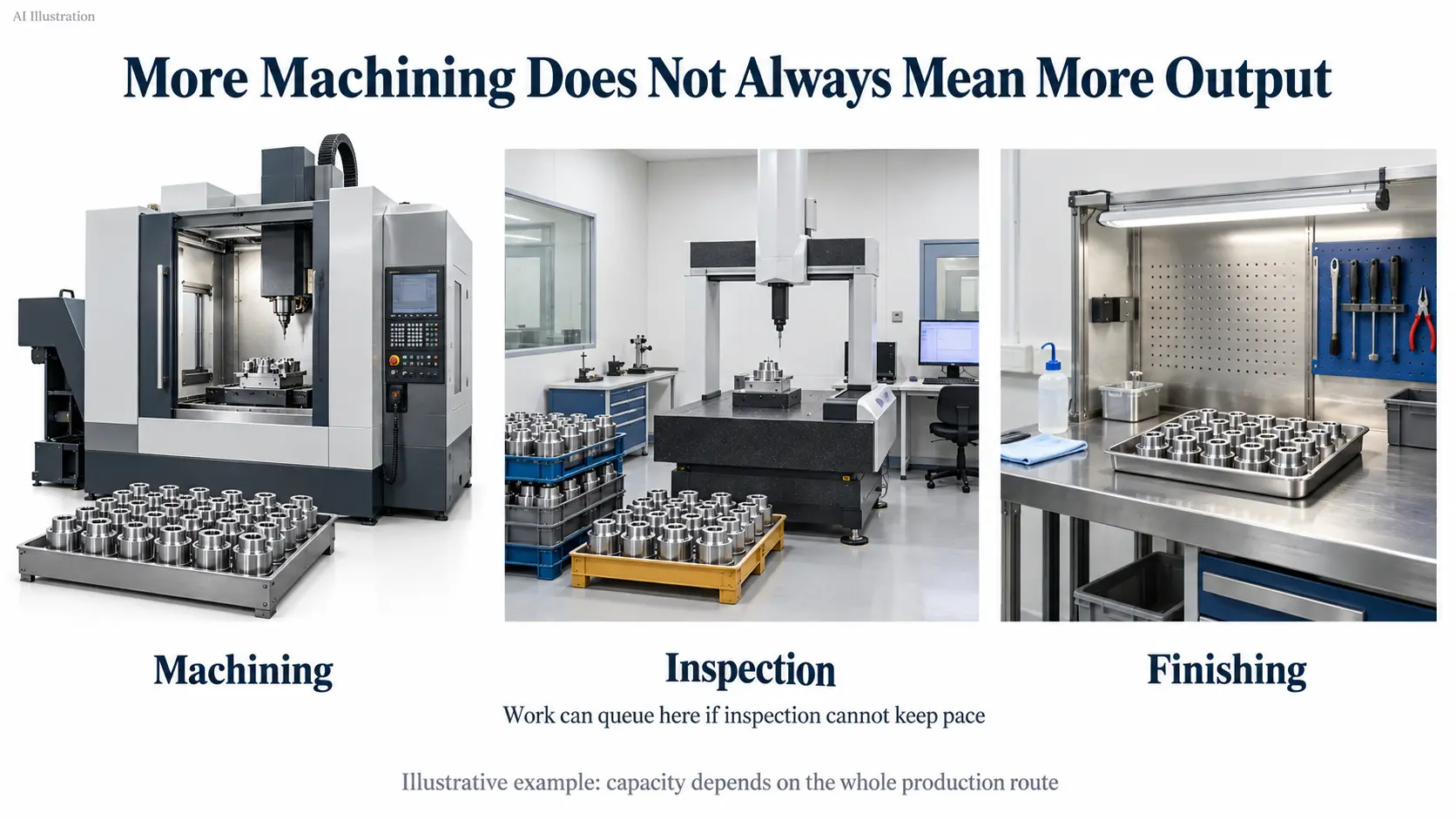
The same principle applies to finishing or preparation. Increasing output at one stage can shift the constraint elsewhere, so investment decisions need to consider the complete route rather than the performance of an individual operation.
This is particularly relevant to UK advanced manufacturing, where investment needs to translate into reliable production. Capacity becomes useful when the supporting stages can accommodate the work, and quality can be demonstrated consistently.
When reviewing a route involving CNC machining, for example, the questions extend beyond how quickly metal can be removed. They include how the component is prepared, held, checked and passed to its next operation, with each stage contributing to the final delivery.
Adapting Capability to the Work Customers Need Next
For PRV Engineering, the wider lesson concerns how manufacturing businesses respond to changing customer requirements. The scale of the announcements may differ from that of a smaller engineering business, but the planning question remains relevant: what must work together to deliver the next job reliably?
A customer’s requirement may place different demands on component size, material, geometry, finish or inspection. Responding effectively means considering the production route and identifying where equipment, skills or supporting processes need attention.
The most useful starting point is the work itself: which operations are required, what information must accompany them and where a component could encounter a delay. That approach gives investment a practical purpose, linking changes in the factory to the requirements of the customer.
For procurement teams, it also encourages a more useful conversation about capability, extending beyond an equipment list to how the proposed work will move through production and be checked.
The Future Factory May Already Exist
Airbus’s conversion shows how an established factory can take on a different production purpose, while Rolls-Royce’s programme illustrates the range of facilities and infrastructure that can support industrial growth.
The engineering challenge is to make those changes function as a complete production system, with equipment, people and supporting processes able to handle the intended work.
The factory of the future may therefore be a familiar building whose layout, skills and processes have changed with its customers’ requirements, allowing it to manufacture something entirely new.
Recent Comments