
What Will It Take to Build Britain’s Next Generation of Nuclear Power?
Britain’s plans for a new generation of nuclear power are beginning to take shape. At the centre of the programme are small modular reactors, or SMRs: nuclear power stations designed around standardised, modular components that can be manufactured in factories before being transported for assembly on site.
Rolls-Royce SMR was selected as the UK programme’s preferred technology partner in June 2025. In April 2026, Great British Energy – Nuclear, known as GBE-N, signed a contract with the company to begin technology and site-specific design work, regulatory engagement and planning.
The initial three-unit project is planned for Wylfa on Ynys Môn. However, important stages remain, including a future Final Investment Decision. It is therefore more accurate to describe Wylfa as a planned project than as one already moving into construction.
Much of the public discussion around UK small modular reactors naturally focuses on energy security and generating capacity. But the programme is also a manufacturing story. Its success will depend on whether complex components can be produced repeatedly, inspected thoroughly and delivered with the consistency and supporting evidence that major nuclear projects require.
Why Small Modular Reactors Are Different
Traditional nuclear power stations are often associated with large, highly bespoke construction projects. The SMR approach is intended to introduce more standardisation into the way nuclear infrastructure is produced and assembled.
GBE-N describes SMRs as using standardised, modular, factory-built components. This means more of the manufacturing work can potentially take place in controlled factory environments before completed modules or assemblies are transported to the project site.
“Modular” is therefore about more than the physical size of the reactor. It also describes a different approach to manufacturing and project delivery.
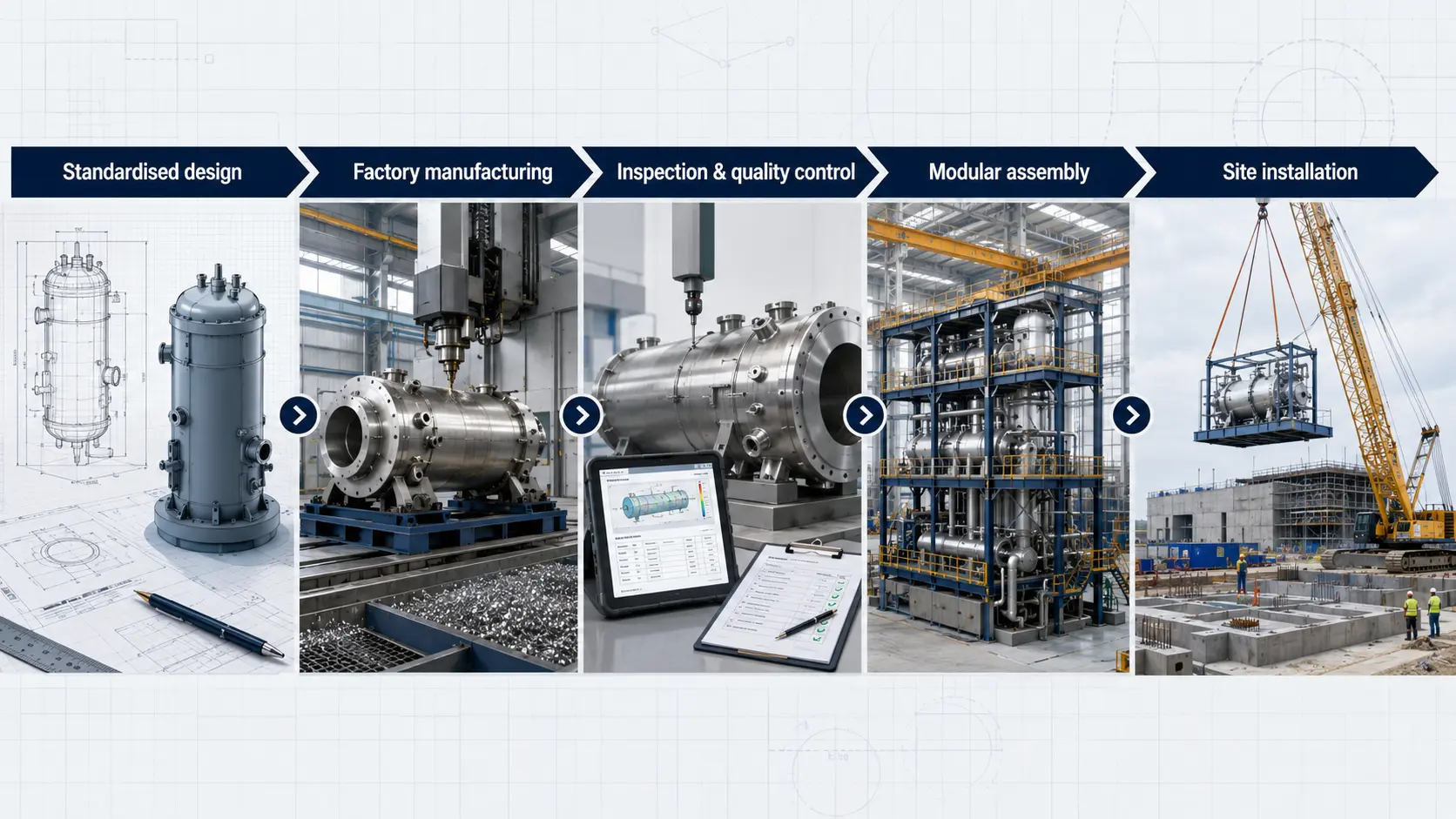
A standardised design makes it possible to establish production methods that can be repeated across several units. Instead of approaching every component as an entirely new manufacturing task, engineers can develop controlled processes and apply what they learn from one unit to the next.
GBE-N says this approach is intended to reduce delivery risk and shorten construction timelines. Those are intended benefits rather than guaranteed outcomes, but they explain why manufacturing strategy is so important to the SMR concept. Factory production can only provide an advantage if the required components can be made accurately and consistently at the necessary scale.
Why Wylfa Matters
The planned Wylfa project would comprise three Rolls-Royce SMR units with at least 1.4GWe of combined generating capacity. GBE-N describes it as the planned location for the UK’s first fleet of SMRs.
Its significance extends beyond the construction site. A programme of this scale could create sustained demand across a broad network of engineering, manufacturing, construction and supporting businesses. In June 2026, GBE-N reported that the total value of contracts it had awarded since its inception in 2023 had reached nearly £900 million. This figure covers contracts awarded by GBE-N generally; it should not be interpreted as £900 million spent specifically on Wylfa.
GBE-N also said that more than 70% of those contracts had gone to UK-registered companies. This refers to the proportion of contracts, not necessarily the proportion of the total monetary value. The figures indicate the programme’s potential relevance to British industry, but they do not mean that every UK manufacturer will automatically benefit. Securing work within a demanding infrastructure supply chain depends on much more than location. Businesses must also be able to meet the required standards for quality, documentation, capacity and delivery.
The Manufacturing Challenge
There is a fundamental difference between making a complex component once and producing it repeatedly. A skilled engineering team may be able to manufacture a one-off part that meets its specification. Repeatable production requires something more: the process itself must remain controlled so that the same result can be achieved across multiple components, batches or reactor units.
Dimensional accuracy is one part of that challenge. Components must be manufactured within their specified tolerances, but manufacturers must also be able to demonstrate how measurements were taken, which equipment was used and whether that equipment was properly controlled.
Material traceability is equally important. A finished component may need a clear record of the material from which it was produced, together with the processes, inspections and checks applied during manufacture. Documentation is not simply an administrative task added at the end. It forms part of the evidence that the component has been made correctly.
Repeatability also depends on consistent production methods. If a process changes between components without appropriate control, the finished results may vary even when they appear similar. Quality assurance, inspection and process documentation help identify and manage that risk.
There is also the question of long-term capability. A programme involving several units needs suppliers that can maintain the required standards over an extended period. Machinery, skills, materials, inspection capacity and production planning all have to support reliable delivery – not just a successful first component. Standardisation does not make these requirements disappear. In many ways, it makes process control more visible because the value of the modular approach depends on being able to reproduce the intended result.
The Opportunity for British Manufacturing
Large energy projects can create demand across many areas of industry, including precision engineering, fabrication, specialist materials, electrical infrastructure, inspection, construction, maintenance and long-term supply-chain support. These are broad examples of the capabilities major infrastructure programmes may require. They should not be treated as a confirmed list of Wylfa contracts or procurement packages.
The strongest opportunities are likely to be available to companies that can combine technical capability with dependable processes. Producing an accurate component is important, but so are traceability, inspection, controlled documentation, consistent delivery and the ability to communicate effectively across a wider supply chain.
Capacity matters as well. A company may have the technical skills to complete an individual task but still need to show that it can maintain performance across a longer production programme.
The opportunity for British manufacturing is therefore significant but conditional. The programme could help develop skills, industrial capacity and long-term supply relationships, but participation will depend on companies being able to satisfy the applicable commercial, quality and regulatory expectations.
Regulation and Quality Still Matter
The Rolls-Royce SMR Limited 470 MWe design is progressing through the Office for Nuclear Regulation’s Generic Design Assessment. The design completed Step 2 before entering Step 3 in July 2024. The ONR currently lists its assessment of the reactor design as ongoing.
Generic Design Assessment should not be confused with final approval to construct the planned units at Wylfa. It is one part of a wider process that also includes site-specific work, planning, regulatory engagement and a future investment decision.
The article does not need to explore the regulatory framework in detail to make the central engineering point. Nuclear projects require controlled processes and strong supporting evidence. Manufacturers must be able not only to complete demanding work, but also to demonstrate that it has been completed correctly and consistently.
What This Means for Engineering Companies
Large infrastructure components rarely depend on a single manufacturing process. A component or assembly may pass through cutting, machining, fabrication, finishing and inspection before it is ready for delivery.
Every transfer between separate suppliers can create another point at which schedules, documentation and technical information must be coordinated. Bringing complementary processes together can help reduce these handovers and may improve communication, quality control and delivery oversight.
PRV Engineering works across demanding sectors including energy, defence, rail and aerospace. Its integrated engineering capabilities cover machining, fabrication, cutting and finishing, illustrating how related manufacturing processes can be coordinated within one engineering operation.
This does not imply that PRV is supplying Wylfa or Rolls-Royce SMR. Rather, it demonstrates a broader principle relevant to complex infrastructure: integrated manufacturing can provide greater continuity as work moves through different production stages.
Building the Next Generation of Nuclear Power
The success of Britain’s SMR programme will depend on more than the reactor design itself. It will also depend on whether the manufacturing and engineering supply chain can deliver complex components consistently, repeatedly and with the evidence needed to support quality.
Wylfa could create an important opportunity for British industry, but it will not be an automatic one. Companies looking to participate in demanding energy supply chains must be able to combine engineering capability with controlled processes, traceability, inspection and dependable long-term delivery.
That is what makes SMRs such an important manufacturing story. They could reshape not only how nuclear power is built, but also how Britain plans, produces and assembles the infrastructure behind major energy projects.
Small modular reactors are not the only advanced nuclear technology attracting engineering attention. PRV has also examined the very different challenges involved in nuclear fusion engineering.
Recent Comments