
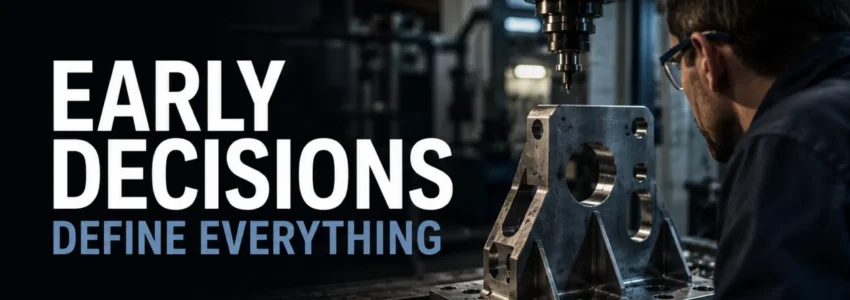
Every Precision Component Has A Starting Point
Waterjet cutting is often viewed as a manufacturing process in its own right. In reality, it’s frequently the beginning of a much larger engineering journey.
Whether a component is destined for a defence vehicle, an electrical power system or a piece of industrial machinery, the first manufacturing decision can influence everything that follows. Material selection, production efficiency, machining time and even the long-term performance of the finished component are often shaped long before the first hole is drilled or the final surface is machined.
That’s why experienced engineering teams don’t simply ask how a component should be manufactured. They consider the entire production workflow from the outset, selecting manufacturing processes that work together rather than in isolation.
Waterjet cutting has become an important part of that approach. Far more than simply cutting material to shape, it often creates the starting point from which every subsequent manufacturing operation becomes more efficient.
Planning The Manufacturing Route
Consider a typical aluminium mounting bracket used within an electrical enclosure, defence application or industrial machine.
On the computer screen, the design is complete. In reality, the component still exists only as raw material waiting for its first manufacturing operation.
There are several ways it could be produced. It might be machined entirely from solid material. It could begin life as a fabricated assembly. Another approach may involve preparing an accurate blank before any precision machining takes place.
Choosing between those options isn’t simply a question of machinery. It’s an engineering decision that considers material, production volume, tolerances, downstream operations and overall manufacturing efficiency.
It’s a principle we explored in more detail in our article on Design for Manufacturability, where engineering decisions made early in a project often influence everything that follows.
Letting CNC Machines Do What They Do Best
CNC machining excels at producing precision features.
Threaded holes, machined pockets, sealing faces, precision bores and tight-tolerance surfaces are exactly the type of operations these machines are designed to perform.
Large-scale material removal is different.
By allowing waterjet cutting to establish the component’s overall profile first, machining time can often be reduced while tooling is used more efficiently. Instead of performing every stage of production, each manufacturing process contributes where it delivers the greatest value.
Waterjet cutting doesn’t replace CNC machining. It allows CNC machining to perform at its best.
Once the overall profile has been established, the component moves into CNC machining, where critical features such as precision bores, threaded holes and machined faces are produced.
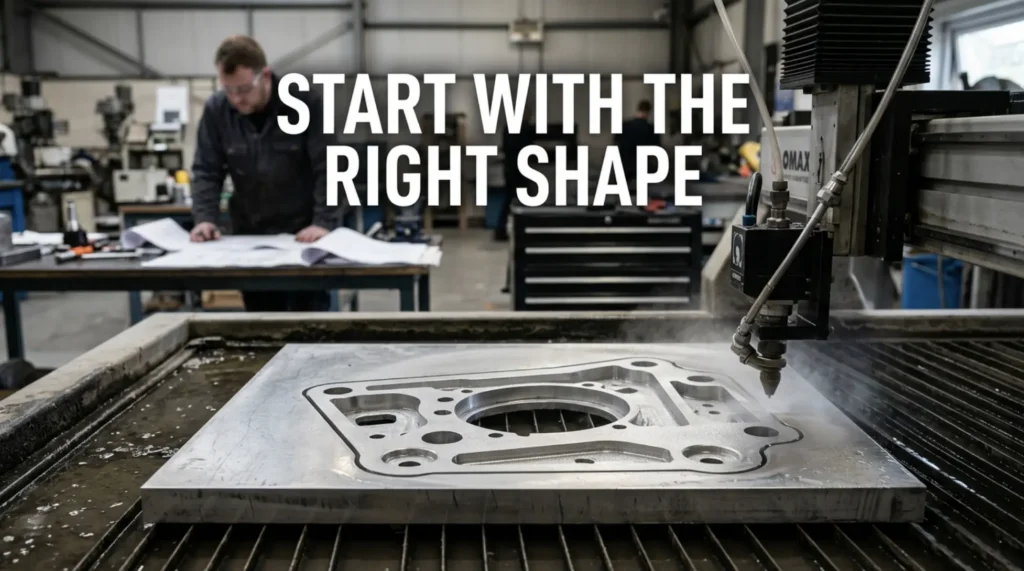
Protecting Material Before Precision Machining
Accuracy is only part of the story.
By the time our mounting bracket reaches the machining centre, it already resembles the finished component. The profile has been established, unnecessary material has been removed and the next stage can focus entirely on precision.
Accuracy, however, isn’t the only objective. The condition of the material itself is just as important. If the first manufacturing process has altered its properties, every operation that follows has to work around those changes.
In some applications that may have little practical impact. In others, particularly where components operate in demanding environments, preserving the material exactly as specified is a key engineering requirement.
Why Heat Matters
Many cutting methods rely on heat to separate material. They are fast, effective and entirely appropriate for countless manufacturing applications. That said, there are occasions when introducing heat isn’t the preferred option.
Certain aluminium alloys, hardened steels, copper and specialist materials are selected because of their specific mechanical or physical properties. Altering those properties during the first manufacturing stage may introduce unnecessary challenges later in the production process.
One advantage of hydro-abrasive waterjet cutting is that it does not introduce a heat affected zone (HAZ). Unlike thermal cutting processes, the material is cut without exposing it to the high temperatures that can alter its microstructure and mechanical properties. The principles behind heat affected zones are explained in more detail by The Welding Institute (TWI).
For manufacturers working in sectors such as defence, power distribution and advanced engineering, that can be an important advantage.
Find out more about PRV Engineering’s Hydro-Abrasive Waterjet Cutting service.
Waterjet Cutting Is One Part Of A Bigger Process
Good engineering rarely revolves around a single manufacturing process.
- Laser cutting
- Plasma cutting
- Sawing
- Waterjet cutting
- Fabrication and CNC machining
All of these exist because each solves a different manufacturing challenge. The skill lies in understanding where one process ends and the next begins.
Returning to our mounting bracket, waterjet cutting has already established the profile. The CNC machine now produces the precision features. If required, fabrication, finishing and inspection will follow before the component finally reaches assembly.
None of those stages is more important than the others but each one contributes something different to the finished product.
Choosing The Right Manufacturing Sequence
It’s tempting to compare manufacturing processes as though one must always be superior to another.
In reality, experienced engineers spend far more time deciding which sequence of processes will deliver the best overall result.
That decision depends on numerous factors, including the material, the geometry of the component, production volumes, inspection requirements and the environment in which the finished part will operate.
It’s also the reason why process selection should never be separated from design. Decisions made at the beginning of a project often determine how efficiently every subsequent stage can be completed.
If you’d like to explore that subject further, our recent articles explain why these early decisions are so important.
- Why Manufacturing Process Selection Matters More Than Engineers Think
- Why Material Selection In Engineering Matters More Than You Think
From Waterjet Cutting To Finished Components
Our aluminium mounting bracket is now approaching its final stages of manufacture.
The CNC machine has completed the critical features. Any fabrication or finishing operations have been carried out, and the component moves into inspection before becoming part of a larger assembly.
Viewed individually, these are separate manufacturing processes. As a whole, they’re a single engineering workflow where each stage has prepared the component for the next.
That joined-up approach is becoming increasingly valuable as manufacturers look to simplify supply chains, improve communication and reduce unnecessary handling between suppliers.
Bringing Engineering Together
This is where integrated manufacturing offers real advantages.
Rather than managing separate suppliers for cutting, machining, fabrication and finishing, many organisations now prefer to work with engineering partners capable of delivering multiple processes within the same manufacturing environment.
At PRV Engineering, projects that begin with hydro-abrasive waterjet cutting frequently continue into CNC machining, fabrication and other precision engineering services. Planning those stages together helps create a more efficient manufacturing workflow while maintaining consistency from the first cut through to the finished component.
Better Manufacturing Begins With Better Engineering Decisions
Our aluminium mounting bracket has now completed its manufacturing journey.
What began as a flat aluminium plate is now a finished precision-engineered component, ready to perform as part of a much larger assembly. Along the way, every manufacturing stage has contributed something different. Waterjet cutting established the profile, CNC machining produced the critical features, and inspection verified that every dimension met specification before the component moved on to its final application.
Viewed in isolation, each process is simply another step in production. Together, they illustrate something far more important: successful manufacturing is rarely defined by a single technology. It’s the result of carefully planned engineering decisions, where each process prepares the component for the next.
That’s why experienced manufacturers don’t ask which machine is best. They ask which combination of manufacturing processes will produce the highest quality component in the most efficient and commercially practical way.
For many applications, waterjet cutting provides the ideal starting point. For others, a different manufacturing route may be more appropriate. Understanding the difference is what transforms manufacturing capability into engineering expertise.
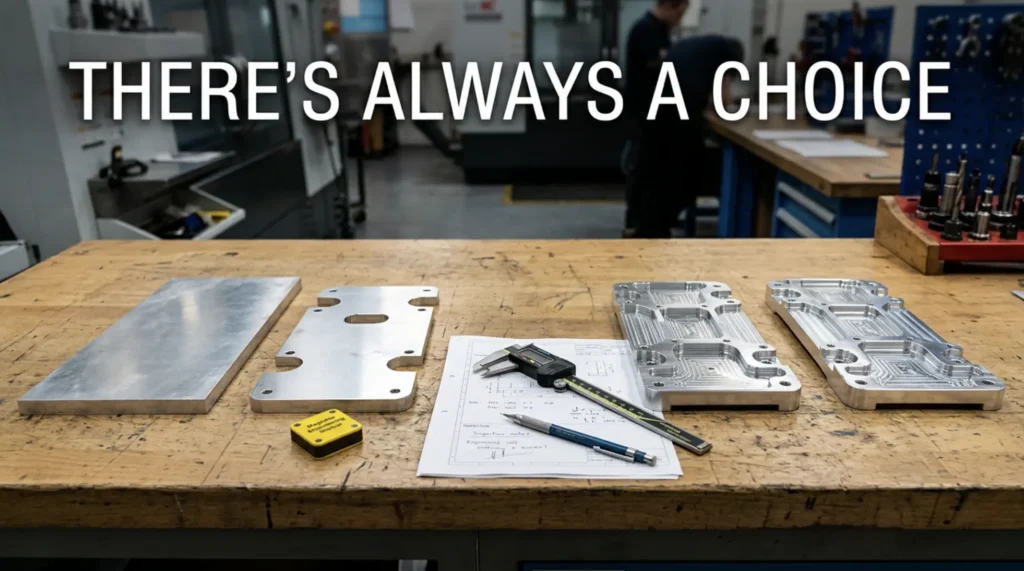
Manufacturing Is A Connected Process
One of the biggest advantages of working with an engineering partner that offers multiple manufacturing capabilities is continuity.
Instead of treating waterjet cutting, CNC machining and fabrication as unrelated services, each process becomes part of a single production plan. Decisions made during the early stages continue to influence quality, lead times and manufacturing efficiency long after the first cut has been made.
This joined-up approach is one of the reasons organisations across defence, aerospace, power distribution and advanced manufacturing continue to invest in integrated engineering partners rather than managing multiple specialist suppliers for every stage of production.
Whether a project requires hydro-abrasive waterjet cutting, CNC machining, fabrication or a combination of manufacturing processes, the objective remains the same: producing components accurately, efficiently and consistently.
Explore PRV Engineering’s manufacturing capabilities:
Discover More About PRV Engineering
Whether you’re looking for a single manufacturing process or a partner capable of supporting a complete production workflow, PRV Engineering provides a range of precision engineering services, including Hydro-Abrasive Waterjet Cutting, CNC Machining, fabrication and specialist manufacturing for sectors such as defence, aerospace and power distribution.
Recent Comments