

Why The Smallest Components Keep Modern Industry Moving
Aircraft, defence vehicles, power infrastructure, industrial machinery and advanced manufacturing systems all rely on precision engineered components. Yet the most important parts are often the ones nobody notices.
While attention is naturally drawn to engines, software, robotics and advanced electronics, it is frequently a bracket, busbar, housing, mounting system or machined component that determines whether a system performs reliably for years or fails prematurely.
Formula 1 cars, fighter aircraft and modern data centres may represent the cutting edge of engineering, but their success often depends on components hidden beneath panels, inside enclosures or deep within complex assemblies.
Because while advanced technology attracts attention, precision engineered components often determine whether it actually works.
The Technology Gets The Headlines
Every generation has its engineering breakthroughs.
Today, headlines are dominated by electric vehicles, artificial intelligence, advanced robotics and next-generation defence systems. Manufacturers proudly showcase powerful processors, sophisticated sensors and increasingly capable software platforms.
These innovations deserve attention but they rarely operate in isolation.
- An autonomous robot still relies on precision machined components to maintain accuracy.
- A modern defence platform depends on electrical distribution systems that can function reliably in demanding environments.
- Even the most sophisticated electric vehicle requires structural supports, brackets, housings and connectors that quietly perform their role every day.
This is one of the reasons engineering can be deceptive from the outside.
The visible technology often receives the credit, while the precision engineered components supporting it remain hidden beneath panels, inside enclosures or buried deep within assemblies. Without those components, the technology making headlines would never leave the drawing board.
Engineers Learn This Lesson Early
Ask an experienced engineer to identify the most important part of a complex system and they rarely point to the largest or most expensive component.
More often, they focus on the parts that could cause the greatest disruption if they fail.
- Small brackets can affect the alignment of critical equipment.
- A housing can protect sensitive electronics from vibration, contamination and environmental damage.
- A machined mounting surface can determine whether multiple components fit together correctly during assembly.
These examples rarely attract attention because they appear straightforward. The challenge lies in producing them consistently and ensuring they perform exactly as intended throughout their operational life.
This principle applies equally to aircraft, industrial machinery, rail infrastructure and defence systems.
The reliability of a complex assembly often depends on numerous precision engineered components performing their role without attracting any attention at all.
In many ways, success is measured by invisibility. When these components do their job properly, nobody notices them.
The Busbar Nobody Thinks About
Few people outside engineering have heard of a busbar but modern industry would struggle to function without them.
Busbars are used to distribute electrical power efficiently throughout a system and can be found in applications ranging from switchgear and renewable energy installations to electric vehicles, industrial machinery and defence equipment.
As electrification continues accelerating, their importance is growing rapidly.
Electric vehicle battery systems, charging infrastructure, energy storage installations and modern data centres all require increasingly efficient methods of handling large electrical loads. Behind many of these systems are specialist busbars designed to deliver reliable performance under demanding conditions.
The increasing demand for electrical infrastructure is one of the reasons organisations such as the International Energy Agency continue to highlight the importance of expanding electricity networks and power distribution systems.
Most people will never see them even though they play a critical role in keeping modern infrastructure operating. The same story repeats itself throughout engineering. Some of the most important components within a system are often the least visible.
The First Cut Matters More Than The Last
Precision engineered components do not become precise by accident. Long before a component reaches final assembly, decisions made during manufacturing can have a significant impact on performance.
- Material selection matters
- Cutting methods matter
- Machining strategies matter
- Quality control matters
Consider components manufactured from copper, aluminium or specialist alloys. If material properties are compromised during production, downstream processes can become more challenging and final performance may suffer.
This is one reason hydro-abrasive waterjet cutting remains valuable for many applications. Because the process does not introduce a heat-affected zone, it helps preserve material integrity while achieving accurate cuts across a wide range of materials.
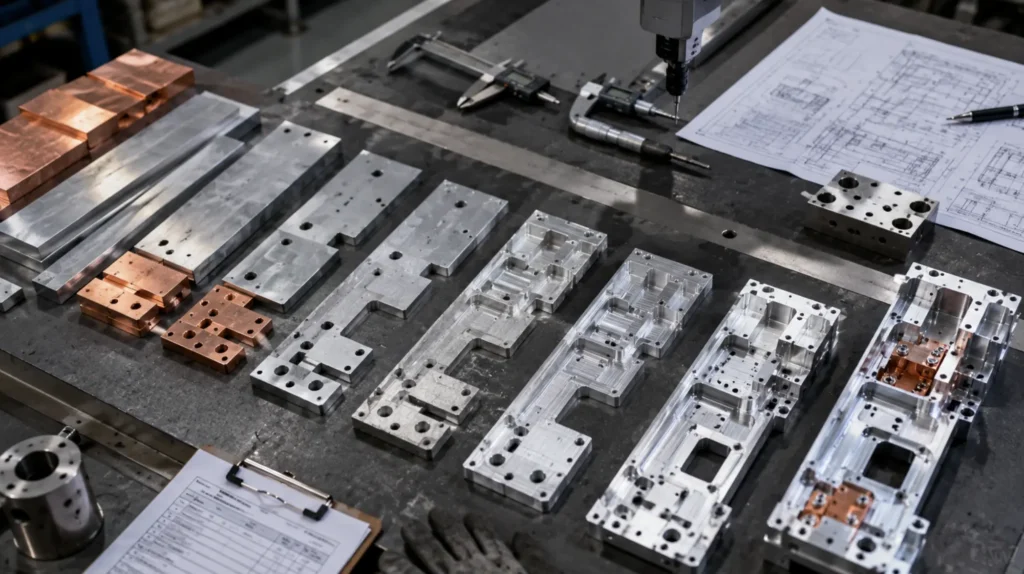
The quality of the finished component is often influenced by decisions made much earlier in the manufacturing process than many people realise.
Precision Is Built, Not Added
There is a common misconception that precision can be added at the end of a manufacturing process. In reality, precision is built into every stage.
A poorly prepared component cannot simply be machined into perfection. Likewise, dimensional inconsistencies introduced early in production often create challenges later.
Advanced CNC machining plays an important role in producing precision engineered components capable of meeting demanding specifications. However, successful outcomes depend upon the entire manufacturing process working together.
- Material preparation
- Cutting
- Machining
- Inspection
- Quality control
Each stage contributes to the final result.
This is particularly important in industries where reliability and repeatability are essential rather than desirable.
Why Manufacturers Are Reducing Complexity
An interesting trend is emerging across modern manufacturing. Rather than adding more components, many organisations are looking for ways to reduce complexity.
The objective is not necessarily to build simpler products but to eliminate unnecessary processes, handoffs and potential points of failure. We explored this idea in greater detail in our recent article examining what gigacasting reveals about the future of manufacturing.
While the technology itself attracts considerable attention, the broader lesson is equally important. Manufacturers increasingly recognise that reliability often improves when complexity decreases.
That philosophy applies to precision engineered components as much as it does to large assemblies. Every unnecessary interface, connection or process introduces another opportunity for something to go wrong.
The Same Principle Applies Across Defence, Aerospace And Industry
At first glance, a fighter aircraft, an offshore wind turbine, a Formula 1 car and a manufacturing robot appear to have very little in common.
Look more closely and similarities begin to emerge as they all
- depend upon reliable electrical systems
- require structural integrity,
- rely on components manufactured to precise specifications
- operate in environments where failure can be costly.
This is especially true within sectors such as defence engineering, where reliability, durability and performance remain critical considerations throughout the design and manufacturing process.
The technologies may differ but the engineering principles remain remarkably consistent.
The Components Nobody Notices
The next time a new aircraft is unveiled, a Formula 1 team launches a car or a manufacturer introduces a breakthrough product, most of the attention will focus on the technology everyone can see.
The headlines will discuss software, performance figures and innovation. Few people will think about the busbar distributing power through the system.
Fewer will consider the machined housing protecting critical electronics and almost nobody will notice the fabricated bracket supporting a vital assembly. Yet these are often the components that determine whether a system performs reliably for years or fails unexpectedly.
Precision engineered components rarely make headlines. Modern industry depends on them regardless.
And that is why the smallest components continue to keep modern industry moving.
Recent Comments