
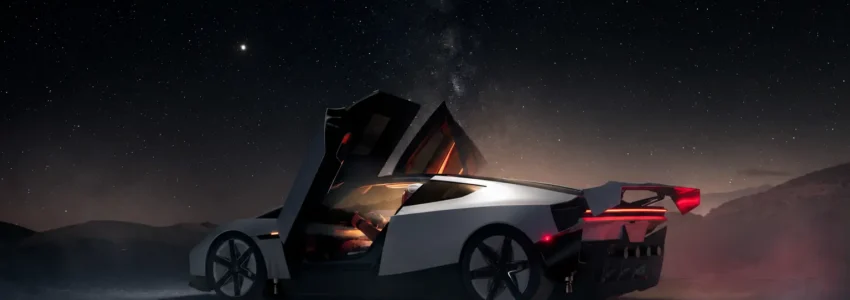
New Tesla Roadster: The Engineering Behind the Spectacle
A car driving up a steep ramp is an unusual opening to a vehicle launch, even before it turns upside down and becomes airborne. Tesla’s demonstration on 15 October 2026 gave the new Tesla Roadster an entrance few conventional performance cars could match, combining electric propulsion with cold-gas thrusters and a suction system intended to generate substantial downforce.
The event at a SpaceX facility in Texas arrived almost nine years after Tesla first presented its earlier second-generation concept. This time, the company demonstrated a substantially different proposition, with configurations ranging from a two-seat performance car to a single-seat version capable of brief airborne manoeuvres.
Musk’s stated production target is 2028, although buyers still have no firm delivery commitment. For UK readers, the presence of a reservation page also leaves important questions about price, steering configuration and legal availability unanswered.
The spectacle deserves attention, but so does the engineering behind it. Demonstrating an extraordinary manoeuvre establishes that something can work under particular conditions; producing customer vehicles requires that performance to sit alongside consistent manufacturing, durability and clear operating limits. Those demands will determine how much of the Roadster’s ambition reaches its eventual owners.
What Are the New Tesla Roadster’s Specifications?
The Tesla Roadster specifications need to be read by configuration because the range, acceleration and airborne capabilities do not describe one standard vehicle.
The Verge’s breakdown of the three configurations reports the following Tesla claims and targets:
- Performance – Two Seats: Active aerodynamics and a suction system, with a claimed 0-60 mph time below 1.6 seconds and a range target exceeding 300 miles.
- Thrust – Two Seats: A suction system and rear-mounted cold-gas thrusters, with a claimed 0-60 mph time below 0.9 seconds.
- Rocket – One Seat: Additional directional thrusters, with a claimed 0-60 mph time below 0.59 seconds and a top speed above 230 mph.
These remain manufacturer claims rather than independently verified production results. In particular, the Performance range target should not be combined with Rocket’s acceleration and speed figures to create a misleading headline specification.
Pricing needs similar care. The often-repeated $200,000 starting figure belongs to the 2017 concept, while a final purchase price for the redesigned vehicle remains unconfirmed. Reservation payments should therefore be kept separate from any discussion of what the finished car will cost.
Tesla’s aerospace-inspired design gives the electric hypercar a distinctive identity, but the configuration differences have greater practical significance. Before asking how quickly it accelerates, a prospective owner needs to know which version is being discussed, what equipment it carries and where it may be used.
How Do the Roadster’s Cold-Gas Thrusters and Suction System Work?
The word “rocket” can suggest burning fuel and a plume of hot exhaust, whereas the Roadster’s cold-gas system uses stored compressed air to produce thrust. Releasing that air through nozzles creates a force that can supplement the vehicle’s electrically driven movement.
The verified reporting distinguishes rear-mounted thrusters on Thrust from the broader directional arrangement on Rocket. That distinction matters because assisting a straight-line launch and controlling movement while airborne involve different demands.
The suction system has a separate purpose: generating downforce rather than forward propulsion. By drawing air from beneath the vehicle, it creates a pressure difference that presses the car towards the surface below it, increasing the load acting through the tyres.
That offers a way of generating downforce without relying solely on air flowing over the body at speed. It also explains why the suction system and thrusters should not be described as interchangeable technologies, even though both contributed to the demonstration’s unusual capabilities.
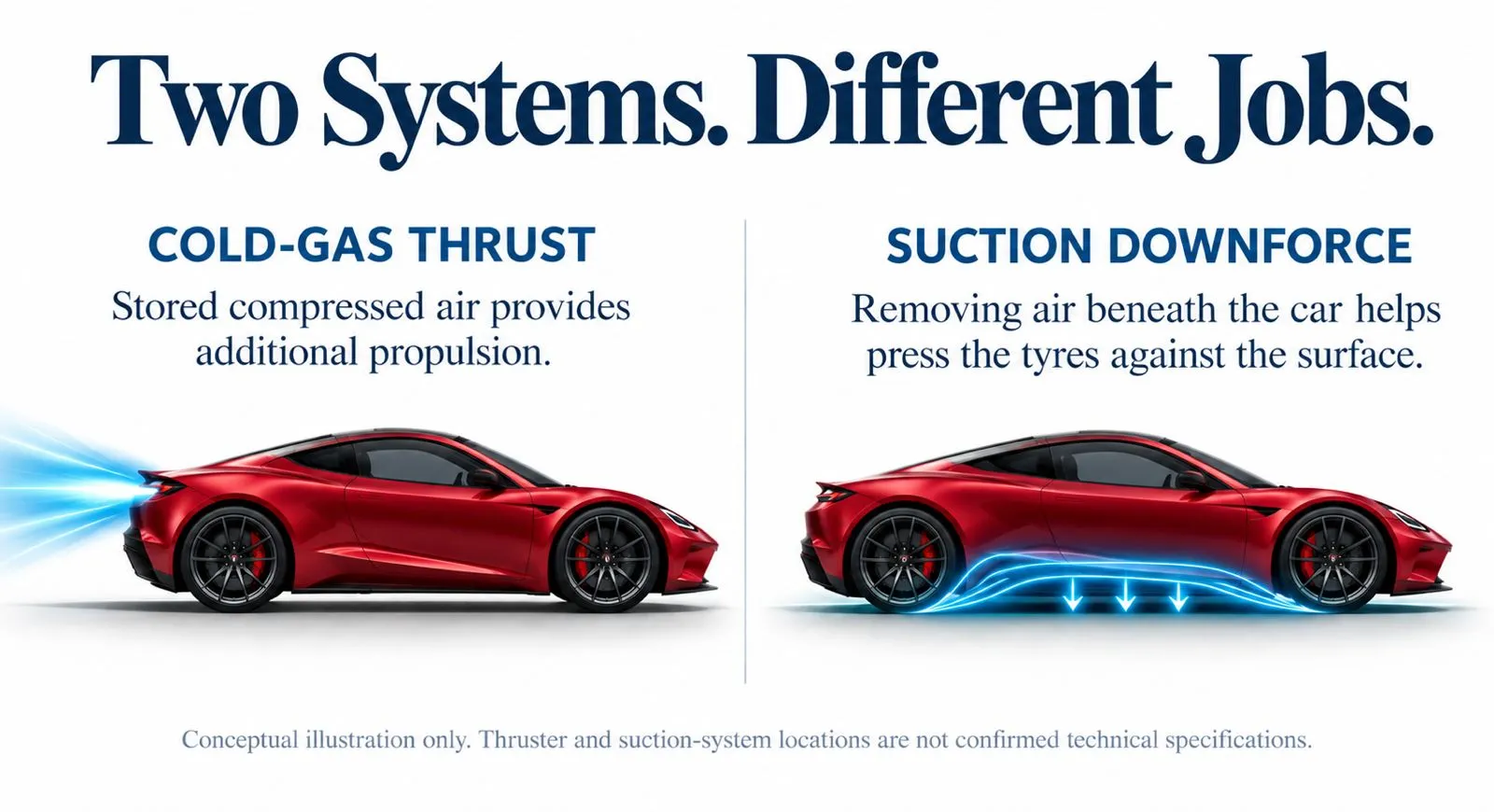
From an automotive engineering perspective, the demanding part is coordinating these forces. Steering, braking, tyre contact, suction and thrust must produce behaviour the control system can manage, rather than simply delivering impressive individual outputs.
There are practical questions to resolve around compressed-air storage, replenishment and the equipment needed to manage it. The sources checked do not establish every operating limit or maintenance requirement, so firm claims about repeated launches, refill times or everyday usability would go beyond the available evidence.
Can the Tesla Roadster Really Fly?
The demonstration supports a narrower description than the phrase “flying car” might suggest. Tesla showed brief, controlled airborne manoeuvres, including rotation, rather than demonstrating a vehicle intended for routine journeys through the air.
Associated Press’s reporting on the demonstration and regulatory hurdles records both the airborne display and the unresolved obstacles to customer use. Rocket, the configuration associated with those manoeuvres, is invitation-only and is not approved for public-road use.
Those qualifications should remain attached to the spectacle. A successful demonstration does not establish how an owner could operate the vehicle, which locations would permit its use or what restrictions would apply.
The engineering achievement can be recognised without treating it as proof of a commercially viable flying car. Its eventual usefulness will depend on a clearly defined operating environment, supported by appropriate testing and approval, rather than the fact that it briefly left the ground.
When Will the Tesla Roadster Arrive in the UK?
For anyone considering a Tesla Roadster UK reservation, the immediate answer is that the material checked does not establish a customer delivery date. The 2028 production target should therefore be read as a company timetable, rather than a confirmed UK launch commitment.
Tesla’s official UK Roadster page provides a reservation route, but also states that availability depends on each region’s legal requirements and applicable laws. It currently specifies a left-hand-drive vehicle only.
A UK-facing website consequently answers only part of the purchasing question. It allows a customer to register an interest through the reservation process, while leaving final purchase pricing, delivery timing and the relevant approvals unresolved.
The page also says that its indicated features and specifications reflect the optional Thrust augment, reinforcing the need to check configuration details carefully.
Readers searching for the Tesla Roadster 2028 should keep that distinction in mind: a production target describes when Tesla intends to begin building vehicles, while UK availability depends on further commercial and regulatory decisions. Neither a reservation payment nor an overseas demonstration settles those questions.
The Manufacturing Challenge Behind Extreme Performance
The move from demonstrator to production vehicle changes the questions engineers must answer. A prototype can be prepared for a particular event, whereas a customer vehicle needs defined performance limits, consistent assembly and a testing programme that reflects its intended use.
Lightweight construction illustrates the trade-off. Reducing mass can help performance, but components must still carry their expected loads and accommodate the systems attached to them. Material selection, joint design and manufacturing tolerances therefore need to be considered together, rather than judged solely by the weight saved.
Dimensional accuracy also matters when components must align, seal or move predictably. Precision machining can help control those interfaces, although there is no basis in the verified research for identifying particular Roadster parts, suppliers or machining processes.
Thermal management raises another set of questions about sustained use. An acceleration demonstration cannot establish how consistently the complete vehicle will perform across repeated operation, changing conditions and the service life expected by its customers.
Inspection and maintenance deserve equal attention. Engineers need ways to confirm that assemblies meet requirements and to identify deterioration before it affects operation. Access for servicing can also influence how practical a complex vehicle becomes after delivery.
These are considerations for production development, rather than evidence of specific Roadster faults. The available demonstration establishes an impressive capability; it does not provide a complete account of manufacturing readiness, durability or ownership requirements.
What Advanced Automotive Engineering Means for Manufacturers Such as PRV
For an engineering business such as PRV, the Roadster offers a useful subject through which to examine how complex vehicle development affects manufacturing requirements. Its unusual equipment makes the story striking, but the underlying questions concern accuracy, integration and responsibility for the finished assembly.
A component specification needs to explain how a part will be made and inspected, alongside the conditions it must withstand. Where several processes contribute to an assembly, decisions made at one stage can affect the work that follows, including the ability to achieve the required fit or finish.
That makes coordination across the manufacturing supply chain a practical concern. PRV’s capabilities include waterjet cutting, machining, fabrication and finishing, allowing several manufacturing stages to be coordinated within one business. These processes form part of PRV’s engineering services, supporting the journey from individual components to finished assemblies.
The relevance to PRV is this wider engineering discussion, rather than any suggested involvement with Tesla or SpaceX. The Roadster provides an extreme example of a familiar manufacturing question: how can an ambitious design be translated into controlled, repeatable production?
The Roadster’s Next Test Is Production
The new Tesla Roadster has given engineers and motorists something substantial to discuss, with a demonstration that combined unusual propulsion and downforce systems in a visually compelling way.
Its lasting significance will depend on what follows. Production consistency, reliability, cost and permitted use will shape the ownership proposition, while independent testing will help establish which performance claims can be repeated.
For now, the most useful assessment recognises both the achievement and the unanswered questions. Tesla has demonstrated remarkable capability under controlled conditions; the next stage is showing how that capability can become a dependable vehicle with clearly defined limits.
Recent Comments