
What Joby’s 3,199-Mile Flight Reveals About Autonomous Aircraft Technology
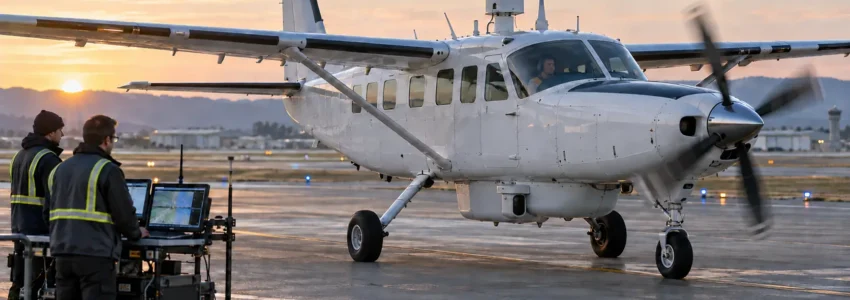
A converted Cessna Caravan has completed a 3,199-mile journey across the United States without its onboard safety pilot making a single control input. According to Joby Aviation, the aircraft handled taxiing, take-off, route navigation and landing autonomously as it travelled from California to North Carolina.
The achievement needs some careful qualification. This was a multi-leg journey rather than a single nonstop flight, a safety pilot remained in the cockpit and teams supervised the operation remotely. Describing it simply as a “pilotless flight” would therefore give the wrong impression, even though the aircraft itself reportedly controlled every phase of the journey.
The engineering importance lies beyond the headline distance. The demonstration shows how autonomous aircraft technology must connect sensors, software, communications and physical flight controls while operating through changing weather, airports and airspace environments.
It also raises a larger question: what does it take to convert a proven aircraft platform into an autonomous operating system without losing the reliability, traceability and human oversight expected in aviation?
What Joby’s Autonomous Cessna Caravan Actually Did
In its announcement of the completed flight, Joby said the aircraft covered 3,199 miles from Buchanan Field Airport in Concord, California, to Dare County Regional Airport in North Carolina’s Outer Banks.
The aircraft was a converted Cessna 208B Grand Caravan equipped with Joby’s autonomy technology and referred to by the company as the J208. The name identifies the autonomy-equipped demonstrator rather than a new aircraft type.
The journey was completed over several flight legs, with principal stops reported at Phoenix, Fort Worth and Shaw Air Force Base before the aircraft reached North Carolina. AOPA reports that the eastbound journey began on 7 September 2026 and concluded seven days later, while Joby announced the completed milestone on 18 September.
Joby describes the journey as the first autonomous flight across the United States. That claim should remain attributed to the company because the available research does not establish that the record has been independently certified. AOPA uses more cautious language, describing it as likely to be the first civilian autonomous aircraft to cover that distance.
What “Fully Autonomous” Means In This Case
The phrase “fully autonomous” can suggest that no people were involved but a safety pilot remained onboard while teams in California and at Shaw Air Force Base supervised the flights remotely. Joby says the pilot made no control inputs as the system handled ground movement, take-offs, navigation and landings with supervision taking place from distances of up to 2,323 miles.

The aircraft therefore controlled the flight but human oversight remained part of the operating system. This was autonomous control within a supervised structure rather than completely uncrewed operation.
That distinction matters because the ability to control an aircraft autonomously is only one part of the wider question about how responsibility may eventually be divided between onboard systems, safety personnel and remote teams.
Why Convert A Proven Aircraft Rather Than Build A New One?
The Cessna Caravan provides an established physical platform onto which Joby’s autonomy system has been integrated, allowing the development work to focus on connecting new digital capabilities with a well-understood utility aircraft.
However, an “already-certified airframe” does not mean the complete autonomous configuration is approved for routine pilotless operations. New sensors, computers, communications and control equipment create a modified engineering system that must be assessed as a whole.
Retrofitting also requires new equipment to work with the aircraft’s existing architecture. Sensors need suitable positions, computers require secure installation and electronic decisions must reach the physical controls accurately. This can depend on precisely manufactured brackets, housings and interfaces produced through processes such as CNC machining, although the verified sources do not identify the individual methods used on the J208.
Autonomous Flight Is A Systems Engineering Problem
Joby’s technology builds on the autonomy platform it acquired from Xwing in 2024. Xwing had already used a Cessna 208B Grand Caravan for autonomous flight development before its autonomy division became part of Joby.
Joby’s account of that work identifies vision-system processing, sensor fusion, detect-and-avoid algorithms, mission management, trajectory planning and real-time updates among the areas involved. It also refers to automated decision-making, ground-control stations, remote operations and the integration of artificial intelligence and machine-learning algorithms.
These functions have to operate as a connected engineering system. Sensors must gather useful information, processing systems must interpret it, planning functions must determine an appropriate response and the resulting instruction must reach the aircraft’s physical controls reliably. Communications must also support the remote supervision needed for the broader operation.
The published sources do not disclose the J208’s detailed architecture, so it would be inappropriate to speculate about specific hardware, redundancy arrangements or proprietary algorithms. What can be said is that autonomous aircraft technology depends on the integration of several digital, electrical, communications and mechanical functions rather than one piece of software acting alone.
Why The Different Flight Legs Matter More Than The Headline Distance
The 3,199-mile distance is eye-catching but the stronger engineering test involved repeating ground operations, take-offs, navigation and landings across several flight legs and changing environments.
Joby says the J208 operated at Phoenix Deer Valley Airport and rerouted around severe weather and thunderstorms in real time. These remain company-reported claims but they explain why the demonstration involved more than following one fixed route.
The journey does not prove that the aircraft can manage every abnormal situation. It does, however, provide evidence that the system can perform repeated flight phases across several operational environments while remaining under human supervision.
Human Oversight Has Not Disappeared
According to AOPA’s account of the flight, the safety pilot remained in the cockpit while Joby’s software handled each phase of the journey. Remote teams also monitored the operation in real time from locations thousands of miles away.
This means the demonstration did not remove people from the operating system, it changed what they were required to do. Instead of manually controlling the aircraft, the people involved provided safety coverage and operational supervision while the autonomy system conducted the flight.
The approved sources do not explain precisely how responsibility would be divided during every possible failure, nor do they detail the circumstances in which a safety pilot or remote team might intervene. Those questions should not be answered through speculation.
What the flight does illustrate is that autonomy can redistribute work between aircraft and people. As direct control becomes more automated, monitoring, system assurance, communications and responsibility for unusual situations become increasingly important parts of the engineering and operational model.
A Successful Demonstration Is Not The Same As Commercial Approval
Completing a long-distance journey without onboard control inputs is a notable technical achievement but it is not the same as receiving approval for routine commercial flights without an onboard pilot.
The verified sources do not establish that the J208 configuration is approved for uncrewed commercial cargo operations or provide a confirmed deployment date. Joby instead presents the flight as evidence of capability and a step towards future autonomous logistics.
A demonstration tests whether technology can perform within a defined operating structure, while commercial approval must address repeatability, safety assurance, accountability and regulatory acceptance. The journey is therefore an important milestone but it does not show that every remaining technical and operational question has been resolved.
Where Autonomous Aircraft Technology Could Be Used First
Joby identifies commercial freight, medical transport, disaster response, remote-community logistics and defence logistics as potential applications for the autonomy platform. These are intended uses rather than autonomous services that the company has already launched.
Logistics provides a practical context for the technology because an aircraft can be assigned a defined transport task without immediately introducing the additional public-acceptance questions associated with autonomous passenger travel. Medical supplies, urgent replacement components and emergency freight are among the examples Joby uses when describing its longer-term ambitions.
Remote and hazardous operations could also create situations in which reducing onboard exposure has value. However, the current flight still included a safety pilot, so it should not be used as evidence that those future missions are ready to operate without onboard personnel.
It is reasonable to ask whether freight and specialist logistics could provide an earlier route into commercial autonomous aviation but the approved sources do not establish which application will be deployed first or when that deployment might occur.
What This Demonstration Means For Manufacturers
The J208 story is centred on software and autonomous decision-making but its operation still depends on physical engineering. Sensors, computers, communications equipment and control interfaces must be manufactured, installed and maintained consistently if the digital system is to act reliably through the aircraft.
Retrofitting makes those relationships particularly important because new equipment must connect with an existing platform. Mounting arrangements, mechanical interfaces, component positioning and physical protection can all affect whether the complete system operates as intended even when the software performs correctly.
For manufacturers the wider lesson is that sophisticated autonomy does not reduce the importance of precision engineering. It increases the need for controlled components, repeatable interfaces, configuration management and reliable communication between mechanical, electrical and software disciplines. Appropriate quality control and component inspection also provide evidence that the manufactured hardware conforms to its engineering requirements.
The approved sources do not identify the individual manufacturing processes used for the J208 conversion, so no assumptions should be made about particular components or suppliers. The broader engineering principle is enough: digital intelligence can only control the aircraft through physical systems that have been produced, integrated and verified correctly.
Autonomy Does Not Remove Engineering Responsibility
Joby’s 3,199-mile journey is significant because the aircraft reportedly completed repeated taxi, take-off, navigation and landing operations without the onboard safety pilot touching the controls. At the same time, the safety pilot remained present and remote teams continued to supervise the operation.
The result is more informative than a simple claim that an aircraft “flew itself”. It shows how responsibility can be redistributed across software, sensors, physical controls, communications systems and human oversight without disappearing from the operation.
As more decision-making is entrusted to the aircraft, integration and verification become more important rather than less. Every sensor input, software decision and control movement depends on the wider system functioning as intended.
For PRV Engineering, the wider lesson is clear: autonomous aircraft technology may change who or what controls the flight but it does not remove the need for precise manufacturing, controlled inspection and engineering accountability. As digital and physical systems become more closely connected, the reliability of the components and interfaces between them becomes more critical.
Recent Comments