
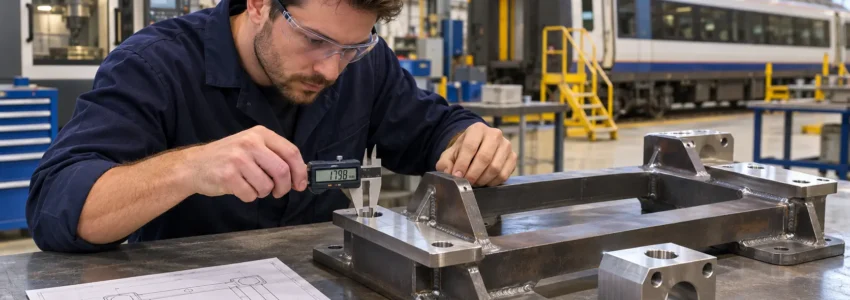
The Engineering Behind Modern Railways
A train or a new section of railway infrastructure is the visible result of work carried out across a much wider supply chain. Behind it are components and assemblies that must be manufactured to specification, checked and delivered in a condition that allows the next stage of work to proceed.
Rail manufacturing covers more than complete vehicles and track. It also supports the structures, equipment and electrical systems needed to build, maintain and modernise railway operations.
For manufacturers and procurement teams, this creates a practical challenge. A component may require cutting, machining, fabrication and finishing, with different requirements applying at each stage. Choosing suitable processes matters but so does establishing how the finished work will be accepted. Precision engineering contributes by turning those requirements into a controlled manufacturing route, supported by the appropriate inspection and records.
What Components Does the Rail Industry Need?
Manufacturing requirements vary across rolling stock, infrastructure and supporting equipment. Depending on the application, an enquiry might involve a bracket, machined housing, equipment enclosure, mounting structure or fabricated assembly. Electrical systems bring further component requirements.
These examples should not be treated as one category of work. An equipment enclosure and a precision mounting component may require different materials, manufacturing methods and evidence of compliance.
The wider investment picture also affects how suppliers plan. In its September 2026 response to the Rolling Stock and Infrastructure Strategy, the Railway Industry Association welcomed the intention to coordinate fleet and infrastructure requirements, including refurbishment and repeatable procurement.
RIA also stressed that the strategy was not yet a funded delivery plan. Suppliers needed clearer information about volumes, timescales, procurement opportunities and funding before investing with confidence.
For rail component manufacturing, that distinction matters. A proposed programme can indicate future requirements but it does not establish the specification or production schedule for an individual part.
Electrical Infrastructure and High-Voltage Switchgear in Rail Engineering
Rail infrastructure also depends on electrical systems that support power distribution, switching and protection. High-voltage switchgear, electrical connections, contacts and associated components all form part of this wider engineering requirement.
Manufacturing these components can involve precision machining, metal fabrication and specialist conductive materials, with dimensions, material specifications and surface treatments determined by their intended application.
This is an area where PRV Engineering has established experience. Its involvement in the rail sector includes manufacturing electrical connections, contacts and components for rolling stock, alongside work associated with overhead line equipment and switchgear.
For rail equipment manufacturers and their suppliers, access to integrated machining, fabrication and busbar manufacturing capabilities can help simplify procurement, particularly where multiple manufacturing processes are required.
Why Precision and Repeatability Matter in Rail Manufacturing
Precision starts with understanding which features the drawing requires and how they will be checked. It should not become a general claim that every railway component needs the tightest tolerance a machine can achieve.
For a hypothetical mounting assembly, the position of its fixing holes and the dimensions of its mounting faces would need to satisfy the specified requirements. Repeat production would then need to reproduce those features consistently.
Inspection provides evidence that the work meets its acceptance criteria. Material identification and traceability may also form part of the order, alongside manufacturing and inspection records.
Network Rail’s Quality Requirements – Standard Terms and Conditions provide a useful example. Within their contractual scope, they address inspection and test plans, acceptance criteria, material traceability and supporting records.
Those requirements should not be applied automatically to every rail supplier or rolling-stock component. The relevant contract determines what is required.
Operational considerations must be equally specific. Durability or vibration requirements need to come from the intended application and its specification. A manufacturer should understand those requirements before agreeing the production route, rather than assume that a familiar-looking component can be made and accepted in the same way as an earlier job.
CNC Machining for Railway Components
CNC machining, including turning and milling, can produce specified features in components, including work involving complex geometry. Its suitability depends on the material, dimensions and features required.
For a buyer, the useful discussion begins with the drawing.
- Which surfaces need machining?
- What dimensions govern acceptance?
- Are there features that must be inspected before later operations make them harder to access?
CNC machining for rail should therefore be considered alongside the proposed inspection arrangements. The ability to produce a shape does not, by itself, demonstrate that all the requirements of its railway application have been met.
Material choice also belongs in that discussion. A supplier’s ability to machine several materials is useful but the approved specification must establish which material is required for the part.
Where machining forms one stage of a larger assembly, its relationship with cutting, fabrication and finishing needs to be understood. That allows the manufacturing proposal to account for the complete component.
Metal Fabrication and Specialist Cutting
Metal fabrication for railway applications can involve cutting, forming, welding and assembly, with the combination determined by the component. Some enquiries concern individual parts; others require several pieces to be brought together into an assembly.
Consider a hypothetical equipment mounting structure made from cut plate and formed sections. Its manufacture would need to follow the drawing, with the joining method, dimensions and inspection requirements established before work begins.
The order of operations deserves attention. If the assembly also requires machined mounting features or a specified finish, those requirements need to be considered when planning the fabrication.
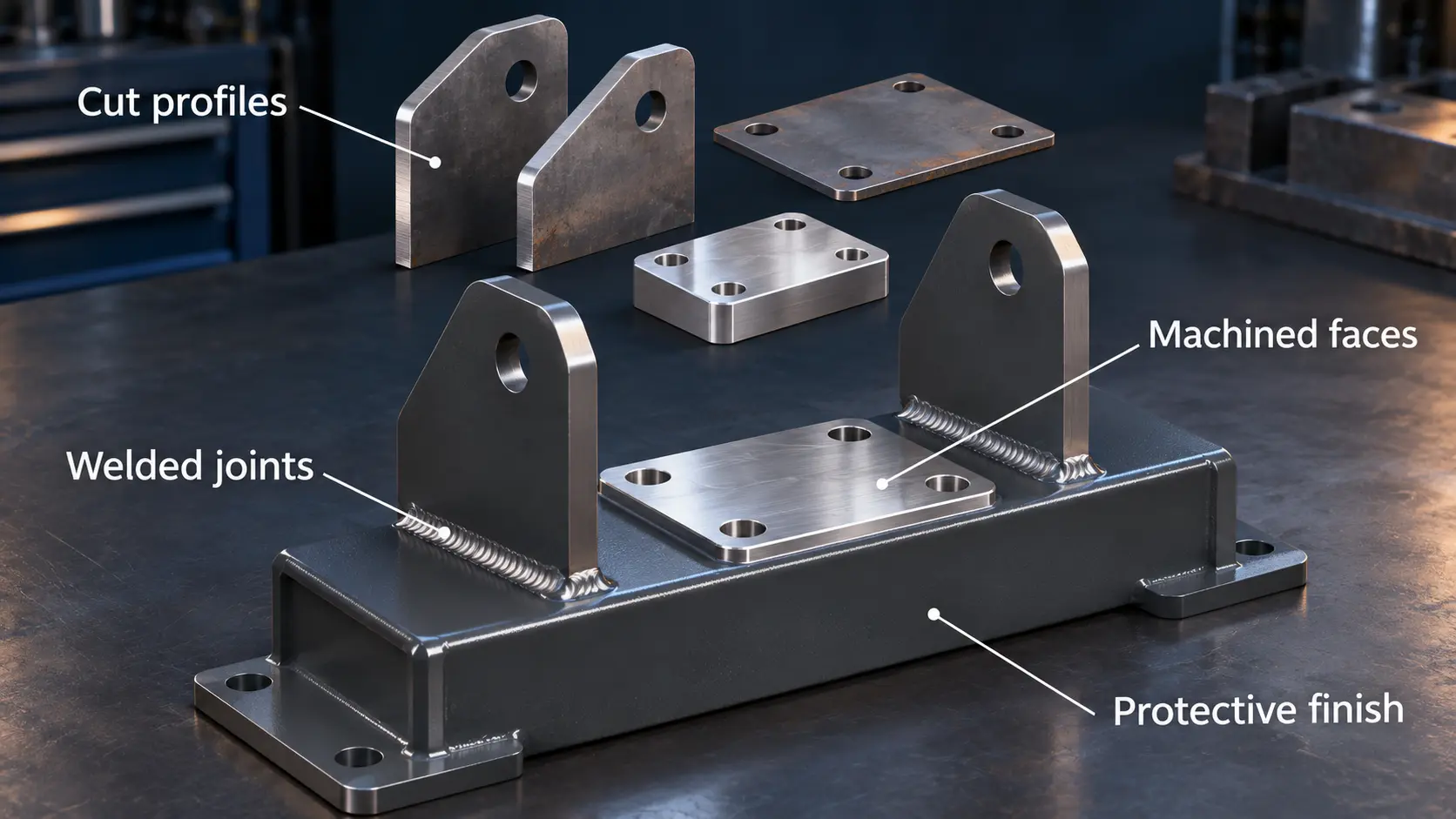
A quotation for welding alone would not explain how the complete structure is to be delivered. The customer and supplier also need to agree what happens before and after that operation.
For procurement teams, this makes the proposed manufacturing route an important part of supplier assessment. Capability should be matched to the agreed scope, including any applicable process qualifications or certification requirements.
Where Waterjet Cutting Fits Into Rail Engineering
Hydro-abrasive waterjet cutting can provide an initial profile for a component that will subsequently be machined, fabricated or finished. It is one option to assess against the material and specification.
Its cold-cutting characteristics can be useful where avoiding a thermal heat-affected zone is important. The process can cut suitable plate and complex profiles without introducing the thermal effects associated with a heat-based cut.
That advantage does not make it the right choice for every railway component. Material, geometry, required edge condition and subsequent operations all need consideration.
A cut profile may also be an intermediate stage. Certain features may still require machining or the part may need to be joined into a larger assembly.
The useful question is therefore how cutting contributes to the finished requirement. Establishing that connection early allows the supplier to consider the initial profile alongside the work still needed, rather than treating a completed cut as a completed component.
Finishing, Protection and Long-Term Durability
Finishing belongs in the manufacturing specification from the outset. Surface preparation, painting or powder coating should be selected for the application, with the required condition and acceptance criteria understood before production.
Services such as spray painting, powder coating and shot blasting provide different options for preparing and finishing components. The availability of a process does not establish that it meets a particular railway requirement and a general description of a protective finish cannot replace the specified system.
Acceptance also extends beyond appearance. For relevant infrastructure products, Network Rail’s product-acceptance process considers safety, compatibility, reliability and fitness for purpose. Its guidance identifies which types of new or modified products and applications may require acceptance, with exceptions governed by the applicable standard.
This is distinct from registering as a supplier or possessing general manufacturing capability. It should not be described as an identical process for every rolling-stock component.
For manufacturers, the practical lesson is to establish the applicable requirements before work is agreed. Neither a well-presented finish nor a general quality accreditation replaces the evidence required for the particular product.
How Integrated Engineering Can Help Rail Manufacturers
A component requiring several operations also creates several interfaces to manage. Drawings, material requirements, inspection stages and finishing instructions need to remain consistent as work progresses.
PRV Engineering brings together machining, fabrication, hydro-abrasive waterjet cutting and finishing capabilities. Its published waterjet offering describes how cut components can move into wider in-house machining, fabrication, assembly and finishing processes where required.
For customers with a suitable requirement, PRV Engineering’s products and services provide an opportunity to discuss several operations as one agreed scope. Keeping those operations together can reduce external hand-offs and give the customer fewer separate manufacturing arrangements to coordinate.
The fit still depends on the job. Drawings, quantities, materials, inspection requirements and delivery expectations need to be reviewed before a commitment is made. Any project-specific qualifications or approvals must also be established.
For rail manufacturers, an early discussion can help clarify which stages PRV can undertake and how those stages connect. That gives procurement and engineering teams a clearer basis for assessing the proposal against the complete component requirement.
Reliable Rail Systems Start With Reliable Manufacturing
Rail manufacturing depends on components being produced consistently to the requirements of their intended use. Suitable processes, agreed inspection and the necessary records all contribute to that outcome.
Specialist manufacturers have a practical role in connecting those requirements with the work needed to deliver a finished part. Where several processes are involved, clear responsibility and realistic planning help the customer understand how production will proceed.
The strongest proposal explains more than the available machinery. It shows how the specification will be met, what evidence will support acceptance and how the agreed work will be managed through to delivery.
Recent Comments