
Why Complex Components Rarely Rely on One Manufacturing Process
A finished engineering component may look simple. The route taken to manufacture it often is not.
A plate may begin on a waterjet cutting machine before moving into CNC machining. A fabricated assembly can require cutting, welding, machining and finishing. An electrical component may need accurate profiling followed by plating to achieve the required conductivity and protection.
That is why modern subcontract engineering is increasingly about combining the right processes, rather than finding one machine capable of doing everything.
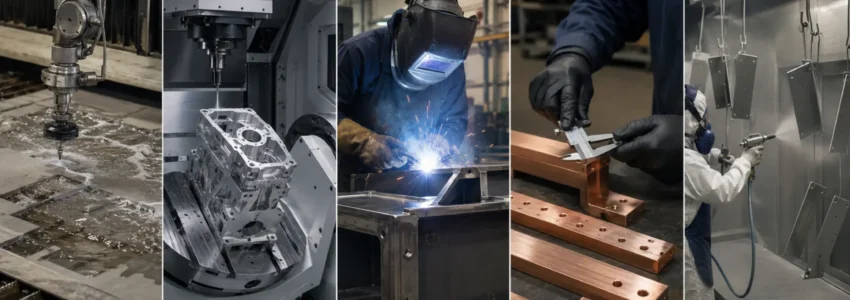
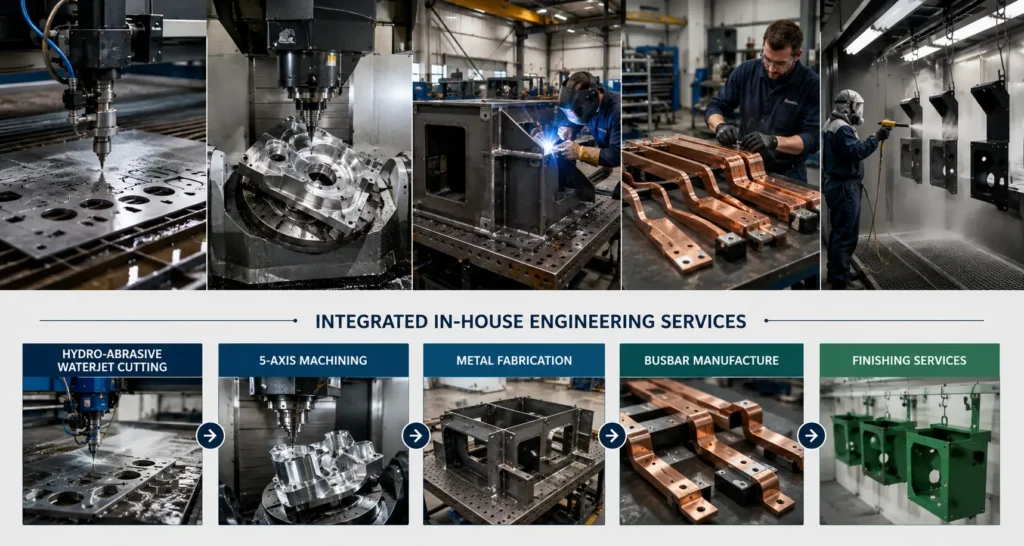
At PRV Engineering, those processes include hydro-abrasive waterjet cutting, CNC turning and milling, 5-axis machining, metal fabrication, welding, busbar manufacture and specialist finishing.
So, what are they actually used for?
1. Waterjet Cutting: When Heat Is the Problem
Waterjet cutting uses an extremely high-pressure stream of water, usually combined with an abrasive, to cut and profile material. Unlike laser, plasma and other thermal processes, hydro-abrasive waterjet cutting does not introduce a heat-affected zone into the material.
That makes it particularly useful for materials where heat could cause distortion or affect their properties.
PRV’s Idroline S 1730 waterjet system can be used on materials including:
- hardened steels and armour plate
- aluminium
- titanium and specialist alloys
- copper
- composites
- plastics and rubber
Typical applications range from profiles and development components to parts that require further machining afterwards. The real advantage is often what happens next. A component can move from precision waterjet cutting directly into machining, fabrication or finishing without leaving PRV.
2. CNC Machining: Turning a Profile into a Precision Component
Cutting a basic shape is one thing. Producing holes, threads, machined faces, pockets and complex geometries to the required specification is another. That is where CNC machining takes over.
PRV operates more than 30 machining centres, covering CNC turning, milling and multi-axis production. Its capabilities range from smaller precision parts through to considerably larger components, with true 4th and 5th-axis machining available for more complex geometries.
With 5-axis machining, several faces of a component can be machined within a more integrated process.
That becomes particularly useful for complex aerospace, defence, automotive and industrial parts where repeatedly repositioning a workpiece would add time and introduce further opportunities for variation.
3. Fabrication: When the Component Becomes an Assembly
Not everything starts and finishes as a machined billet. Larger engineering projects can involve cut plate, formed sections, welded structures and machined components coming together as a complete assembly.
PRV’s metal fabrication capability allows those stages to remain connected to the machining and cutting operations around them. That matters because a fabrication problem is not always solved at the welding stage.
Hole positions, machined interfaces, material choice, surface preparation and final dimensions can all influence whether the finished assembly performs as intended.
Keeping those processes connected makes it easier to identify problems before they become expensive ones.
4. Busbars: Precision Engineering for High-Current Applications
PRV also manufactures busbars for electrical power distribution.
These components are commonly manufactured from conductive materials such as copper or aluminium and require accurate cutting, forming and finishing. Depending on the application, specialist plating may then be used to improve conductivity, corrosion resistance or connection performance.
PRV carries out silver and tin plating in-house, another example of how apparently separate manufacturing processes can form part of one component journey. Busbars are used across electrical infrastructure, power distribution and specialist engineering systems, including applications within the defence sector.
5. Finishing Is Part of the Engineering
A component is not necessarily finished when the machining stops. Surface treatments can determine how a part performs once it enters service. PRV’s in-house capabilities include shot blasting, powder coating, spray painting and specialist plating.
These processes may provide corrosion resistance, electrical performance, surface protection or simply the finish required by the drawing. More importantly, they can be planned as part of the manufacturing sequence rather than treated as an afterthought.
The Machine Matters. The Journey Matters More.
Waterjet cutting is valuable because of what it can cut. 5-axis machining is valuable because of the complexity it can produce.
Fabrication, welding, coatings and plating each solve different engineering problems. But increasingly, the bigger advantage is how those processes work together.
A project that moves between five unrelated subcontractors creates five sets of schedules, quality controls, communications and handovers. When more of that manufacturing journey can remain under one roof, there are fewer interfaces to manage.
For straightforward work, that may simply make production easier. For complex, confidential or high-specification projects across sectors such as defence, aerospace, rail and automotive, it can make the entire manufacturing process more predictable.
And ultimately, that is what a serious engineering customer is buying. Not merely access to a machine. Confidence that the complete component will arrive as it should.
Recent Comments