
Why Choose PRV Engineering for Complex Manufacturing Projects?
A manufacturing project can involve several capable suppliers and still be difficult to control. The cutting contractor completes its work, the machine shop has a different production slot and the finishing specialist needs the component before it can confirm delivery. Each company manages its own operation, while the customer remains responsible for making the whole route work.
For engineering managers, procurement teams and project directors, choosing an engineering subcontractor in the UK therefore involves more than comparing individual capabilities. The wider question is how much coordination the project will require, where responsibility sits and whether the manufacturing route can be managed without consuming more internal time than the business can reasonably spare.
When Manufacturing Becomes a Coordination Problem
A component or assembly may need several processes before it is ready for use. Consider a hypothetical fabricated assembly requiring cut profiles, welding, accurately machined mounting faces and a protective finish. Each operation has its own requirements but the final result depends on how those operations connect.
When different suppliers undertake each stage, the customer may need to arrange transport, confirm that the latest drawings have reached everyone and check that the next production slot remains available. A delay during fabrication can affect machining, while a missed machining slot may push finishing beyond the original delivery date.
The difficulty is not necessarily that any supplier lacks competence. Each company may perform its own work well, yet the overall project still depends on someone managing the interfaces between them, including what must be completed, checked and communicated before the component moves on.
Subcontract manufacturing can extend a company’s capabilities but it also creates coordination work. When internal teams are already handling design changes, customer commitments and their own production schedules, managing several external operations can become a substantial additional responsibility.
The Hidden Cost of Multiple Subcontractors
Individual quotations rarely capture everything needed to deliver a finished component. Transport between suppliers, protective packaging, purchase-order administration and progress chasing can all add costs or consume staff time. These activities may be necessary but they still belong in the assessment of the manufacturing route.
Quality checks also need careful consideration. A supplier receiving a partly manufactured component may need to inspect relevant features before accepting it for further work. Such checks serve a legitimate purpose, although repeated receiving inspections and documentation reviews can add time as the component passes between businesses.
Changes create another layer of work, particularly when several suppliers are working from related drawings and specifications. A revised hole position, material requirement or finish specification may need to be communicated across the complete route, with any effect on work already completed assessed before production continues.
This is why the lowest collection of process quotations does not always produce the lowest total project cost. The Chartered Institute of Procurement & Supply’s guidance on total cost of ownership explains why purchasing decisions should consider costs beyond the quoted price, including logistics, lead times and supply disruption.
For buyers comparing engineering services in the UK, the practical question is whether an apparent saving at one stage creates extra expense or risk elsewhere. That assessment should include the management effort required to get the finished component delivered.
One Engineering Partner for More of the Manufacturing Journey
PRV can help when a project requires several manufacturing processes that would otherwise need to be purchased and coordinated separately. Its range of capabilities allows more of the work to remain within one company, with responsibility for those stages established from the outset.
For example, a component beginning with hydro-abrasive waterjet cutting may subsequently require CNC machining to achieve its specified features. Where complex geometry calls for 5-axis machining, the cutting and machining requirements can be considered as parts of the same route rather than separate purchasing exercises.
A fabricated assembly creates a similar coordination challenge. Linking metal fabrication services with machining and finishing allows the requirements of later operations to be considered alongside earlier work, with fewer external transfers where the agreed processes can remain within PRV.
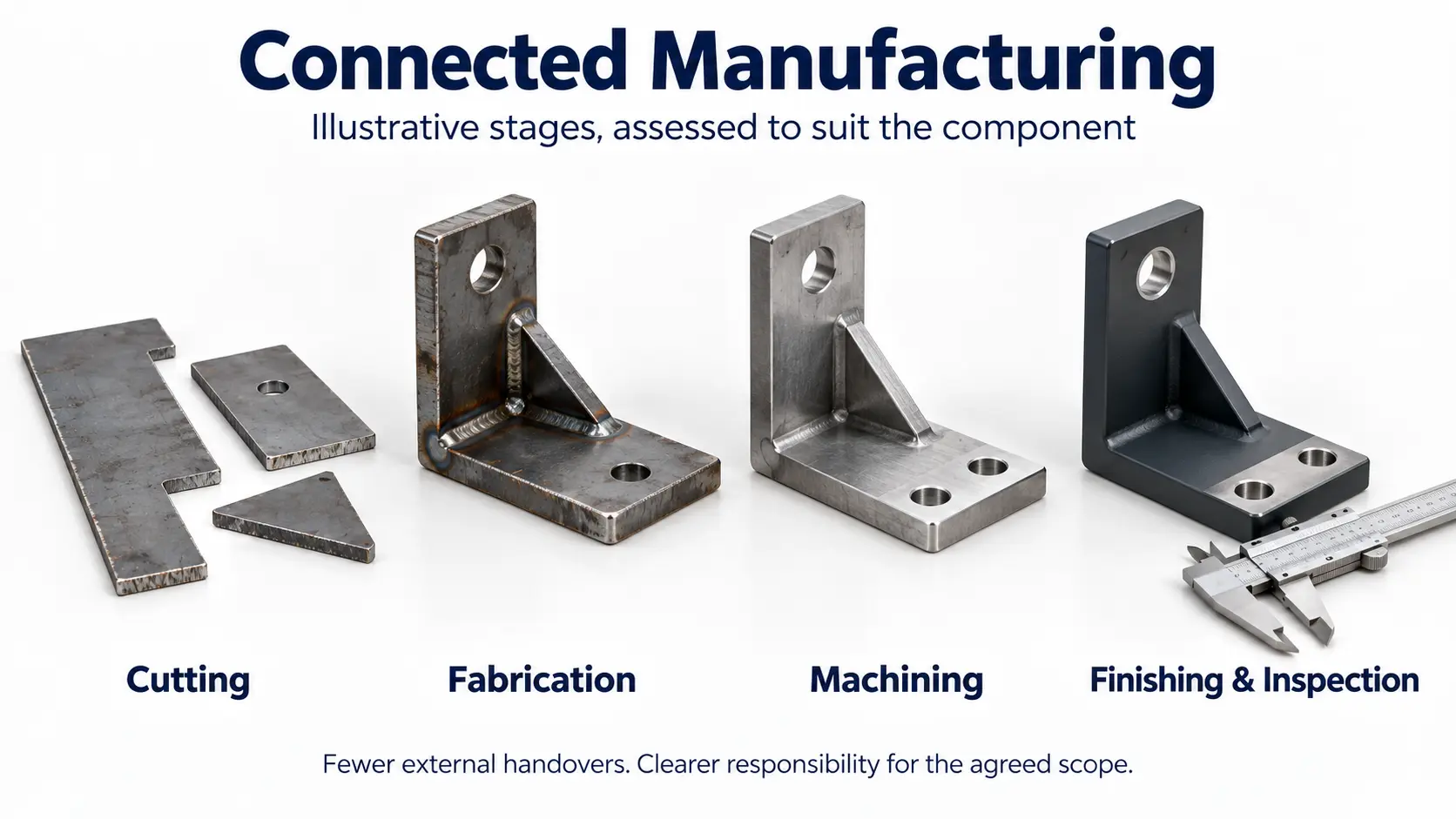
The same principle applies when assessing CNC machining services, specialist drilling or electrical components requiring surface treatment. The useful question is how the selected operations contribute to the finished specification, rather than how many services appear on a supplier’s website.
For the buyer, the practical benefit is having fewer transfers to arrange and fewer suppliers to chase. The proposed approach still needs to suit the component’s material, dimensions, specification and delivery requirements.
For an explanation of the individual processes, From Waterjet to 5-Axis: Inside PRV Engineering’s Manufacturing Capability provides further detail. Here, the commercial value is having more of those processes connected, with a clearer point of responsibility for the work PRV agrees to undertake.
Support From Prototype to Production
Companies approach subcontract manufacturers at different stages of development. Some have a finished drawing ready for manufacture, while others need production input before settling the design. A prototype may require refinement or an existing component may need a replacement assessed from available drawings, specifications or an OEM sample.
PRV offers design and manufacturing development, prototype work and batch production, allowing customers to start the discussion at different stages. Some enquiries will be ready for quotation, while others will need technical questions resolved before manufacture can begin.
Moving from a prototype into repeat production requires more than making additional copies. The manufacturing route needs to suit the intended quantity, with specifications, inspection requirements and any approved changes clearly established. Production input can help identify practical issues before the customer commits to the next stage.
A specialist operation such as deep-hole drilling may also represent a capability gap within an otherwise familiar project. Discussing that requirement alongside the remaining work can help establish whether PRV can undertake a broader manufacturing scope.
Replacement work requires its own assessment. PRV’s busbar manufacturing offering includes replacement busbars but recreating any component depends on the information available and the requirements it must satisfy.
Additional capability or capacity may help a business consider work beyond its internal resources. Urgent requirements, however, still need a realistic discussion about feasibility, material availability and production scheduling before a delivery commitment is agreed.
Better Control Over Quality and Delivery
Keeping more manufacturing stages connected can make communication easier, particularly when the work involves several related specifications. Drawing revisions, inspection requirements and surface treatments need to be understood consistently throughout the route, rather than treated as separate instructions at each supplier.
For electrical components requiring silver and tin electroplating, manufacture and plating must both reflect the agreed requirement. Similarly, spray painting, powder coating and shot blasting need to be coordinated with earlier operations so that surface preparation and finishing are included in the production plan.
PRV describes inspection of manufactured components and a dedicated quality inspection department. For the customer, the important discussion is what needs checking, at which stages and what records or acceptance criteria the project requires.
Connected operations can also make it easier to investigate a discrepancy before further work adds cost. With fewer external interfaces, there may be fewer separate conversations needed to establish what happened and agree the next step. This does not remove the possibility of delays or quality problems. Effective delivery still depends on clear requirements, suitable capacity and realistic schedules, while the customer needs to understand what PRV has agreed to manufacture and inspect.
When assessing an engineering subcontractor in the UK, these arrangements deserve attention alongside the available machinery and processes.
When PRV Is the Right Fit
PRV is particularly relevant when a component or assembly requires several manufacturing disciplines and the customer wants fewer suppliers to coordinate. It may also suit projects where technical input or specialist capability is needed beyond a single operation.
The fit may be strongest when delivery and technical requirements make coordination especially important. A high-specification assembly, for example, needs a manufacturing route that accounts for how each operation affects the work that follows, together with appropriate inspection and acceptance requirements.
Confidential projects require a separate conversation about information handling, including any non-disclosure agreement needed before sensitive drawings or specifications are shared. These arrangements should be established for the particular enquiry rather than assumed.
Supplier selection should also reflect the scope of support required, the proposed schedule and the customer’s available management capacity. The objective is to identify a workable manufacturing arrangement, with clear responsibilities and suitable capability, rather than make the decision solely on the cheapest isolated process.
Why Companies Choose PRV Engineering
Companies managing complex manufacturing projects need the individual operations to work together, with someone able to assess the interfaces, communicate requirements and take responsibility for the agreed scope. Fewer external handovers can provide a clearer route through that complexity and reduce the coordination burden on the customer.
PRV’s value is therefore closely linked to how its capabilities can be combined for a particular requirement. Cutting, machining, fabrication and finishing become more useful commercially when they can form a connected route to the specified component.
If a project requires several manufacturing processes, PRV Engineering can review the complete requirement rather than considering only one isolated stage. Send the team your drawings, specifications or project requirements to discuss the most practical route from initial manufacture to finished component, with the technical scope, inspection requirements and delivery expectations agreed from the outset.
Recent Comments