
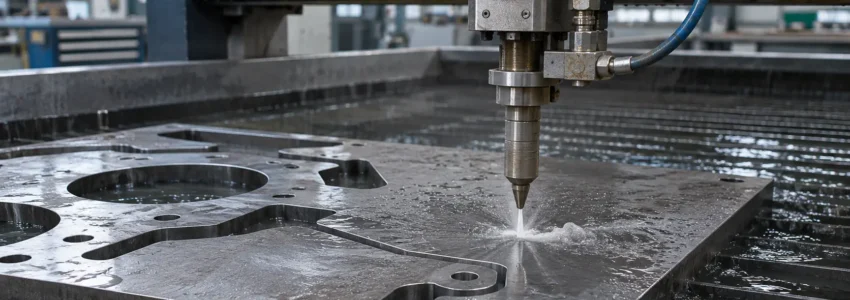
It All Starts With Choosing the Right Cutting Process
A drawing can show exactly what a component should look like without making the manufacturing route obvious. The material may be difficult to process, the profile may be intricate or certain features may need machining after the initial shape has been cut.
Choosing waterjet cutting services starts with those requirements. It also means understanding what happens after profiling because the cheapest initial cut does not necessarily represent the most practical route to a finished component.
Waterjet can be useful where thermal effects are undesirable or where suitable materials need complex profiles. Other jobs may be better suited to laser, plasma or mechanical cutting. For engineering and procurement teams, the task is to establish which process or combination of processes, meets the specification and gives the supplier enough information to quote accurately.
What Is Abrasive Waterjet Cutting?
Abrasive waterjet cutting uses a high-pressure stream of water mixed with abrasive to cut and profile material. The abrasive distinguishes it from water-only cutting and allows it to process suitable hard materials, including metals.
One characteristic is the absence of a thermal heat-affected zone. The process separates the material without relying on the high temperatures used by thermal cutting methods.
That can matter when a material has been selected for particular properties and introducing a thermally affected edge is undesirable. It does not mean every waterjet-cut component is automatically ready for assembly.
The drawing may still require machined faces, threaded holes, a particular finish or further fabrication. Understanding that distinction helps buyers specify what they need: a cut profile, a prepared blank for subsequent work or a component requiring several manufacturing operations.
When Is Waterjet Cutting the Right Choice?
Waterjet is worth considering when avoiding thermal effects is part of the manufacturing requirement. PRV identifies heat-sensitive materials, thick or hardened metals and intricate profiles among the applications for its service.
The benefit needs to be assessed against the actual component. A material being suitable for waterjet cutting does not establish that every feature on the drawing can be completed by that process alone.
For example, an overall plate profile might be suitable for cutting, while a mounting face or bore requires subsequent machining. The supplier needs to understand which features must be completed at each stage.
When assessing hydro-abrasive waterjet cutting, discuss the required edge condition and dimensions alongside the material and geometry. A general request for “precision cutting” leaves too much open to interpretation.
This is especially useful where some surfaces will remain as cut and others will be processed further. Identifying those differences gives the supplier a clearer basis for assessing feasibility and preparing a quotation.
Which Materials Can Be Waterjet Cut?
PRV’s published waterjet capabilities include steels, aluminium, titanium and specialist alloys, copper, composites, plastics and rubber. That range makes the process relevant to different industrial requirements but a material list is only a starting point.
The enquiry should identify the actual material specification and thickness. “Aluminium plate” or “steel component” may describe the general requirement without providing enough detail to assess the proposed work.
Geometry and equipment capability also need consideration. A supplier must assess the component rather than assume that experience with one material or profile transfers directly to another.
For industrial waterjet cutting, the useful question is whether the specified material and features can be processed to the required condition. Avoid treating published machine travel or bed dimensions as a statement of maximum cutting thickness; these describe different aspects of the equipment.
Waterjet Cutting Versus Laser, Plasma and Mechanical Cutting
Comparing cutting methods is most useful when the finished requirement is clear. Asking which process is best in general rarely resolves the decision for a particular drawing.
Start with the material and whether thermal effects are acceptable. Waterjet’s absence of a thermal heat-affected zone can be relevant here. Laser and plasma are thermal cutting processes but that does not make them unsuitable for every application where waterjet could also be considered.
Next, establish the required edge condition and dimensional acceptance criteria. The comparison should account for whether the cut edge will remain on the finished component or undergo further machining.
Speed and price also need to be assessed against the actual work. The permitted sources do not establish a universal ranking that makes one method faster, cheaper or more accurate across all materials and geometries. Mechanical cutting should likewise be considered as the relevant operation, such as sawing, rather than one uniform alternative.
For procurement teams, a useful comparison asks what each quotation delivers. Does it cover only profiling or does it include the work needed to reach the finished specification? Comparing the same scope makes the commercial decision much clearer.
Waterjet Cutting in Automotive and Rail Manufacturing
Automotive and rail manufacturing can involve components that begin as plate profiles before moving into other operations. Brackets, mounting components and development parts provide useful illustrative examples.
Consider a hypothetical plate bracket requiring an external profile, fixing holes and a machined mounting face. Waterjet cutting might be assessed for the initial shape, with machining used for features that need further processing.
A development component could present a similar decision. The enquiry would need to establish the material, quantity and required condition, together with any subsequent work.
These examples describe possible manufacturing routes rather than confirmed PRV customer projects. The sector name does not establish whether a particular process is suitable or whether a supplier meets the application’s acceptance requirements.
The specification must guide that assessment. A rail mounting component and an automotive prototype may share manufacturing processes while having different inspection, documentation and delivery requirements. Our comparison of waterjet, laser and plasma cutting explores the process-selection considerations in more detail.
Why Cutting Is Often Only the First Manufacturing Stage
A cut profile can resemble the finished component while still having several operations ahead of it. Holes may need drilling or threading, mounting faces may require machining and separate pieces may need to be formed or welded into an assembly.
CNC machining can produce features such as bores, pockets, threads and machined faces after the overall profile has been established. Whether those operations are required depends on the drawing.
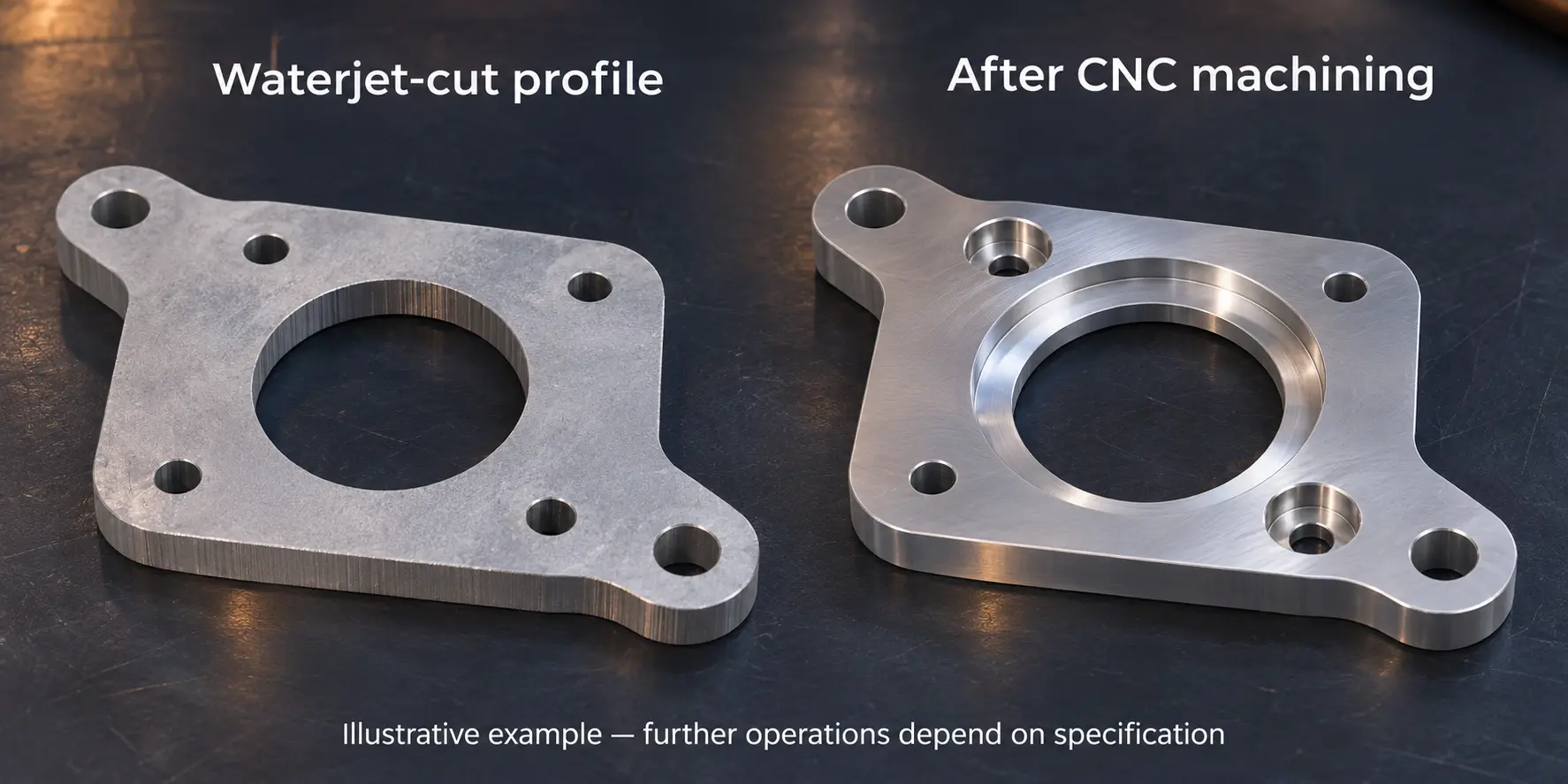
Depending on the component, further work may include metal fabrication and finishing. A profile intended for a welded assembly should be considered alongside the assembly requirements. A component needing a coating must have that requirement included in the agreed scope.
PRV’s explanation of waterjet, CNC and engineering manufacturing processes describes how these operations can connect.
For the buyer, the practical benefit of discussing the full route is clarity. The quotation can distinguish what will be delivered after cutting from what remains to be done. It also helps establish who is responsible for later stages, avoiding an assumption that a profiled blank and a finished component are the same deliverable.
What Engineers Should Include in a Waterjet Cutting Enquiry
A useful enquiry gives the supplier enough information to assess both the cutting requirement and any subsequent operations. For waterjet cutting services, include the following wherever available:
- Drawings and CAD files: Supply the current drawing and available geometry files, identifying the applicable revision.
- Material specification: State the required grade or specification rather than only the general material family.
- Thickness: Identify the stock thickness and any relevant requirements shown on the drawing.
- Dimensions and tolerances: Make clear which features require particular accuracy and which will be machined later.
- Quantities: State whether the enquiry concerns a single component, a batch or an anticipated repeat requirement.
- Edge condition and finishing: Explain what condition is required after cutting, including any specified treatment.
- Subsequent operations: Identify machining, drilling, forming, welding or assembly within the requested scope.
- Delivery requirements: Provide the required date and identify any stages being handled elsewhere.
If something remains unresolved, flag it. A clear question about a material or feature is more useful than leaving the supplier to guess.
PRV’s service page invites customers to submit drawings, CAD files or specifications for review. The checklist helps make that discussion more complete; it is not a claim that every item is a mandatory field in the enquiry form.
PRV Engineering’s Integrated Waterjet Cutting Services
PRV’s waterjet offering sits alongside in-house machining, fabrication, assembly and finishing capabilities. Where suitable for the requirement, components can move from cutting into those subsequent operations.
That creates an opportunity to review several stages together. A customer can discuss the initial profile alongside the machined features, fabrication and finish needed for the agreed component.
The approach described in Better Manufacturing Starts with Waterjet Cutting reinforces why the first operation should be considered in relation to what follows. For this enquiry, the important outcome is a clear proposal covering the work the customer actually needs.
Keeping suitable operations within one supplier can reduce external hand-offs. It can also give the customer fewer separate production arrangements to coordinate. Those benefits depend on the agreed scope and should not be treated as guarantees of lower cost or shorter delivery.
Before work is committed, the discussion needs to establish feasibility, inspection requirements and realistic delivery expectations. Some enquiries may require cutting alone; others may justify a broader manufacturing package.
Sending PRV the available drawings and specifications allows that distinction to be assessed. The aim is to agree a practical route, with responsibility for each included operation understood from the outset.
The Right Process, the Right Manufacturing Partner
Waterjet cutting is most useful when its capabilities match the component requirement. Avoiding thermal effects, producing a suitable profile and preparing material for subsequent operations can all form part of that decision.
The supplier assessment should then extend to what happens next. Required machining, fabrication, finishing and inspection need to be included wherever they form part of the requested work.
For engineering and procurement teams, a clear specification and a complete quotation provide a sound basis for comparing options. The right manufacturing proposal explains how the agreed component will be produced and delivered, starting with the cutting process that suits the job.
Recent Comments