Tag Archives: aerospace manufacturing

1 Oct 2026
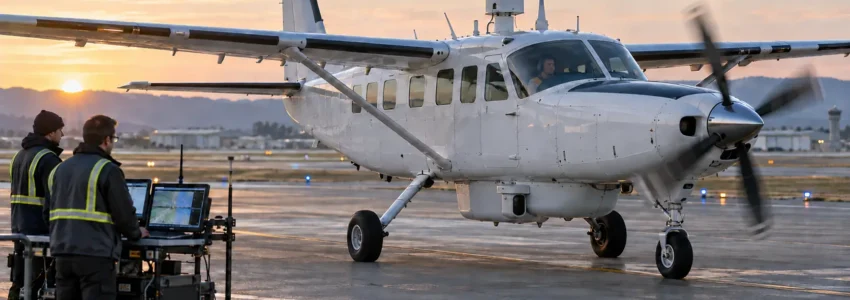
Autonomy-equipped utility aircraft taxis while engineers monitor the flight and a safety pilot remains onboard.

What Joby’s 3,199-Mile Flight Reveals About Autonomous Aircraft Technology

A converted Cessna Caravan has completed a 3,199-mile journey across the United States without its onboard safety pilot making a single control input. According to Joby Aviation, the aircraft handled taxiing, take-off, route navigation and landing autonomously as it travelled from California to North Carolina.

The achievement needs some careful qualification. This was a multi-leg journey rather than a single nonstop flight, a safety pilot remained in the cockpit and teams supervised the operation remotely. Describing it simply as a “pilotless flight” would therefore give the wrong impression, even though the aircraft itself reportedly controlled every phase of the journey.

The engineering importance lies beyond the headline distance. The demonstration shows how autonomous aircraft technology must connect sensors, software, communications and physical flight controls while operating through changing weather, airports and airspace environments.

It also raises a larger question: what does it take to convert a proven aircraft platform into an autonomous operating system without losing the reliability, traceability and human oversight expected in aviation?
25 Sep 2026
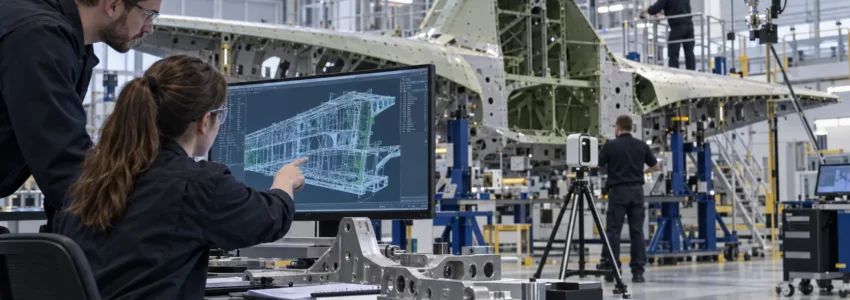
Aerospace engineers compare a digital aircraft structure model with manufactured components in an assembly facility.

How Britain’s Next Fighter Is Changing the Way Complex Engineering Is Manufactured

The latest investment in Britain’s future combat-air capability is not only funding the development of a new aircraft. It is also supporting a different engineering model in which design, testing, production and through-life support are connected through shared digital information.

On 22 July 2026, the Ministry of Defence announced a £708 million contract extension to accelerate the development of advanced technologies for the UK’s Future Combat Air System or FCAS. The wider system will include the next-generation aircraft being developed by the UK, Italy and Japan through the Global Combat Air Programme known as GCAP.

The distinction matters because FCAS describes the UK’s broader future combat-air capability, while GCAP is the international programme responsible for developing its core aircraft platform. Together, they provide a useful case study in how Future Combat Air System manufacturing could connect digital engineering with physical production.

The central question is therefore bigger than how the aircraft will perform. If it is engineered digitally from the outset, what changes in the factories, supplier networks and physical processes required to manufacture it?

18 Sep 2026
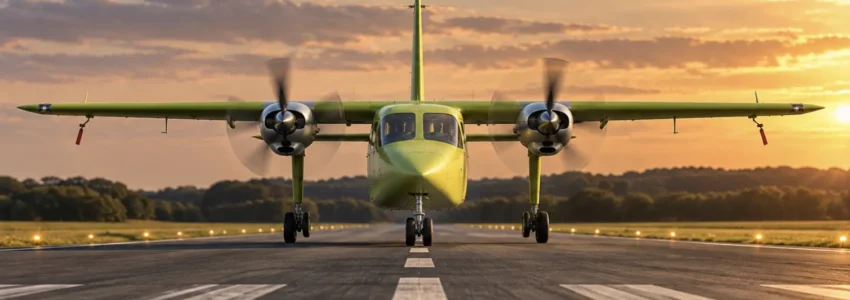
AI illustration showing the aircraft manufacturing supply chain, from raw materials and precision machining through fabrication and assembly to a completed twin-engine aircraft like the Islander.

The British-Built Islander Is Back: The Engineering Reality of Reshoring Aircraft Production

The first Islander to pass through Britten-Norman’s reshored production line at Bembridge entered its ground-test programme in August 2026. Although the return of a fully UK-assembled Islander is a notable moment for British aviation, the more important story concerns the manufacturing capability behind the aircraft.

Bringing complex aircraft manufacturing back to the UK involves considerably more than relocating an assembly line. Production depends on controlled engineering information, specialist knowledge, suitable tooling, skilled people and a network of suppliers capable of delivering compatible parts and systems.

The Islander therefore provides a useful case study in what reshoring means at factory level. Its progress from component manufacture through assembly and into testing illustrates how industrial capability must be reconstructed as a connected system before a British production line can produce dependable aircraft repeatedly.

12 Mar 2026
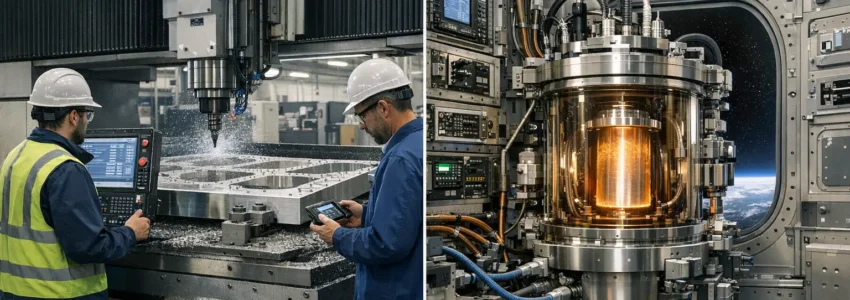
Split-scene image showing safe aerospace CNC machining on Earth and a realistic orbital semiconductor manufacturing module in low Earth orbit.

Microgravity Is Changing Advanced Materials in Space Manufacturing

Space manufacturing is rapidly moving from theoretical research into a serious engineering discussion.

For most of the space age, manufacturing has taken place almost entirely on Earth. Satellites, spacecraft components and instruments are designed, machined and assembled in terrestrial facilities before being launched into orbit.

But engineers are beginning to question whether some materials might actually be produced more effectively in space.

In microgravity environments, liquids behave differently, crystal structures can form more uniformly and impurities do not settle in the same way they do under Earth’s gravity. These changes may allow scientists and aerospace engineers to manufacture certain materials with properties that are difficult to achieve in conventional factories.

What once sounded like science fiction is now becoming a practical area of aerospace engineering research.

13 Feb 2026
Waterjet Cutting Services from PRV Engineering | Close-up of a waterjet cutting machine

When Waterjet Cutting Services Are the Right Choice for Industrial Projects

Choosing the right cutting process is rarely about preference. It is about material behaviour, thickness, tolerances, finishing requirements, and downstream performance.

Waterjet cutting services are often selected when thermal cutting methods introduce risk. While laser and plasma systems have their place in modern manufacturing, hydro-abrasive waterjet cutting offers a fundamentally different approach; one that removes heat from the equation entirely.

Understanding when to choose waterjet cutting services over alternative methods can significantly influence cost, quality, and long-term performance.

8 Jan 2025

Precision aerospace engineering has become a cornerstone in modern aviation, especially as the industry confronts growing demand for speed, reliability and sustainability. Aircraft manufacturers are exploring supersonic and hypersonic flight concepts, while airlines seek more efficient fleets. Meanwhile, passengers want shorter travel times and enhanced safety. In this article, we’ll explore how this specialised field supports aerospace manufacturing, the role of rapid prototyping, the creation of precision aerospace parts and trends in aviation engineering. We’ll also highlight the role of PRV Engineering in this fascinating sector.

18 Jan 2024

The realm of material science is constantly evolving, playing a crucial role in the future of industries like aerospace engineering and automotive manufacturing. From the development of new materials to the improvement of existing ones, material science has contributed significantly to advancements in various industries such as healthcare, energy, transportation, and electronics. In this article, we will explore some of the key innovations in material science that are driving future growth.

4 May 2023

The aerospace manufacturing industry relies heavily on precision engineering to create intricate and reliable components and systems vital for the safe and efficient functioning of aircraft. This process involves design, development, manufacturing and testing of high-quality products. In this article, we will discuss the role of precision engineering in aerospace manufacturing and explore how it contributes to the development of advanced aerospace technologies.

Recent Comments

    Events

    October 2026
    M T W T F S S
     1234
    567891011
    12131415161718
    19202122232425
    262728293031