
Why Carmakers Are Replacing Hundreds Of Parts With Just One
There’s no denying modern cars are becoming increasingly complex. New vehicles contain thousands of components, miles of wiring, advanced electronics, structural reinforcements, safety systems and manufacturing processes that would have seemed unimaginable only a few decades ago.
Yet some of the world’s largest automotive manufacturers are pursuing a surprisingly simple idea. Instead of building a vehicle structure from hundreds of individual components, why not manufacture large sections of it as a single part?
That question sits at the heart of one of the most significant developments in automotive engineering today: gigacasting.
While the term may sound like little more than another manufacturing buzzword, gigacasting represents something much more important. It highlights a growing shift in engineering thinking, one that prioritises simplicity, efficiency and reduced complexity throughout the manufacturing process.
The implications extend far beyond the automotive industry.
What Is Gigacasting?
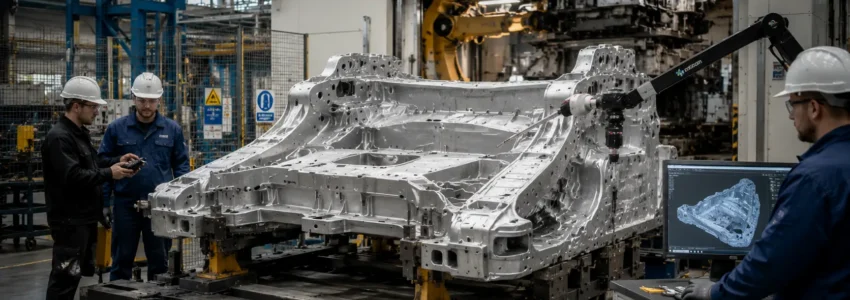
Gigacasting is a manufacturing process that uses enormous high-pressure die-casting machines to produce large structural vehicle components from a single aluminium casting.
Traditionally, vehicle underbodies and structural sections are assembled from numerous stamped, welded and joined components. Depending on the design, hundreds of individual parts may be required to create a finished assembly.
Gigacasting aims to replace many of those parts with one large casting.
Tesla is often credited with accelerating interest in the technology, using giant casting machines to manufacture major sections of vehicle structures. Since then, manufacturers including Volvo, Toyota, Hyundai and others have explored similar approaches.
At first glance, gigacasting appears to be a casting innovation.
In reality, it is a manufacturing strategy designed to eliminate complexity.
Why Carmakers Are Investing Billions In Gigacasting
Building a vehicle is an incredibly complicated process.
Every component requires design work, tooling, quality control, inventory management, supplier coordination, transportation, inspection and assembly. Multiply that by hundreds of parts and it becomes easy to understand why manufacturers are searching for efficiencies.
Gigacasting offers a potential solution.
If a structure previously required 100 separate components, multiple suppliers and numerous assembly operations, replacing it with a single casting can dramatically simplify production. The appeal goes beyond cost reduction.
Manufacturers also gain:
- Fewer assembly stages
- Reduced welding operations
- Improved production speed
- Simplified supply chains
- Lower inventory requirements
- Potential weight savings
For companies producing hundreds of thousands of vehicles each year, even small improvements can generate enormous savings.
The Benefits Of Reducing Hundreds Of Parts To One
One of the most interesting aspects of gigacasting is that the technology itself is only part of the story. The bigger story is what happens when complexity disappears.
A traditional vehicle structure may involve dozens of suppliers providing different components. Each supplier introduces lead times, logistics considerations and quality control variables.
Every weld introduces another manufacturing step. Every bracket introduces another component, and every assembly stage introduces another opportunity for delay.
Gigacasting attempts to remove many of those variables entirely.
This philosophy is becoming increasingly common throughout manufacturing. Engineers are continually looking for ways to simplify products, reduce assembly requirements and improve production efficiency without compromising performance.
We explored one example of this trend in our article examining the world’s first single-cast EV chassis, where manufacturing innovation was used to rethink how vehicle structures are produced.
The technology may differ, but the underlying objective remains remarkably similar: achieve more by reducing complexity.
Gigacasting Is Not Without Challenges
The headlines surrounding gigacasting often focus on its potential benefits.
The engineering challenges receive far less attention.
Producing large structural castings consistently is extremely demanding. Material behaviour, cooling rates, shrinkage, dimensional stability and defect control become increasingly difficult as component size grows.
Small casting defects that might be manageable in smaller parts can become far more significant in large structural components.
Why Quality Control Becomes More Important
When a structure is built from numerous components, individual sections can often be replaced or modified during production. A single casting changes that equation.
Manufacturers must ensure dimensional accuracy and structural integrity across an entire component from the outset. This places increasing importance on inspection processes, metrology and precision machining operations.
Many cast components require extensive post-casting operations before they are ready for assembly. Critical features, mounting points and interfaces often need additional machining to achieve the required tolerances.
Processes such as 5-axis machining play an important role in achieving the precision required for complex engineering components.
The Technical Challenges Continue
Manufacturers and researchers continue working to overcome challenges associated with large-scale castings. Issues such as hot tearing, porosity and distortion remain active areas of development.
For readers interested in the engineering challenges involved, Casting Campus provides an excellent technical overview of hot tearing in gigacastings, highlighting some of the complexities involved in producing large structural castings successfully.
The reality is that simplifying manufacturing often requires extraordinarily sophisticated engineering.
What Gigacasting Reveals About The Future Of Manufacturing
The most interesting aspect of gigacasting is not the casting process itself. It is what the technology reveals about where manufacturing is heading.
For decades, manufacturing innovation often focused on adding capability. More components, systems, features and a lot more complexity.
Today, many manufacturers are pursuing the opposite approach. They are asking whether fewer parts, fewer suppliers and fewer manufacturing stages might produce better outcomes.
This shift can be seen across multiple industries.
- Automotive manufacturers are reducing part counts.
- Aerospace companies are exploring integrated structures.
- Defence suppliers are seeking more efficient production methods.
- Engineering teams are increasingly designing products with manufacturability in mind from the very beginning.
The objective is no longer simply to create a better product. It is to create a better product that is easier to manufacture.

Manufacturing Is Moving Towards Simplicity
The lesson from gigacasting extends well beyond vehicle production.
Modern manufacturing increasingly rewards organisations that can reduce complexity without sacrificing quality, reliability or performance.
That trend influences everything from product design to supplier selection.
Companies are looking for ways to:
- Reduce handoffs
- Improve communication
- Simplify supply chains
- Shorten lead times
- Improve consistency
- Reduce risk
This is one reason manufacturing partnerships have become increasingly important.
Rather than coordinating numerous suppliers across multiple disciplines, many organisations are seeking engineering partners capable of delivering a broader range of capabilities under one roof.
Whether the challenge involves machining, fabrication, finishing or assembly, reducing complexity often creates value throughout the entire production process.
For example, advanced aluminium fabrication continues playing a vital role across industries where lightweight structures and manufacturing efficiency remain priorities.
The principle is the same: Simpler production pathways frequently lead to better outcomes.
A Lesson Beyond Automotive Engineering
It is easy to view gigacasting as a story about electric vehicles or automotive manufacturing. That would miss the bigger picture.
The real significance of gigacasting lies in what it teaches us about modern engineering. Manufacturers are increasingly questioning long-established assumptions about how products should be designed, assembled and delivered.
The technology itself may evolve.
- Alternative manufacturing methods may emerge.
- Different industries may adopt different solutions.
- What is unlikely to change is the underlying direction of travel.
- Complexity is becoming more expensive.
- Efficiency is becoming more valuable.
We explored a similar theme in our article examining what today’s modern hypercars reveal about manufacturing, where advanced engineering increasingly depends upon production capability as much as design innovation. Gigacasting is ultimately another example of the same idea.
The future of manufacturing may not belong to the companies that can build the most complicated products. It may belong to the companies that can achieve the same result with fewer parts, fewer processes and fewer opportunities for things to go wrong.
More Than A Casting
The rise of gigacasting is not simply a story about giant aluminium components. It is a story about manufacturing priorities changing.
For decades, engineering progress often meant adding more. Today, some of the most significant innovations are focused on removing unnecessary complexity instead.
That shift is already reshaping automotive manufacturing. It may ultimately reshape much more than that.
Recent Comments