Monthly Archives

July 2026

28 Jul 2026
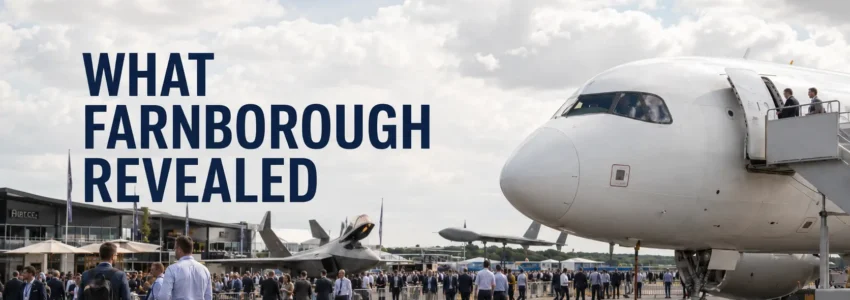
Busy aerospace trade show with commercial and military aircraft on display, delegates walking between exhibition halls and the headline “What Farnborough Revealed”.

What Farnborough Revealed About The Future Of Aerospace

The Farnborough International Airshow has always combined spectacle with serious business.

Aircraft perform overhead while manufacturers, airlines, governments, investors and engineering businesses negotiate what the industry will build next. The flying displays attract attention, but many of the most important developments happen inside exhibition halls and private meeting rooms.

Farnborough Airshow 2026 took place from 20 to 24 July, bringing together the aerospace, aviation, defence and space industries. Organisers described it as the largest and most ambitious event in the show’s 78-year history, with a sixth exhibition hall added to meet demand.

There was no shortage of aircraft orders, technical announcements or ambitious concepts. Yet the bigger story was not simply what the industry wants to build.

It was whether manufacturers and their supply chains can produce, support and continuously improve everything being promised.


24 Jul 2026
Modern passenger aircraft with folded outer wing sections on an airport apron at sunset, illustrating how longer wings could improve efficiency while remaining compatible with existing airports.

Could Folding Wings Solve Aviation’s Wingspan Problem?

Aircraft wings are getting a second look.

For years, the basic challenge in commercial aviation has been clear. Airlines want aircraft that burn less fuel, produce lower emissions and operate more efficiently over long distances. One of the most effective ways to improve that efficiency is to use longer, slimmer wings.

The problem is that airports were not built for unlimited wingspan.

That is why folding aircraft wings are back in the conversation. They offer a way to give aircraft more aerodynamic efficiency in the air without making them too wide for existing gates, taxiways and ground operations.

24 Jul 2026

Can McLaren Win Le Mans Again?

McLaren will return to the top class of the 24 Hours of Le Mans in 2027, more than three decades after the F1 GTR won at its first attempt.

This time, it will race the MCL-HY, a purpose-built hybrid prototype created for the FIA World Endurance Championship. The car combines a carbon fibre monocoque, a twin-turbocharged V6 and a hybrid motor-generator system producing up to 520kW, or 707PS, at the rear axle.

Those figures are impressive. Le Mans, however, is rarely decided by one specification. The winning car must remain quick, efficient and dependable for an entire day and night.

10 Jul 2026
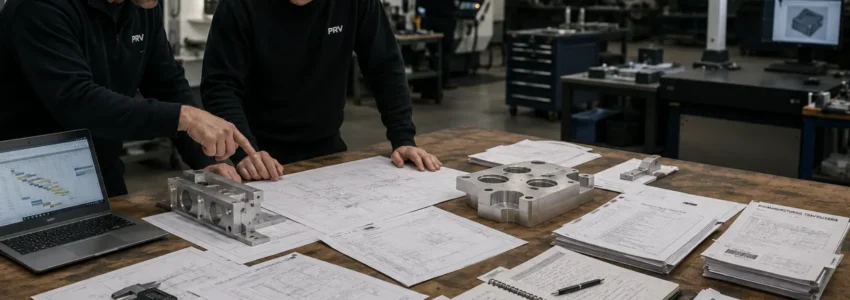
Engineers reviewing a component design while precision machining begins, illustrating how early manufacturing decisions influence cost, quality and production efficiency.

Manufacturing Is Becoming More Complex. Your Supply Chain Shouldn’t Be

An engineering supply chain is only as strong as the connections between the companies involved.

That might sound obvious, yet many manufacturing projects become more difficult not because of the component being produced, but because every stage of production is handled by a different supplier. One company cuts the material, another machines it, another fabricates it, while finishing, coating and inspection take place elsewhere.

Each supplier may do an excellent job but the real challenge lies in everything that happens between them.

Every handover introduces another opportunity for delays, miscommunication or quality issues. Drawings are transferred, components are packaged and transported, production schedules are coordinated and specifications are interpreted by another team. None of these activities adds value to the finished component, but all consume time and introduce risk.

As manufacturing projects become more sophisticated, many organisations are beginning to question whether managing an increasingly fragmented supply chain still makes commercial sense.

2 Jul 2026
Engineer reviewing a precision aluminium component alongside CNC machining equipment, illustrating how early manufacturing decisions influence production quality.

Every Precision Component Has A Starting Point

Waterjet cutting is often viewed as a manufacturing process in its own right. In reality, it’s frequently the beginning of a much larger engineering journey.

Whether a component is destined for a defence vehicle, an electrical power system or a piece of industrial machinery, the first manufacturing decision can influence everything that follows. Material selection, production efficiency, machining time and even the long-term performance of the finished component are often shaped long before the first hole is drilled or the final surface is machined.

That’s why experienced engineering teams don’t simply ask how a component should be manufactured. They consider the entire production workflow from the outset, selecting manufacturing processes that work together rather than in isolation.

Waterjet cutting has become an important part of that approach. Far more than simply cutting material to shape, it often creates the starting point from which every subsequent manufacturing operation becomes more efficient.

Recent Comments

    Events

    July 2026
    M T W T F S S
     12345
    6789101112
    13141516171819
    20212223242526
    2728293031