
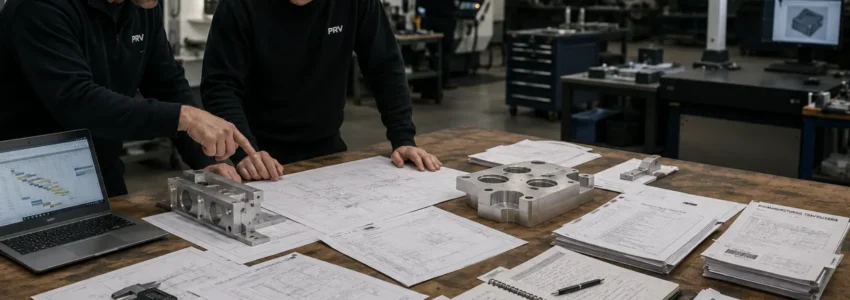
Manufacturing Is Becoming More Complex. Your Supply Chain Shouldn’t Be
An engineering supply chain is only as strong as the connections between the companies involved.
That might sound obvious, yet many manufacturing projects become more difficult not because of the component being produced, but because every stage of production is handled by a different supplier. One company cuts the material, another machines it, another fabricates it, while finishing, coating and inspection take place elsewhere.
Each supplier may do an excellent job but the real challenge lies in everything that happens between them.
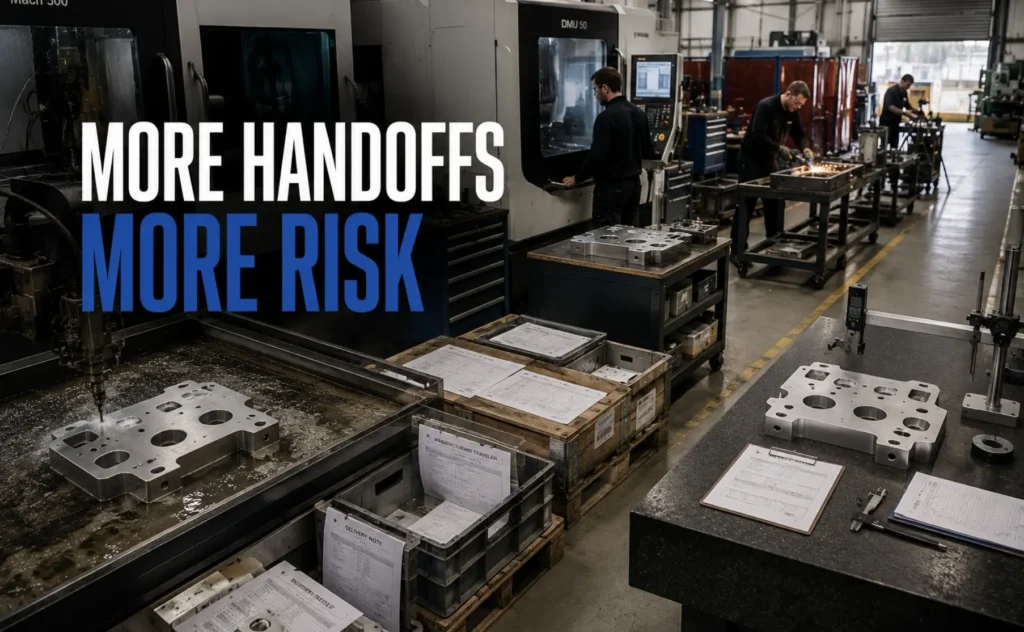
Every handover introduces another opportunity for delays, miscommunication or quality issues. Drawings are transferred, components are packaged and transported, production schedules are coordinated and specifications are interpreted by another team. None of these activities adds value to the finished component, but all consume time and introduce risk.
As manufacturing projects become more sophisticated, many organisations are beginning to question whether managing an increasingly fragmented supply chain still makes commercial sense.
Every New Supplier Adds Another Variable
Imagine two identical engineering drawings landing on a project manager’s desk.
- The first will be manufactured by a single engineering company with in-house capabilities covering waterjet cutting, CNC machining, fabrication, finishing and inspection.
- The second requires five specialist subcontractors, each responsible for one stage before passing the component to the next supplier.
On paper, both routes are capable of producing exactly the same part. In practice, the project experience is often very different.
Every additional supplier introduces another programme to coordinate, another production queue to monitor and another delivery date that has to align with everything else. Even when every company performs well, the overall project becomes harder to manage simply because there are more moving parts.
That’s one reason why manufacturers are increasingly looking beyond individual processes and focusing on the efficiency of the entire production workflow.
It’s a theme we looked at in our recent article, Better Manufacturing Starts With Waterjet Cutting, which explains how early manufacturing decisions can influence every stage that follows.
Coordination Is Work Too
Engineering drawings don’t move themselves. Components don’t inspect themselves when they arrive from another supplier. Production teams don’t automatically know when the previous process has finished.
The thing is, someone has to coordinate every stage.
For procurement teams and project managers, that often means far more than raising purchase orders. Progress needs to be monitored, suppliers chased, delivery schedules adjusted and unexpected issues resolved before they affect the wider project.
The hidden cost isn’t always found on an invoice. It’s found in the hours spent managing the gaps between suppliers.
Those coordination costs rarely appear on a quotation, yet they can have a significant impact on overall project efficiency, particularly when manufacturing schedules are tight or several engineering disciplines need to work together.
Better Engineering Starts With Better Planning
Experienced engineers rarely think in terms of isolated manufacturing processes. Instead, they consider how each stage influences the next.
- Material selection affects machining
- Manufacturing methods influence inspection
- Early design decisions often determine how efficiently production can proceed from start to finish.
That’s why topics such as Design for Manufacturability and Manufacturing Process Selection have become increasingly important across modern engineering.
Rather than asking, “Who can complete this operation?”, the more useful question is often, “What’s the most efficient route from raw material to finished component?”
That subtle shift in thinking frequently leads to simpler manufacturing workflows, fewer unnecessary handovers and greater confidence that projects will be delivered as planned.
A Better Supply Chain Isn’t Always A Bigger One
Fewer handoffs mean fewer opportunities for problems. With that in mind, let’s imagine our aluminium mounting bracket once again.
The profile has been cut accurately and the component is ready for machining. Rather than moving directly to the next process, it’s packaged, loaded onto a vehicle and transported to another supplier.
- After machining, it travels again for fabrication.
- Then again for finishing.
- Finally, it reaches inspection before being delivered to the customer.
Each stage may only add a day or two.
Individually, those delays seem insignificant. Collectively, they can extend lead times, increase transport costs and introduce unnecessary complexity into what should be a straightforward manufacturing project.
More importantly, every handoff creates another point where information can be misunderstood, components delayed or quality concerns discovered later than anyone would like.
Keeping Components Moving
Manufacturing is at its most efficient when components spend their time being worked on, not waiting to move between suppliers.
That’s one reason integrated production workflows have become increasingly attractive across sectors such as defence, aerospace and industrial engineering. Reducing unnecessary movement helps shorten lead times, simplify communication and maintain better visibility throughout production.
It also makes design changes easier to implement. When machining, fabrication and finishing teams are working within the same organisation, questions can often be resolved immediately rather than becoming a series of emails, delivery delays and revised production schedules.
The objective isn’t simply to manufacture components more quickly. It’s to keep projects progressing with fewer interruptions.
Visibility Matters As Much As Capability: Every Conversation Has Value
Complex engineering projects rarely proceed exactly as planned.
- Tolerance may need clarification
- Material specification might change
- Design modification could improve manufacturability or reduce machining time.
When several independent suppliers are involved, those conversations often pass through multiple people before reaching the right engineer. Each step introduces another opportunity for misunderstanding.
Working with a manufacturing partner that offers multiple in-house capabilities can shorten that communication chain considerably. Designers, machinists, fabricators and production teams are often solving the same challenge together rather than passing it between different companies.
The result isn’t simply better communication. It’s often better engineering.
Solving Problems Earlier
Many manufacturing issues aren’t discovered because somebody made a mistake. They’re discovered because the next supplier is the first person to encounter them.
- A machinist notices a tolerance that is unnecessarily tight.
- A fabricator identifies a feature that could be produced more efficiently.
- An inspector spots a recurring issue that originated much earlier in production.
When those disciplines work more closely together, feedback tends to arrive sooner, giving engineering teams greater opportunity to refine processes before delays become expensive.
This collaborative approach is becoming increasingly important as components become more complex and customers expect shorter lead times without compromising quality.
Looking Beyond Individual Processes: Thinking About The Whole Workflow
It’s easy to compare individual manufacturing processes.
- Laser cutting versus waterjet cutting.
- One machining centre versus another.
- One supplier’s quotation against somebody else’s.
In reality, those comparisons only tell part of the story. Our guide to Laser, Plasma or Waterjet Cutting explains why each process has strengths and limitations depending on the material, geometry and the requirements of the finished component.
Experienced manufacturers, like PRV Engineering, often look at a different comparison altogether. They evaluate the efficiency of the entire engineering supply chain.
A slightly lower machining cost can quickly disappear if additional transport, administration, inspection or project management is required elsewhere. Likewise, choosing separate suppliers for every operation may appear flexible, but the cumulative effect can be greater complexity, longer lead times and less visibility across the project as a whole.
Final Thoughts From PRV Engineering
The Whole Is Greater Than The Sum Of Its Parts
Manufacturing becomes far easier to manage when every stage is planned as part of a single workflow rather than a series of disconnected operations.
Selecting the right manufacturing processes is only one part of the decision. Equally important is understanding how those processes work together throughout production.
For many organisations, the greatest efficiencies don’t come from improving a single process. They come from reducing unnecessary handovers, improving communication and creating a manufacturing workflow that’s designed to deliver predictable results from the outset.
If you’d like to explore this topic further, our article on Manufacturing Process Selection Matters More Than Engineers Think explains why the sequence of manufacturing operations is often just as important as the individual technologies themselves.
Recent Comments