
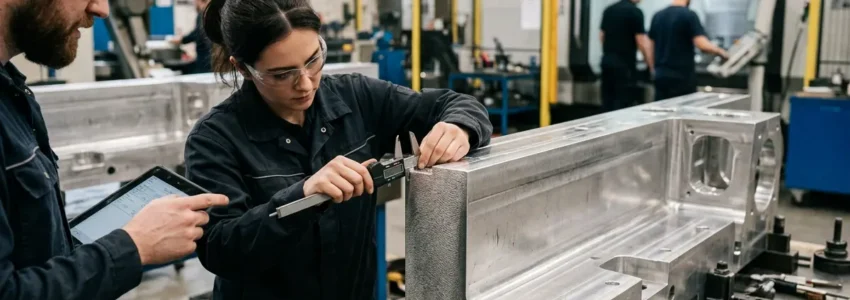
The Difference Between A Great Design And A Great Product
Design for manufacturability is one of the most important principles in modern engineering, yet it’s often overlooked until production begins.
Every engineer has seen it. A component looks perfect on the CAD model. Every dimension is correct and every feature has been carefully considered. The design meets the specification and performs exactly as intended but then somebody tries to manufacture it and suddenly, questions begin to appear.
The Moment Theory Meets Production
- Can the cutting tool actually reach that internal corner?
- Will the material distort during fabrication?
- Are those tolerances genuinely necessary?
- Could this be produced more efficiently using a different manufacturing process?
These aren’t manufacturing problems. They’re design problems that only become visible during production.
This is exactly what design for manufacturability seeks to prevent. Rather than treating manufacturing as the final stage of product development, it considers how a component will actually be produced from the very beginning.
For organisations working in sectors such as defence, aerospace, industrial engineering and power systems, this approach often determines whether a project progresses smoothly or becomes an expensive exercise in redesign, rework and delay.
Design Doesn’t End At CAD
Modern CAD software allows engineers to design almost anything. Manufacturing doesn’t.
Features that look straightforward on a computer screen may require specialist tooling, multiple machining operations or complex workholding once they reach the shop floor. Something as simple as a deep pocket, a sharp internal corner or an inaccessible fixing point can significantly increase manufacturing time and cost.
This is why experienced engineers think beyond the drawing itself. They consider how the component is cut, held during machining, inspected and how it’s assembled.
Good design is never just about geometry. It’s about ensuring every stage of production can be completed efficiently without compromising quality or performance.
Engineering Insight: The easiest component to manufacture is often the one that was designed with manufacturing in mind.
The Most Expensive Problems Are Often Designed In
Many studies suggest that the majority of a product’s lifetime cost is effectively determined during the design phase, long before the first component reaches production.
A seemingly minor design decision can influence machining time, tooling requirements, inspection methods, assembly complexity and even future maintenance.
Imagine a simple aluminium mounting bracket. On the CAD model, it includes several deep internal pockets, extremely tight tolerances across every surface and sharp internal corners.
None of these features appears particularly problematic. Until manufacturing begins.
Specialist cutting tools become necessary and additional machining operations are introduced. Inspections also take longer, lead times increase and costs start to climb.
Now imagine the same bracket after a conversation between the design engineer and the manufacturing team.
- The internal corners are given practical radii.
- Only critical dimensions retain tight tolerances.
- A pocket depth is reduced slightly without affecting performance.
Nothing changes from the customer’s perspective but everything changes for production.
This is the real value of design for manufacturability. Rather than redesigning parts after problems appear, it removes unnecessary complexity before production ever begins.
Good Design Makes Manufacturing Easier
Design for manufacturability isn’t about limiting creativity. It’s about applying engineering knowledge where it has the greatest impact.
For example, engineers are increasingly looking for opportunities to reduce unnecessary part count. Combining several components into a single manufactured part can remove fasteners, simplify assembly and reduce the number of opportunities for variation.
Material selection is equally important. Choosing materials that suit both the application’s performance requirements and the intended manufacturing process often improves consistency while reducing unnecessary waste. As explored in our previous article on Why Material Selection in Engineering Matters More Than You Think, these early decisions frequently influence every stage of production.
Tolerances also deserve careful consideration. Specifying unnecessarily tight tolerances across an entire component increases machining time, inspection requirements and manufacturing costs. Experienced engineers understand that precision should be applied where it genuinely matters, not everywhere by default.
None of these changes alters the function of the finished product. They simply make it easier to manufacture reliably, consistently and economically.
Design for Manufacturability Starts With Collaboration
One of the biggest misconceptions in engineering is that a design should be completed before manufacturing specialists become involved. In reality, the opposite is often true.
The earlier manufacturing expertise is introduced, the more opportunities there are to simplify production, reduce costs and eliminate unnecessary risk.
A conversation that lasts thirty minutes during the design phase can save weeks during production.
Manufacturing engineers may identify a more suitable material. A machinist might recommend changing a corner radius to improve tool access. A fabrication specialist may suggest splitting a complex assembly into more manageable sections. Even a small adjustment to a hole position or fixing method can make assembly quicker and more repeatable.

These conversations aren’t about compromising the design. They’re about ensuring the design performs just as well on the shop floor as it does on the computer screen.
For organisations developing complex components, involving manufacturing partners early is often one of the simplest ways to reduce delays, minimise rework and improve production confidence.
There Is More Than One Way To Manufacture The Same Component
One of the most overlooked aspects of engineering is that the same component can often be manufactured in several different ways.
A bracket might be machined from billet. It could be fabricated from sheet steel or it might be produced using waterjet-cut profiles before secondary machining.
For higher production volumes, it could even be cast or forged. Every approach is technically valid.
The challenge is selecting the one that best suits the application, production volume, material, budget and performance requirements. This is where design for manufacturability becomes far more than a design exercise. It becomes an engineering decision.
Manufacturing decisions rarely exist in isolation. Material selection, manufacturing methods, tolerances, assembly requirements and long-term performance all influence one another.
Engineering decisions made during the design stage often influence cost, quality and reliability throughout the entire product lifecycle, a principle widely recognised across the engineering profession (Royal Academy of Engineering).
Ultimately, the objective isn’t simply to manufacture a component. It’s to manufacture it in the most appropriate way for the project as a whole.
Sometimes The Best Solution Is To Change The Design
Returning to our aluminium mounting bracket, imagine production is about to begin.
The design works perfectly. But the manufacturing team identifies several opportunities to make it easier to produce.
- Increasing two internal corner radii allows standard tooling to be used.
- Relaxing a non-critical tolerance reduces machining and inspection time.
- A mounting hole is repositioned slightly to improve fixture access.
The component is now easier to machine, easier to inspect and easier to assemble. Its function and performance haven’t changed but its manufacturability had been improved.
This is why design for manufacturability isn’t about making products simpler. It’s about removing unnecessary complexity before it becomes an expensive manufacturing problem.
Manufacturing Processes Should Support The Design
Choosing the right manufacturing process is one of the clearest examples of design for manufacturability in practice.
For instance, if a component is manufactured from heat-sensitive material or requires exceptional dimensional stability, engineers may deliberately choose hydro-abrasive waterjet cutting rather than a thermal cutting process.
Although another process might appear quicker, preserving the material’s properties can significantly reduce downstream machining challenges and improve overall production quality.
This is one reason many high-spec industries continue to use hydro-abrasive waterjet cutting for specialist applications where precision, material integrity and repeatability are critical.
As explored in our recent article, Why Manufacturing Process Selection Matters More Than Engineers Think, selecting the right manufacturing process is rarely about choosing the fastest option.
It’s about choosing the option that gives the entire project the greatest chance of success.

Good Engineering Begins Long Before Production
Design for manufacturability is often misunderstood as a way of making life easier for manufacturers. In reality, it’s about making better products. Products that are:
- easier to produce consistently.
- simpler to inspect.
- assembled more efficiently.
- performing as expected throughout their working life.
The benefits extend far beyond the production line. Better manufacturability can improve lead times, reduce waste, minimise variation and create a more resilient supply chain. It also allows engineering teams to respond more quickly when designs evolve or customer requirements change.
For organisations operating in high-spec industries, these advantages can make the difference between a project that stays on schedule and one that becomes increasingly expensive to recover.
Design for Manufacturability Is Becoming A Competitive Advantage
As engineering projects become more complex, manufacturers are expected to do far more than simply produce components to a drawing. Customers increasingly value suppliers that can identify potential manufacturing challenges before production begins.
That might mean suggesting an alternative manufacturing process:
- Recommending a different material.
- Improving assembly efficiency.
- Or highlighting a design feature that could increase production time without adding value.
These aren’t changes for the sake of manufacturing. They’re improvements that benefit the entire project.
Organisations that embrace design for manufacturability early often experience shorter development cycles, more predictable production and fewer surprises once manufacturing begins.
Why Early Collaboration Delivers Better Results
Successful engineering projects rarely involve designers working in isolation. The strongest outcomes usually come from collaboration between design engineers, manufacturing specialists and production teams.
Projects in sectors such as defence, aerospace, industrial engineering and power distribution often benefit from these discussions long before production starts.
PRV Engineering regularly supports customers during this stage, helping refine manufacturing routes, material choices and production methods before components reach the shop floor. With integrated capabilities including CNC machining, hydro-abrasive waterjet cutting, fabrication and finishing, potential manufacturing challenges can often be identified and addressed much earlier in the development process.
Rather than waiting until production exposes a problem, experienced engineering teams ask a different question:
“Can we remove the problem before manufacturing even begins?”
That mindset sits at the heart of design for manufacturability.
The Real Takeaway
Every component tells two stories.
- The first is the one shown on the engineering drawing.
- The second is how that component is actually manufactured.
When those two stories work together, production becomes more predictable, quality improves and engineering teams spend less time solving avoidable problems.
This is why design for manufacturability has become an increasingly important part of modern engineering.
It encourages better conversations, better decisions and ultimately, better products. Because the best engineering solution isn’t simply the one that performs well on screen. It’s the one that can be manufactured efficiently, repeatedly and reliably in the real world.
Recent Comments