Tag Archives: British manufacturing

8 Oct 2026
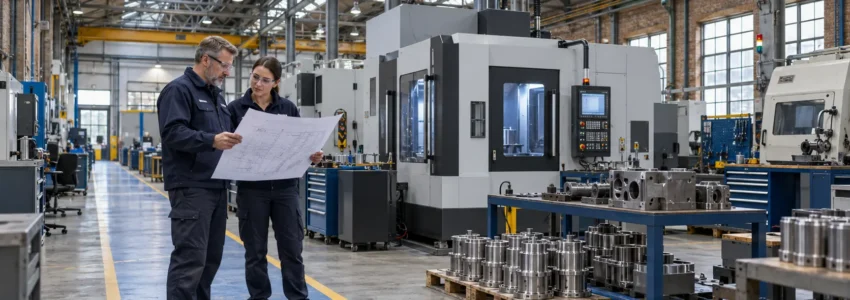
Engineers reviewing a factory layout beside CNC machinery in an existing industrial building.

How Existing Factories Are Being Rebuilt for Advanced Manufacturing

Britain’s next manufacturing era will not necessarily begin with an empty plot and a completely new factory. Some of the capacity needed for future aircraft, propulsion systems and complex components is being developed at established sites, where investment is changing what can be made and how production is organised.

For UK advanced manufacturing, this raises a practical question: how do you turn an existing industrial site into a facility capable of delivering different work reliably? A new machine may provide an essential operation, but its value depends on the environment around it, from component handling and operator knowledge to inspection and production planning.

Airbus’s Broughton conversion and Rolls-Royce’s investment programme illustrate different aspects of that transition, while Isembard’s London factory offers another perspective on bringing manufacturing and its supporting functions together.

18 Sep 2026
AI illustration showing the aircraft manufacturing supply chain, from raw materials and precision machining through fabrication and assembly to a completed twin-engine aircraft like the Islander.

The British-Built Islander Is Back: The Engineering Reality of Reshoring Aircraft Production

The first Islander to pass through Britten-Norman’s reshored production line at Bembridge entered its ground-test programme in August 2026. Although the return of a fully UK-assembled Islander is a notable moment for British aviation, the more important story concerns the manufacturing capability behind the aircraft.

Bringing complex aircraft manufacturing back to the UK involves considerably more than relocating an assembly line. Production depends on controlled engineering information, specialist knowledge, suitable tooling, skilled people and a network of suppliers capable of delivering compatible parts and systems.

The Islander therefore provides a useful case study in what reshoring means at factory level. Its progress from component manufacture through assembly and into testing illustrates how industrial capability must be reconstructed as a connected system before a British production line can produce dependable aircraft repeatedly.

4 Sep 2026
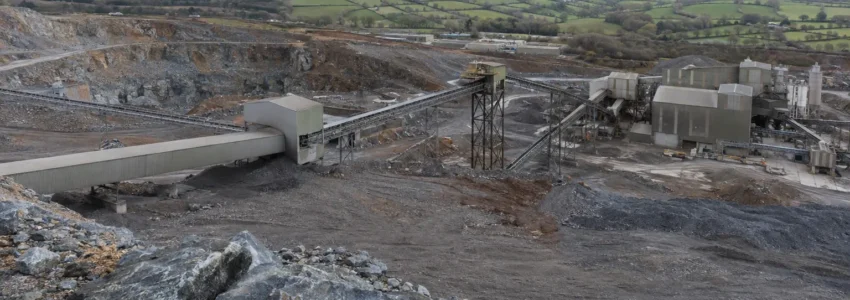
Mineral processing site beside an open quarry in the British countryside.

Why UK Tungsten Supply Matters: The Engineering Behind Britain’s £71m Critical Minerals Bet

A mine on the outskirts of Plymouth is becoming part of a much larger conversation about Britain’s industrial resilience. On 25 August 2026, the National Wealth Fund announced an investment of up to £71 million in Tungsten West. The funding is intended to support the restart of the Hemerdon tungsten and tin mine in South Devon and help establish a secure domestic source of a material used across several strategically important industries.

The intervention raises an obvious question: why is the UK tungsten supply important enough to justify Government backing on this scale?

The answer reaches far beyond the mine itself. Tungsten is associated with manufacturing, high-technology supply chains, aerospace, defence, electronics and next-generation energy. That means access to it is not merely a mining concern. It is also an engineering, procurement and industrial-capability issue.

Hemerdon will not make the UK self-sufficient in tungsten, nor will reopening a mine automatically create a complete domestic supply chain. However, the project illustrates why access to critical materials has moved much closer to the centre of manufacturing strategy.

27 Aug 2026
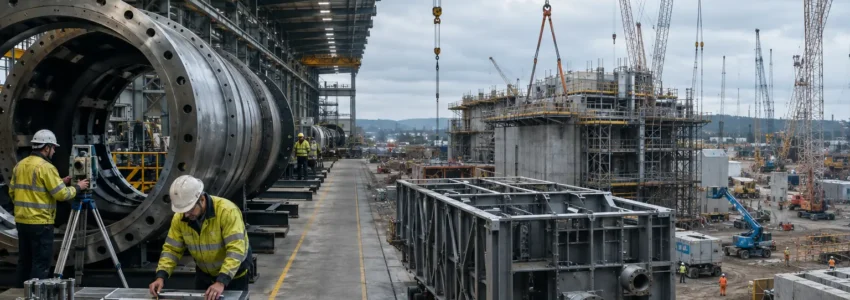
Engineers inspect large manufactured components before modular installation at an energy construction site.

What Will It Take to Build Britain’s Next Generation of Nuclear Power?

Britain’s plans for a new generation of nuclear power are beginning to take shape. At the centre of the programme are small modular reactors, or SMRs: nuclear power stations designed around standardised, modular components that can be manufactured in factories before being transported for assembly on site.

Rolls-Royce SMR was selected as the UK programme’s preferred technology partner in June 2025. In April 2026, Great British Energy – Nuclear, known as GBE-N, signed a contract with the company to begin technology and site-specific design work, regulatory engagement and planning.

The initial three-unit project is planned for Wylfa on Ynys Môn. However, important stages remain, including a future Final Investment Decision. It is therefore more accurate to describe Wylfa as a planned project than as one already moving into construction.

Much of the public discussion around UK small modular reactors naturally focuses on energy security and generating capacity. But the programme is also a manufacturing story. Its success will depend on whether complex components can be produced repeatedly, inspected thoroughly and delivered with the consistency and supporting evidence that major nuclear projects require.

28 Jul 2023

The British Army has ushered in a new era of armoured vehicle technology as they embark on extensive trials for the cutting-edge Boxer armoured vehicle, which sets a new standard for armoured fighting vehicles (AFVs). Designed with flexibility, robustness, and mission adaptability in mind, the Boxer can operate in diverse terrain, under various combat situations. The ability to transport troops, serve as a command vehicle, an ambulance, or even a cargo carrier underlines its multipurpose potential.

7 Jun 2022

For some reason, many people believe that British manufacturing is dead and claim we no longer make anything. While suggesting that Great Britain transformed the industry is perhaps reaching but we know for a fact that we are still producing many products across various sectors. In this article, we look at the story of British manufacturing with some information from Phil Hamlyn Williams, the author of a new book, How Britain Shaped the Manufacturing World.

11 Nov 2019

Even though the British manufacturing sector is the ninth-largest in the world, Brexit has already had an impact and it could get even worse. Factories in Britain have suffered a sixth consecutive month in October showing fewer new orders thanks to the ongoing Brexit uncertainty. The industry is facing a tough future with weakened global demand for UK manufactured goods and employment issues.

According to an industry survey, Brexit has not only affected demand but also an increase in job losses. The survey was conducted before the announcement of the election which reflects two months of preparations for leaving the EU on 31 October. Of course, we all know what happened with that story.

Recent Comments

    Events

    November 2026
    M T W T F S S
     1
    2345678
    9101112131415
    16171819202122
    23242526272829
    30