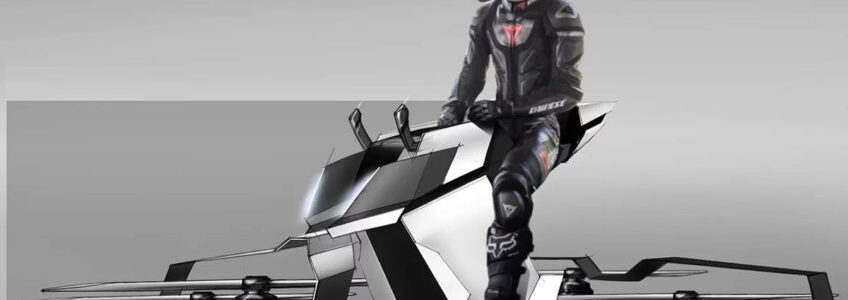
Not that long ago everyone thought the new millennium would usher in flying cars, electric hoverbikes and other advanced tech. It’s no longer just a fantasy as portrayed in sci-fi movies with flying cars and electric hoverbikes in daring police chases. Technology is now at the point where that dream could, in fact, become reality sooner than we think. Not just for military or police purposes, but a much broader horizon awaits us all.
Technology is at the point where talking about a flying car should come as no surprise. This can be attributed mainly to the new lightweight material, improved batteries, advanced computer technology and controls. According to reports, DeLorean Aerospace is in the process of developing a two-seater VTOL aircraft called the DR-7. This puts Paul DeLorean in a whole new category along with Airbus, Uber, Darpa and the likes of Larry Page.
The DeLorean is best remembered for the time-traveling sports car from Back to the Future films piloted by Doc Brown. Who would have thought his quote would
Futurologist Jeremy Rifkin claimed that 3D printing is the beginning of a third industrial revolution. This means it would subsequently succeed the production line assembly that dominated manufacturing which started in the late 19th century. What if he’s right? Imagine printing a new valve for a broken tap or a brake disc for your car. In contrast, perhaps something simpler like a new plate when your little ones drop the good dishes. The possibilities are essentially endless given the right materials and machines.
In recent times there has been an even bigger drive for renewable energy than ever before. This has also given rise once again to the solar power car. It could be due to the global warming phenomena or maybe we finally realised that the sun is in fact our biggest energy source and it’s free. At least in theory it is but putting in place the technology to store sufficient amounts of energy is the challenging part.
McLaren has announced that it is to construct the new McLaren Composites Technology Centre (MCTC) in Sheffield. The facility is the result of a £50m joint investment with Sheffield City Council and the University of Sheffield’s Advanced Manufacturing Research Centre (AMRC).
The facility, which will create 200 jobs will be the first purpose built facility outside of the existing McLaren site in Woking, Surrey. The centre will be responsible for the research and manufacture of carbon fibre chassis for current McLaren automotive cars and also for future models. With work on the new centre due to start shortly, it is anticipated that there will be 2 years of research and development before advanced carbon fibre chassis will be manufactured from 2020. This will mean that at this point in time almost 60% of all McLarens will be UK sourced.


Recent Comments