
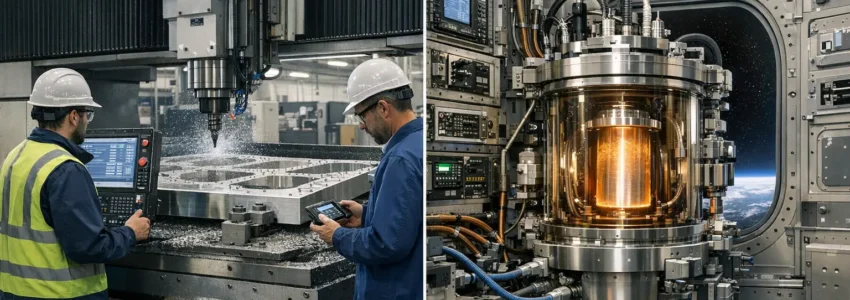
Microgravity Is Changing Advanced Materials in Space Manufacturing
Space manufacturing is rapidly moving from theoretical research into a serious engineering discussion.
For most of the space age, manufacturing has taken place almost entirely on Earth. Satellites, spacecraft components and instruments are designed, machined and assembled in terrestrial facilities before being launched into orbit.
But engineers are beginning to question whether some materials might actually be produced more effectively in space.
In microgravity environments, liquids behave differently, crystal structures can form more uniformly and impurities do not settle in the same way they do under Earth’s gravity. These changes may allow scientists and aerospace engineers to manufacture certain materials with properties that are difficult to achieve in conventional factories.
What once sounded like science fiction is now becoming a practical area of aerospace engineering research.
How Microgravity Changes Manufacturing Physics
Manufacturing processes are heavily influenced by gravity, even when engineers do not immediately notice it.
On Earth, molten materials are constantly affected by convection and sedimentation. Denser particles tend to sink, lighter materials rise and thermal gradients create fluid movement during processes such as crystal growth or alloy formation.
These effects can introduce imperfections into manufactured materials. In microgravity conditions, many of these behaviours are reduced or eliminated.
During manufacturing in space:
- convection currents are weaker
- sedimentation is reduced
- crystal structures can grow more evenly
- fluid flow behaves differently
These changes may sound subtle, but they can significantly affect the quality of certain advanced materials.
According to NASA research into microgravity materials science, the absence of gravity allows scientists to observe how materials behave without convection-driven disturbances that normally affect crystal formation on Earth.
For aerospace engineers and materials scientists, this opens up possibilities that are difficult to replicate in terrestrial laboratories.
NASA’s Role in the Commercial Low Earth Orbit Economy
NASA’s current framing is useful because it places space manufacturing within a wider commercial low Earth orbit economy rather than treating it as a one-off experiment. In its Commercial Space Frequently Asked Questions page, NASA says it supports a “robust commercial space economy” that advances industry through in-space work and research.
That matters because manufacturing in space is unlikely to develop in isolation. It sits alongside commercial research, private missions, orbital platforms and the wider push to make low Earth orbit a more practical place for industrial activity. NASA’s role here is less about running every manufacturing project itself and more about helping create the conditions in which this kind of work can move from demonstration to commercial use.
Space Forge and the Push Towards Commercial Viability
More recent developments show where this could become commercially relevant. UK company Space Forge has been awarded £300,000 for its 2Forge2Furious study, which aims to show how semiconductor seed crystals could be produced commercially in orbit. The goal is improved crystal purity, which could support more efficient and reliable high-power electronic devices for sectors such as telecommunications, data centres, electric vehicle charging and quantum computing.
Why Space Manufacturing Could Improve Semiconductor Materials
One of the most promising applications of space manufacturing involves semiconductor materials.
Semiconductors are the foundation of modern electronics. Electrical power distribution inside satellites is also critical, and spacecraft systems often rely on precision-engineered busbars to safely deliver current across onboard electronics.
They are used in:
- satellites
- spacecraft systems
- telecommunications equipment
- defence technologies
- advanced computing systems
The performance of semiconductor devices depends heavily on the quality of the crystal structures from which they are produced. Even small defects in these structures can reduce electrical performance, heat management or signal stability.
What Happens in a Microgravity Environment?
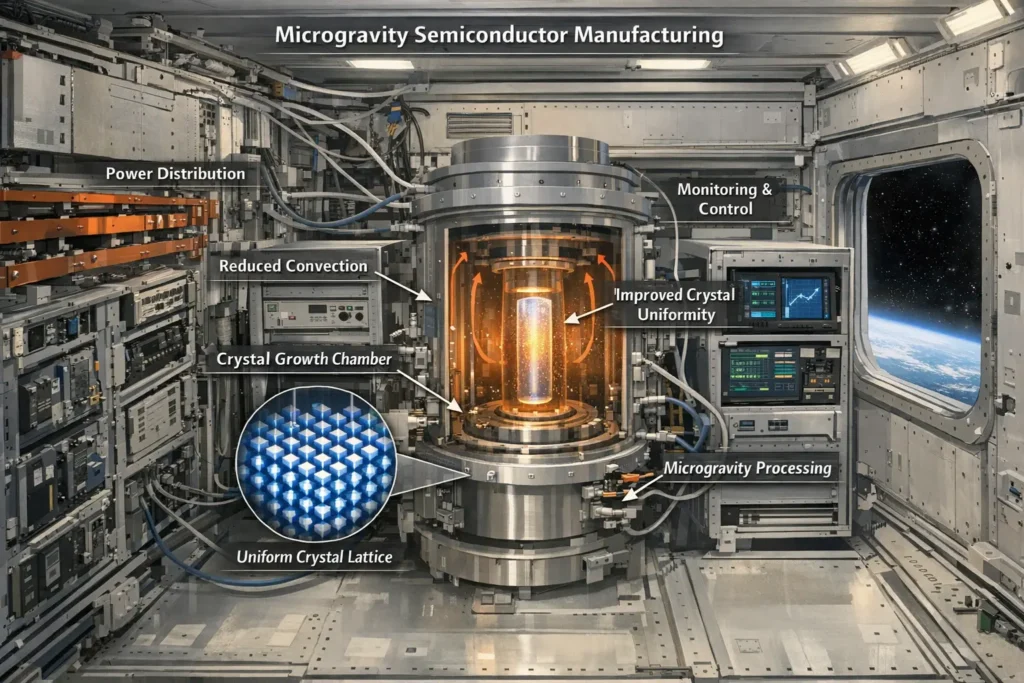
In microgravity environments, crystals can grow with fewer structural imperfections because gravity-driven convection is minimised. Materials such as gallium nitride and silicon carbide, both widely used in high-performance electronics, are particularly sensitive to crystal quality.
Improvements in their structure could lead to:
- more efficient power electronics
- improved thermal management
- higher-frequency communication systems
- greater reliability in harsh environments
This is one reason why space engineers and aerospace companies are now exploring orbital manufacturing platforms designed specifically for advanced materials.
The Companies Trying to Manufacture Materials in Orbit
Several aerospace startups and research organisations are already experimenting with manufacturing in space.
One of the most widely discussed examples is the UK-based company Space Forge, which is developing spacecraft designed to produce semiconductor materials in orbit before returning them safely to Earth.
Their approach focuses on microgravity manufacturing processes that could enable the production of higher-performance semiconductor crystals.
Space Forge and other organisations believe that materials produced in orbit could offer measurable improvements in efficiency and performance compared with conventional Earth-based production.
A recent report on orbital semiconductor manufacturing highlights how microgravity may allow improved crystal growth for advanced electronic materials. If these technologies prove commercially viable, space manufacturing could become a specialised but valuable part of the aerospace supply chain.
The Engineering Challenges of Manufacturing in Space
While the idea of manufacturing in space is appealing, the engineering challenges are substantial. A manufacturing platform operating in orbit must function as a fully autonomous industrial system.
It must withstand:
- launch vibrations and acceleration
- extreme temperature fluctuations
- radiation exposure
- vacuum conditions
- long periods without direct maintenance
Unlike terrestrial factories, orbital manufacturing systems cannot rely on engineers stepping in to resolve problems quickly. Instead, systems must be designed for reliability, automation and remote monitoring.
This creates new challenges for aerospace engineering teams designing the hardware that supports space manufacturing.
Spacecraft designed for orbital production must combine elements of:
- spacecraft engineering
- robotics
- automated manufacturing
- environmental control systems
In many ways, these systems function as small, automated factories operating hundreds of kilometres above Earth.
Why Space Manufacturing Will Focus on High-Value Materials
Despite the excitement around manufacturing in space, it is unlikely that everyday products will be produced in orbit.
Launching materials into space still carries significant cost. As a result, space manufacturing is expected to focus on materials where even small performance improvements justify the additional complexity.
These include:
- semiconductor crystals
- advanced optical fibres
- specialised pharmaceuticals
- experimental alloys
- high-performance nanomaterials
Many of these materials are used in aerospace engineering, telecommunications and advanced electronics where reliability and performance are critical.
In these industries, even incremental improvements can have significant economic and technological value.
The Cost Reality of Launching Materials into Orbit
Launch costs have fallen dramatically over the past decade, largely due to reusable rockets such as SpaceX’s Falcon 9. Historically, launching payloads to low Earth orbit could cost tens of thousands of dollars per kilogram. Modern commercial launch providers have reduced that figure to roughly $2,000–$3,000 per kilogram, depending on the mission and payload configuration.
This reduction has been a major factor in making manufacturing in space more realistic.
However, even at these lower costs, launching large quantities of raw materials into orbit would still be economically impractical for most products. That is why current research focuses on high-value materials where even small improvements in performance justify the additional complexity.
Examples include advanced semiconductor crystals, specialised optical fibres and experimental materials used in aerospace and electronics.
How Earth-Based Engineering Still Supports Manufacturing in Space
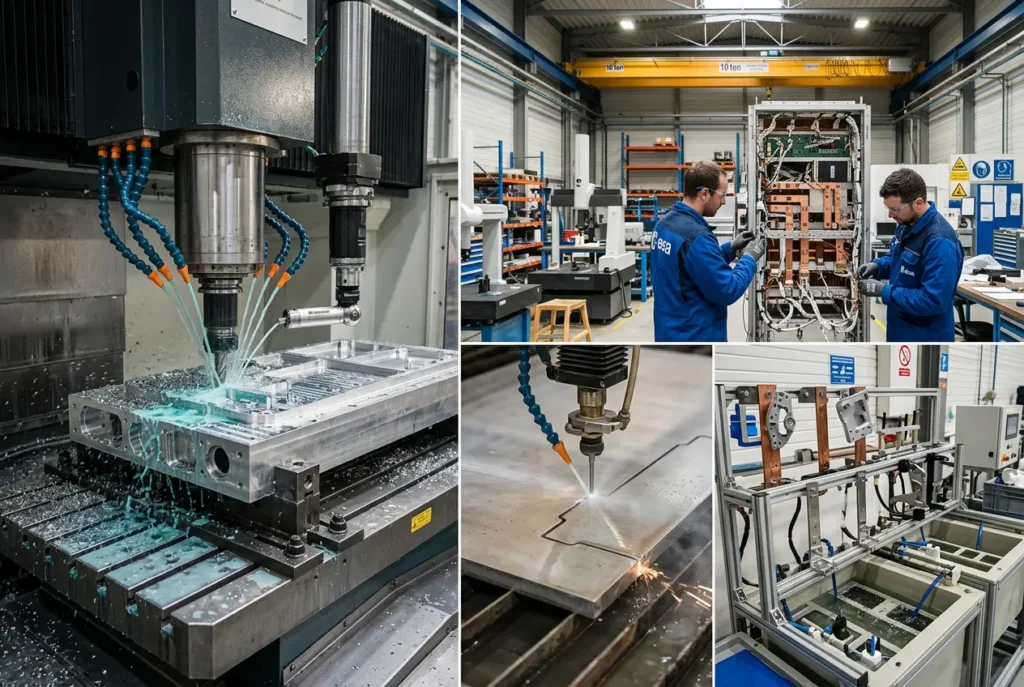
Even if manufacturing in space becomes more common in the future, the infrastructure enabling it will still depend heavily on Earth-based engineering. Spacecraft structures, deployment systems and orbital production platforms all require extremely precise manufacturing before they ever reach orbit.
This involves many of the same disciplines used across modern aerospace engineering:
- precision and large format machining
- advanced fabrication
- structural engineering
- electrical systems integration
- materials engineering
Preparing Materials for Manufacturing in Space
The European Space Agency notes that advanced manufacturing techniques are essential for building the spacecraft and systems that enable future space infrastructure. In other words, while some materials may eventually be produced in orbit, the engineering systems that make this possible will continue to rely on highly specialised manufacturing capabilities on Earth.
Preparing aerospace materials without distortion is also critical during fabrication, which is why processes such as hydro-abrasive waterjet cutting are often used to machine thick metals without introducing heat-affected zones. Engineers frequently compare cutting technologies depending on material thickness and distortion tolerance, which is why waterjet cutting is sometimes chosen over laser or plasma cutting.
Surface treatments also play an important role in aerospace reliability, with processes such as electroplating used to improve corrosion resistance, electrical conductivity and durability in demanding environments.
The Future of Manufacturing in Space
Space manufacturing remains in its early stages, but interest is growing quickly.
Reusable launch systems are gradually reducing the cost of accessing space. Advances in robotics and automation are making remote manufacturing more feasible. At the same time, demand for advanced materials continues to grow across industries such as aerospace, defence and computing.
These trends are beginning to converge. Over time, it is possible that certain high-value materials will routinely be produced in orbit before being transported back to Earth.
This would not replace traditional manufacturing. Instead, it would complement it.
Manufacturing in space may eventually become another specialised branch of engineering, working alongside terrestrial production systems to produce materials that benefit from microgravity conditions.
Our Thoughts on Space Manufacturing
Space manufacturing may still sound futuristic, but the underlying engineering principles are grounded in real materials science.
Microgravity environments offer unique conditions that can influence crystal growth, fluid behaviour and structural formation. These differences could allow engineers to develop materials with improved performance for aerospace systems, electronics and other advanced technologies.
While large-scale orbital factories remain some distance away, the research being conducted today suggests that manufacturing in space could eventually play a role in producing some of the most advanced materials used in modern engineering.
And as the technology develops, the engineers designing spacecraft, materials systems and automated manufacturing platforms will continue to shape how this new frontier evolves.
Recent Comments