

A major milestone has just been achieved in the offshore energy industry. Belgian marine construction firm Jan De Nul has launched the world’s largest and most advanced cable-laying vessel, designed to transform how offshore wind farms are connected to onshore power grids.
Unveiled at the CMHI Haimen shipyard in Jiangsu, China, the new vessel named Fleeming Jenkin, boasts an extraordinary 28,000-tonne cable-carrying capacity, making it the most capable ship of its kind ever built.
Connecting 1,700 Miles of Offshore Energy in Wind Farms
Once operational in 2026, the Fleeming Jenkin will begin its first assignment under Dutch-German grid operator TenneT’s 2GW Program; a major initiative designed to install a new generation of offshore connections capable of transmitting up to 2 gigawatts (GW) of power each.
Over the course of its mission, the vessel will lay more than 1,700 miles (2,800 kilometres) of subsea cable across the North Sea, creating a crucial link between offshore wind farms and mainland Europe’s power grid.
Jan De Nul’s Director of Subsea Cables and Offshore Energy, Wouter Vermeersch, highlighted that the vessel’s construction and on-board systems were designed entirely in-house, combining more than 15 years of cable installation expertise. The result is a ship engineered for both performance and sustainability, significantly reducing fuel use and emissions while improving efficiency.
Offshore Energy Innovation in Action: Hybrid Power and Ultra-Low Emissions
The Fleeming Jenkin is not only powerful but also environmentally advanced. Classified as an Ultra-Low Emission Vessel (ULEv), it features a dual exhaust system that removes up to 99% of nanoparticle emissions, alongside a hybrid power plant integrating a 2.5 MWh battery system and biofuel-capable generators.
This combination enables reduced CO₂ and NOₓ emissions which is a crucial step forward in creating cleaner, more sustainable maritime operations.
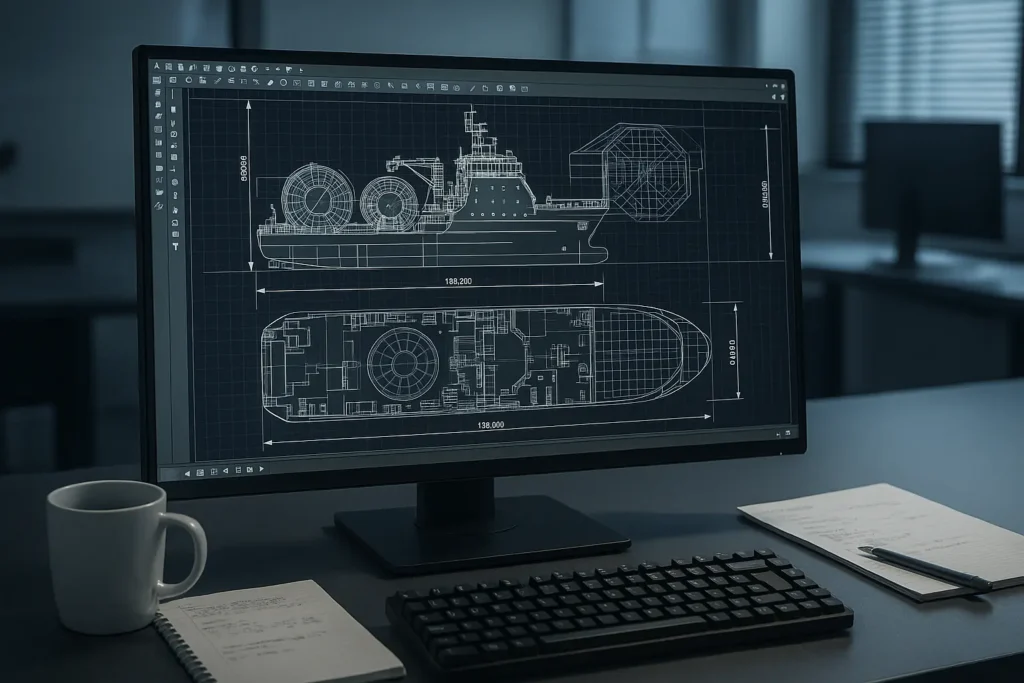
Onboard, three massive cable carousels (two above deck and one below) allow the vessel to lay up to four cables simultaneously and handle tensions up to 150 tonnes which is effectively the weight of the Statue of Liberty. The system is engineered to operate at depths of nearly 3,000 metres, reinforcing its role as a critical link in Europe’s offshore energy expansion.
A Rising Tide for Offshore Fabrication and Engineering
For companies like PRV Engineering, which deliver custom fabrication, precision machining, and structural steelwork for demanding industries such as marine, offshore, and oil & gas, projects like the Fleeming Jenkin illustrate the next era of engineering collaboration.
Offshore infrastructure on this scale relies on a broad network of specialists; from fabricators building deck assemblies and cable supports to engineers producing corrosion-resistant components and bespoke fittings capable of withstanding extreme marine environments.
As Europe and other regions move toward large-scale offshore energy systems, precision fabrication and robust material engineering will be critical to achieving reliability and long service life at sea. These are all areas where PRV’s expertise directly aligns.
Offshore Energy Then and Now
Offshore wind has come a long way in a relatively short time. When PRV Engineering first covered the world’s largest offshore wind farm in this earlier article, large-scale marine renewables were still in their early stages.
Today, the scale and complexity of offshore energy projects like the new Fleeming Jenkin cable-laying vessel, demonstrate how dramatically the industry has evolved. Modern wind farms now span thousands of turbines, with individual projects exceeding 3 GW of capacity, supported by vast subsea infrastructure networks.
This rapid growth highlights why fabrication, precision engineering, and surface protection technologies are more essential than ever to meet the engineering challenges of offshore environments.

Shaping the Future of Offshore Energy
With an estimated €400 billion investment required by 2050 to develop Europe’s offshore energy transmission infrastructure, vessels like the Fleeming Jenkin represent the next step toward building a global renewable power network.
Jan De Nul has already confirmed plans for an additional subsea vessel, the George W. Goethals. It is designed to handle 30,000 tonnes of rock material for subsea stabilisation and infrastructure protection.
As the world accelerates its shift to offshore wind and clean energy, the demand for advanced fabrication, precision engineering, and surface treatment will only grow.
At PRV Engineering, we see this as a defining moment where innovation in marine and offshore engineering merges with sustainability, and where decades of expertise in structural fabrication, architectural steelwork, and precision engineering can continue to support the technologies shaping our onshore and offshore energy future.
Recent Comments