
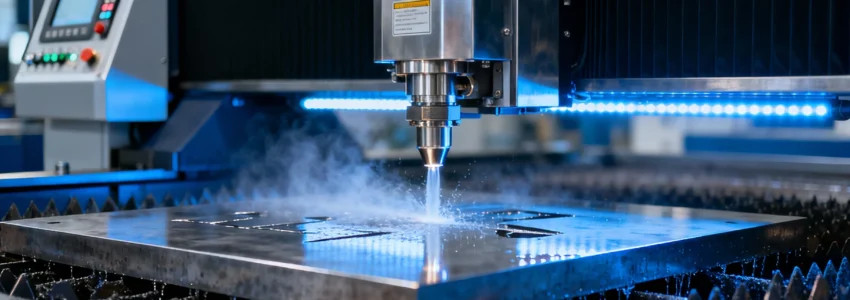
The Evolution of Waterjet Cutting Machines
Waterjet cutting machines have become one of the most critical tools in modern engineering, valued for their accuracy, versatility, and ability to cut materials without generating heat or distortion. As industries move towards smarter, cleaner, and more automated production methods, the evolution of waterjet cutting machines tells a much bigger story; one of innovation, precision, and the future of manufacturing itself.
From the earliest experiments with high-pressure water streams to today’s AI-enabled, multi-axis systems, the journey of waterjet cutting technology reflects the changing demands of engineering. And as new materials, tighter tolerances and more complex geometries continue to emerge, it’s no surprise that waterjet cutting machines now play a vital role across defence, aerospace, automotive, energy and construction.
Why Waterjet Cutting Machines Became Essential in Modern Engineering
The rise of waterjet cutting machines in mainstream manufacturing is no coincidence. As engineering projects have become more complex, industries needed a cutting solution that could:
- handle metals, composites, ceramics, stone and plastics
- produce clean, accurate cuts with no heat-affected zone
- avoid warping or micro-cracking
- work on large-format components
- support prototypes through to full-scale production
Hydro-abrasive waterjet cutting, in particular, offers a combination of precision and material flexibility unmatched by traditional cutting methods. With no thermal stress, minimal waste, and consistent accuracy, waterjet cutting machines are now integral to projects where quality and reliability cannot be compromised.
From Early Experiments to Industrial Adoption
The origins of waterjet cutting machines date back nearly a century. Early research in the 1930s and 1940s explored high-pressure water streams for erosion and material breakdown. These crude techniques found uses in quarrying and mining but lacked the precision needed for engineering and fabrication.
The turning point arrived in the 1970s, thanks largely to Dr Norman Franz, whose pioneering work proved that controlled high-pressure waterjets could cut soft materials cleanly. This breakthrough paved the way for commercial waterjet cutting machines.
The revolution truly accelerated in the 1980s with the introduction of abrasive media which transformed waterjet cutting into a process capable of slicing through steel, aluminium, titanium, composites and other engineering-grade materials. Hydro-abrasive waterjet cutting became the standard for high-performance industries needing fast, clean cuts on demanding materials.
By the 1990s and 2000s, waterjet cutting had become essential equipment in fabrication shops and precision engineering environments worldwide.
How Today’s Waterjet Cutting Machines Work
Modern waterjet cutting technology relies on ultra-high-pressure pumps, precision-machined nozzles and a controlled flow of abrasive particles. Operating at pressures often exceeding 60,000 psi, these systems accelerate water to near-sonic speeds.
Hydro-abrasive waterjet cutting, the most common industrial form, mixes garnet abrasive with the water stream, enabling it to erode metal, stone, ceramics and composite materials with exceptional accuracy.
The benefits of hydro-abrasive waterjet cutting include:
- no heat-affected zone
- no material distortion
- excellent edge quality
- minimal finishing required
- tight tolerances
- ability to cut multi-material laminates
Waterjet cutting machines are therefore ideal for applications where material integrity is critical, such as aerospace components, defence equipment, high-performance automotive parts, energy infrastructure and architectural fabrication.

Applications of Waterjet Cutting Machines
The versatility of modern waterjet cutting machines has made them indispensable across multiple sectors, especially those that rely on precision, repeatability and high material performance.
- Defence: Cutting armour panels, specialist alloys, ballistic materials and structural components without heat damage.
- Aerospace: Ideal for titanium, aluminium, composites and heat-sensitive materials used in aircraft and satellite structures.
- Automotive & EV Manufacturing: Rapid prototyping, low-volume production, lightweight components and high-precision parts.
- Oil, Gas & Energy: Large-format steel profiles, robust housings, flanges, and components exposed to high pressure or corrosive environments.
- Construction & Architecture: Specialist metalwork, stone cutting, façade elements, bespoke shapes and complex profiles.
- Rail & Infrastructure: Rolling stock components, steel platework, safety-critical profiles and structural parts.
In each of these sectors, waterjet cutting provides a level of flexibility that traditional machining, plasma cutting or laser systems cannot always match, especially when the components need zero heat input and clean edges.
The Future of Waterjet Technology: AI, Robotics and Automation
Waterjet cutting is now entering a new era of automation. With advances in digital manufacturing and AI, next-generation systems are becoming faster, smarter and more connected.
- AI-driven optimisation: Artificial intelligence will refine cutting paths, reduce abrasive waste, and shorten cycle times — improving efficiency at scale.
- Robotic multi-axis cutting: Robotics is enabling waterjet cutting machines to move around complex 3D forms, creating new possibilities for aerospace, marine and defence components.
- Real-time quality monitoring: Future systems will self-adjust based on feedback from sensors measuring pressure, velocity, jet stability and cut quality.
- Digital twins & smart factories: Waterjet cutting machines will integrate into full digital ecosystems, enabling simulation, predictive maintenance and automated production flows.
- Sustainability improvements: Closed-loop water systems and energy-efficient pumps will make hydro-abrasive cutting an increasingly low-waste, low-impact technology.
The next decade will see waterjet cutting machines become even more capable as automation and AI reshape the manufacturing landscape.
PRV Engineering’s Advanced Hydro-Abrasive Cutting Capabilities
PRV Engineering operates one of the UK’s most advanced hydro-abrasive waterjet cutting facilities at our state-of-the-art site in Pontypool. Our large-format cutting systems, combined with precision machining and expert fabrication, make us a trusted engineering subcontractor across the UK’s most demanding sectors.
Our full capabilities include:
- Hydro-abrasive waterjet cutting
- Deep hole drilling
- Metal fabrication
- Electroplating (tin & silver plating)
- Spray painting, powder coating & shot blasting
PRV Engineering Supports Various Sectors:
- Defence
- Aerospace
- Automotive
- Oil & Energy
- Construction
- Rail
- Specialist industrial fabrication
- Site installation & engineering support
By combining hydro-abrasive water jet cutting with our wider machining, drilling, fabrication and finishing services, PRV offers a genuine one-stop engineering solution — from raw material cutting through to final assembly and coatings.
Our Thoughts on Waterjet Cutting Machines
The evolution of waterjet cutting technology reflects the evolution of engineering itself: higher precision, smarter processes, a wider range of materials and a greater demand for quality. As AI, robotics and automation transform manufacturing, waterjet cutting will continue to play a crucial role in producing the components that power modern industry.
PRV Engineering’s continuous investment in advanced hydro-abrasive waterjet cutting machines and our wider suite of machining and fabrication services ensures we remain at the forefront of this technology. We aim to always deliver precision, capability and reliability across the UK’s most demanding sectors.
Recent Comments