
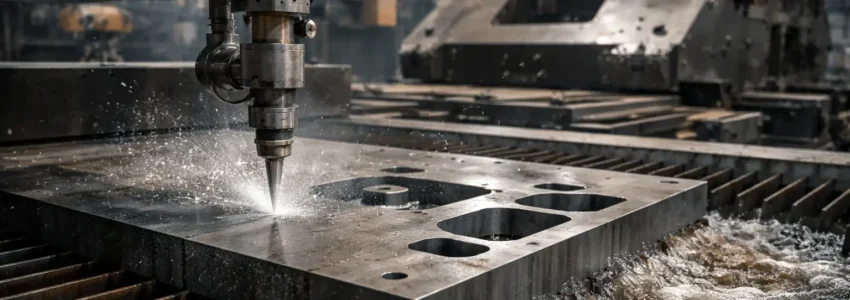
How Waterjet Cutting Services Support Modern Defence Engineering
Waterjet cutting services have become increasingly important in defence-related engineering because they eliminate one of the most common and underestimated risks in manufacturing: heat-induced material distortion. For contractors, project directors and procurement teams, this has direct implications for reliability, compliance, and long-term cost.
In defence manufacturing, the margin for error is effectively zero. Components are expected to perform under extreme conditions, over long operational lifecycles, and often within tightly controlled tolerances. In this environment, the choice of cutting process is not just a production decision but a performance decision.
The Demands of Defence Engineering
Defence projects operate under constraints that go well beyond standard industrial manufacturing. Materials must perform consistently under stress, assemblies must fit precisely without adjustment, and components are often expected to withstand harsh or unpredictable environments.
This places pressure not just on design, but on every stage of production. A single process that introduces variability, even at a microscopic level, can create downstream issues during assembly, testing or deployment.
For engineering contractors managing delivery risk, this is where process selection becomes critical.
Why Thermal Cutting Methods Introduce Risk
Traditional cutting methods such as laser and plasma rely on heat to separate material. While effective in many applications, they introduce a heat-affected zone (HAZ), where the material’s microstructure is altered. Read more about where waterjet cutting services deliver maximum value over plasma or laser.
In defence applications, this can lead to:
- reduced material strength in critical areas
- residual stresses that affect performance under load
- distortion that impacts assembly tolerances
- additional finishing or machining requirements
These effects are not always visible immediately, but they can introduce variability into otherwise tightly controlled systems.
For project leads, this often shows up later, during fit-up, inspection, or performance testing, where the cost of correction is significantly higher.
How Waterjet Cutting Services Remove This Risk
Waterjet cutting services use a high-pressure stream of water, often combined with abrasive material, to cut through metal without introducing heat into the process.
This cold cutting method means:
- no heat-affected zone
- no change to material properties
- zero distortion from thermal expansion
- clean, precise edges ready for downstream processes
For defence manufacturing, this is a fundamental advantage. It allows engineers to maintain the original properties of high-performance materials while achieving the precision required for complex assemblies.
Hydro-abrasive waterjet cutting is particularly valuable where both thickness and accuracy are required, without compromising structural integrity.
Materials Where Waterjet Cutting Services Excel
Defence manufacturing frequently involves materials that are difficult to process using thermal methods. These include:
- armoured and high-strength steels
- titanium and titanium alloys
- aluminium structures used in lightweight systems
- specialist alloys designed for heat and corrosion resistance
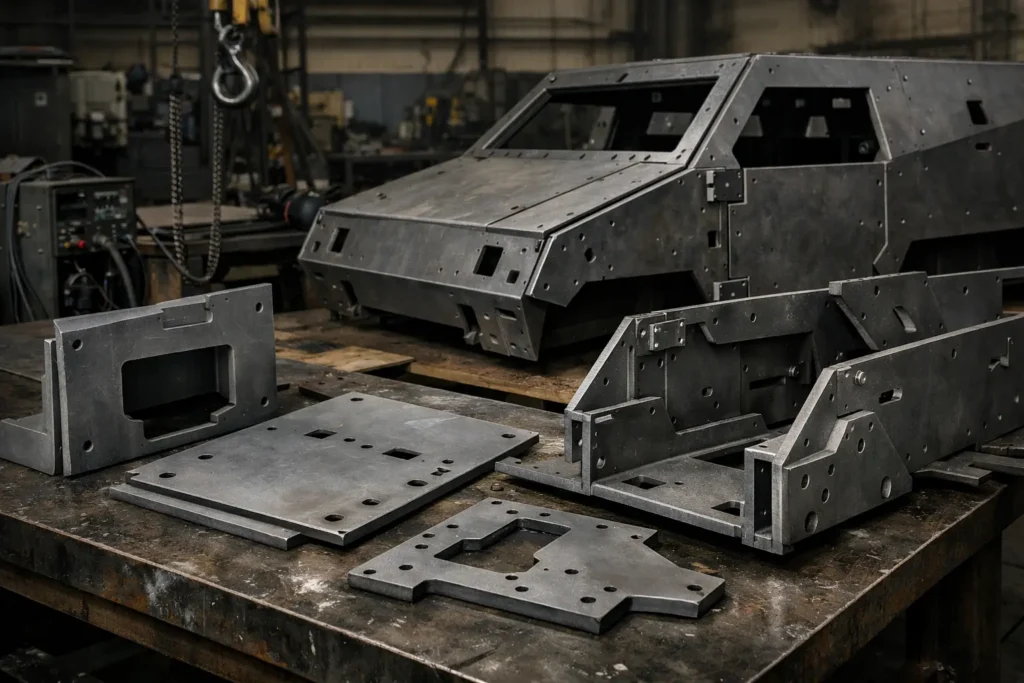
Waterjet cutting services enable these materials to be processed without altering their internal structure, which is critical in applications where strength, fatigue resistance and durability must be preserved.
This is especially important for contractors working across multiple systems or platforms, where consistency of material performance is essential.
Precision and Tolerance in Defence Components
Tolerance control is a defining factor in defence engineering. Components are rarely used in isolation; they form part of assemblies where alignment, fit and load distribution must be exact.
Even small deviations can lead to:
- misalignment during assembly
- increased wear over time
- performance inefficiencies
- failure under stress
Waterjet cutting services support tight tolerances by eliminating one of the main sources of variation: heat distortion. This makes them particularly suitable for components that will undergo further machining, fabrication or finishing.
For project directors, this translates into fewer surprises during assembly and more predictable outcomes across the production cycle.
Supporting Integrated Engineering Workflows
In practice, cutting is only one stage of a broader manufacturing process. Components may go on to be machined, fabricated, coated or assembled as part of a larger system.
Processes that introduce variability at the cutting stage can create compounding issues later on.
Waterjet cutting services support more stable workflows by producing components that are:
- dimensionally consistent
- free from thermal stress
- ready for secondary operations
This aligns well with integrated manufacturing environments, where multiple processes are managed in sequence and consistency is essential.
For contractors managing complex supply chains, this reduces friction between stages and improves overall delivery reliability.
Manufacturing Scale and Supply Chain Pressure
The importance of reliable processes is increasing as defence-related manufacturing demand continues to grow. According to the UK’s Office for National Statistics, manufacturing output remains a significant contributor to the UK economy, with ongoing pressure on supply chains to deliver high-quality components at scale.
As production volumes increase and timelines tighten, the tolerance for rework, delays or inconsistencies reduces.
For decision-makers, this reinforces the need to select processes that minimise risk from the outset, rather than relying on corrective measures later.
A Practical Fit for Defence-Focused Engineering Partners
For companies delivering work into defence, aerospace and related sectors, the ability to handle complex materials and maintain process control is essential.
Hydro-abrasive waterjet cutting sits alongside other critical capabilities such as machining, fabrication and surface treatment, forming part of a broader, integrated manufacturing approach.
PRV Engineering operates in sectors where these requirements are standard, not exceptional, supporting projects that demand precision, reliability and consistency across multiple stages of production.
Explore related capabilities:
- Hydro-Abrasive Waterjet Services
- Large Format Machining
- 5-Axis Machining
- Surface Treatment, Powder Coating and more
Final Thoughts: Why Choose Waterjet Cutting Services
In defence manufacturing, the performance of a component is shaped long before it reaches final assembly. The processes used at the earliest stages, including cutting, play a direct role in determining reliability, durability and compliance.
Waterjet cutting services offer a controlled, predictable method of processing high-performance materials without introducing unnecessary risk. For engineering contractors and project leaders, this is not simply a technical advantage, it is a strategic one.
Choosing the right process at the right time remains one of the most effective ways to protect both project outcomes and long-term performance.
Recent Comments