

Is the AI Impact on Engineering Jobs a Threat or an Opportunity?
The AI impact on engineering jobs is no longer a distant theory, it’s happening right now. As artificial intelligence becomes more embedded in design tools, data analysis, and documentation processes, engineers across disciplines are asking: is this the next leap forward or a warning sign of displacement?
With real-world data from Microsoft’s Copilot study now shedding light on how AI is actually being used in engineering workflows, it’s clear that the conversation has shifted from hype to hard evidence. The challenge isn’t whether engineers will be replaced—but how their roles will evolve.
The AI Impact on Engineering Jobs: A Real Concern or Hype?
The rise of artificial intelligence has left many professionals wondering: will it help me work better, or will it eventually replace me? For engineers, the answer isn’t black or white. A recent Microsoft Research study sheds light on the AI impact on engineering jobs—and the findings challenge some common assumptions.
The study analysed over 200,000 real-world interactions between professionals and Microsoft Copilot AI tools, mapping out where AI currently supports or performs human tasks. For engineers, this raised a vital question: where do they sit on the spectrum between “safe from AI” and “first to be replaced”?
New Study on the Impact of AI on Engineering Jobs
Rather than projecting AI’s future impact based on guesswork, the Microsoft study looked at actual user behaviour, revealing how people use AI across different job roles. Researchers created an “AI applicability score” to determine how many tasks in a given job could realistically be handled by today’s AI.
Here’s where engineers stand:
- CNC tool programmers had a score of 0.44, meaning nearly half of their tasks could be performed by AI.
- Software engineers and technical writers also had relatively high scores, showing AI’s effectiveness in coding and documentation.
- Traditional mechanical, civil, and electrical engineers scored lower due to the physical and hands-on nature of their work.
In other words, the AI impact on engineering jobs depends heavily on what kind of engineering you do.
How Engineers Are Actually Using AI
While AI isn’t taking over core engineering work just yet, it’s already proving useful in areas like:
- Research & information gathering – especially technical specs and regulations
- Technical writing & documentation – engineers use AI to create clearer, faster reports
- Troubleshooting & explanation – AI can help explain complex systems or suggest solutions
Notably, engineers aren’t using AI for critical design calculations, high-stakes decisions, or creative problem-solving—areas where human judgment remains essential.
Recommended: Edge Computing in Manufacturing for Faster and Smarter Factory Floors
AI’s Real-World Impact on Engineering Jobs
Across UK industries such as rail infrastructure, defence systems, advanced manufacturing, and construction, artificial intelligence is increasingly shaping how engineers approach their work. AI tools are proving useful in areas like document generation, data analysis, regulatory research, and even early design simulations—freeing up time for more complex decision-making.
But despite these benefits, many of the sector’s most critical functions remain inherently human. Whether it’s designing busbar systems for high-voltage applications, overseeing on-site installations, or ensuring sub-millimetre accuracy in precision fabrication, these tasks require hands-on expertise and problem-solving that AI cannot replicate.
In this context, AI is best viewed as an enhancement and not a replacement. It’s a tool to support the engineer, not to become one. The UK’s most resilient engineering roles are those that blend digital fluency with physical application, real-world judgement, and multidisciplinary collaboration.
Employment Outlook Despite the AI Impact on Engineering Jobs
Even with AI adoption growing rapidly, engineering jobs aren’t disappearing. In fact:
- A 2024 PwC UK survey found that only 22% of UK engineering firms have begun integrating generative AI into daily operations, largely limited to tasks like documentation, compliance checks, and customer interactions—not core technical work.
- Demand for engineering roles across the UK is projected to rise by 2.8%, equating to approximately 173,000 new net jobs by 2030—a growth rate higher than the national average.
- The Engineering Construction Industry Training Board (ECITB) predicts a 19% increase in workforce demand—requiring an estimated 135,000 workers by 2030 (up from ~114,000 in 2025). Critical roles include mechanical fitters, pipefitters, welders, and design technicians.
According to the World Economic Forum, AI and data processing trends will create 11 million new jobs by 2030—even after accounting for job losses. So, while the AI impact on engineering jobs is very real, it’s more about transformation than elimination.
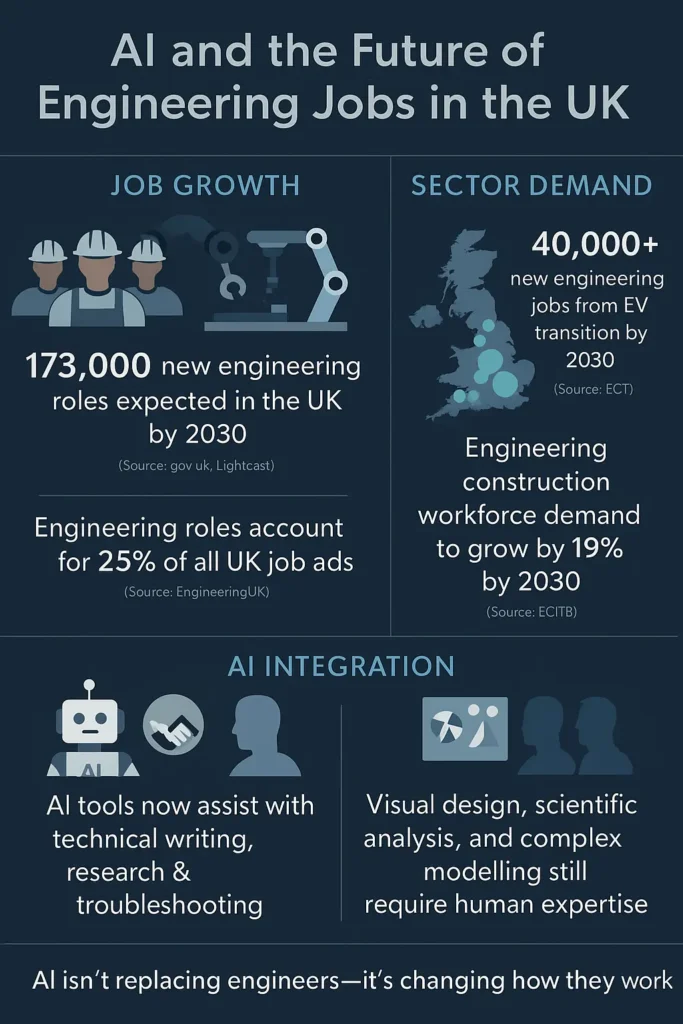
So, Will AI Take Engineering Jobs?
The short answer: no, but it will change them for sure.
AI will likely reduce the demand for some repetitive engineering tasks, especially in roles heavily focused on digital work like CAD drafting, documentation, and code writing. But for engineers involved in physical systems, fieldwork, or high-level design strategy, the human element remains irreplaceable.
In truth, engineers who learn to work alongside AI may find themselves more valuable than ever.
Recommended: The Rise of Humanoid Robots in Manufacturing – A New Era of Automation in 2025
Final Thoughts on the AI Impact on Engineering Jobs
The AI storm isn’t coming, it’s already here. But it’s not the job-killer many headlines suggest. For engineers, the challenge is to adapt and evolve, using AI to enhance what they already do best.
The whole AI impact on engineering jobs is complex, uneven, and full of opportunity. For companies like PRV Engineering, it’s a chance to reimagine processes, empower teams, and futureproof operations without losing the expertise that built the industry in the first place.
If you’re an engineering leader, innovator or decision-maker looking to harness tech without compromising on quality or skill, contact PRV Engineering today.
Recent Comments