

How the Tilting Microcar Is Redefining Urban Automotive Engineering
Most cars resist leaning. The tilting microcar does the opposite. Its engineered to lean on purpose.
In cities where road space is shrinking and emissions rules are tightening, simply making cars smaller is no longer enough. Stability becomes the limiting factor. A narrow vehicle can reduce congestion and improve efficiency, but narrow geometry increases rollover risk.
A tilting microcar solves that problem mechanically. It is a lightweight electric vehicle that leans into corners in a controlled manner, shifting its centre of gravity inward to maintain stability. It combines aspects of motorcycle dynamics with automotive structural engineering.
Developed by AEMotion in France, the AEMotion vehicle applies this leaning car design within Europe’s quadricycle category. As AutoEvolution reports, it represents a different way of approaching urban electric mobility, not by shrinking the conventional car, but by rethinking its balance.
This article examines how the tilting microcar works, the structural and control challenges behind it, and what it signals for European automotive engineering and supply chains.
What Is the AEMotion Tilting Microcar?
The AEMotion tilting microcar is a compact, two-seat electric vehicle capable of leaning during cornering. It is significantly narrower than a traditional passenger car and is engineered to operate within European quadricycle regulations.
A tilting microcar is designed to solve a specific engineering problem: how to maintain cornering stability in a very narrow vehicle.
In a standard car, stability is achieved through track width, suspension stiffness and anti-roll bars. In a tilting microcar, stability is achieved by shifting the cabin inward during turns, reducing lateral load transfer.
This allows a narrow urban EV to corner more safely without increasing width which is a critical constraint in European city centres.
The Engineering Behind a Tilting Microcar System
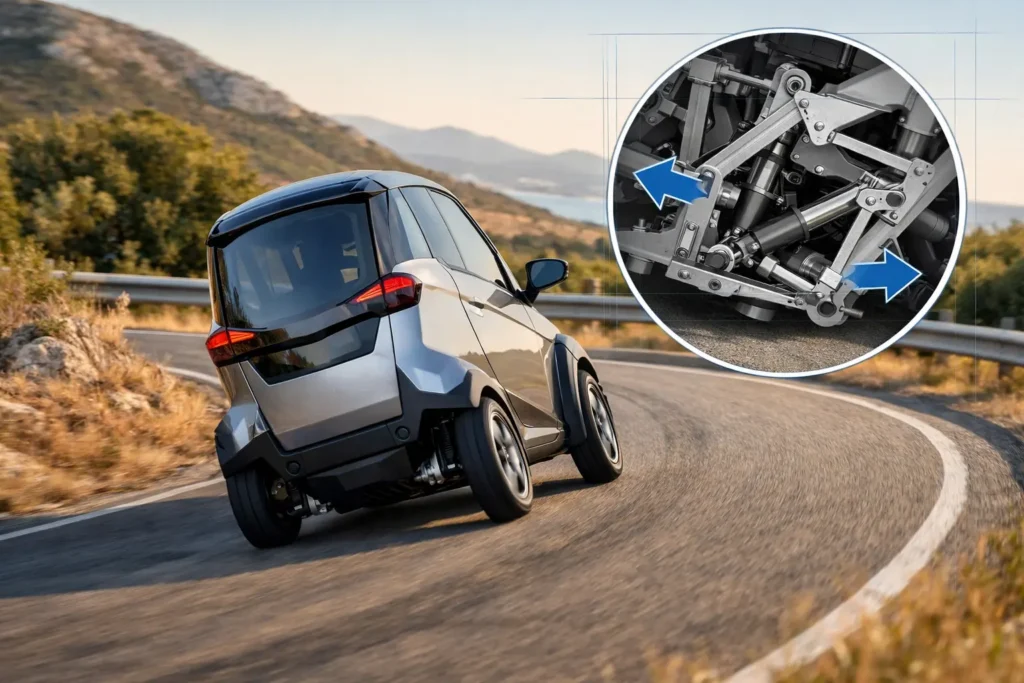
The defining feature of a tilting microcar is its active lean system.
During cornering, centrifugal force pushes the vehicle outward. In a traditional car, this creates body roll resisted by suspension components. In a leaning car design, the vehicle intentionally tilts inward to counteract this force.
Mechanically, such systems can use:
- Electro-mechanical actuators
- Hydraulic tilt assemblies
- Pivot-linked subframes
Sensors monitor steering angle, speed and yaw rate. Control units calculate the required lean angle in real time.
The lean angle must correlate precisely with lateral acceleration. If the system under-tilts, stability benefits are reduced. If it over-tilts, occupant comfort and tyre contact can be compromised.
This blending of mechanical articulation and electronic control is central to tilting electric vehicle design.
Structural and Material Challenges in a Tilting Microcar

Allowing a vehicle to tilt changes how forces flow through the chassis.
In a conventional monocoque, loads are distributed symmetrically. In a tilting microcar, rotational forces concentrate around pivot structures and hinge points.
Key engineering considerations include:
- Torsional rigidity: The frame must remain stiff while accommodating controlled rotation.
- Fatigue resistance: Repeated lean cycles introduce cyclic stress around articulation zones.
- Mounting integration: Actuators must be mounted without weakening crash structures.
Weight is critical. Quadricycle engineering often imposes strict mass limits. As a result, lightweight vehicle engineering becomes central to viability.
Aluminium structures are particularly relevant in this context. For a deeper look at aluminium’s role in modern automotive design, see PRV’s analysis of the world’s first single-cast EV chassis.
Lightweight structural optimisation is not optional in a tilting microcar architecture; it is foundational.
Centre of Gravity and Lean Dynamics in a Tilting Microcar
Vehicle stability depends on the position of the centre of gravity (CoG).
In a narrow urban EV, a high CoG combined with reduced track width increases rollover risk. A tilting microcar addresses this by effectively repositioning the CoG during cornering.
Lean angle follows a principle similar to motorcycle dynamics:
Lean angle ≈ arctan (lateral acceleration ÷ gravitational acceleration)
However, unlike motorcycles:
- The system must stabilise itself at low speed.
- The vehicle must remain upright when stationary.
- Transition between upright and lean states must be smooth and predictable.
This requires a coordinated control strategy integrating steering input, speed sensors and stability algorithms.
It represents a hybrid dynamic model: part automotive, part motorcycle physics.
Suspension and Control Systems in a Tilting Microcar
Suspension systems in a tilting microcar must manage both vertical wheel travel and controlled cabin rotation.
Possible architectures include:
- Independent suspension arms linked to a tilting central module
- Dual-track front axles with articulated upper structures
Electronic control is critical. Sensors track:
- Roll rate
- Yaw rate
- Steering angle
- Vehicle speed
Software determines how aggressively the vehicle leans. Calibration must prioritise predictability over sharp response.
This intersection of software and structural engineering reflects broader trends in European automotive engineering, where electric vehicles increasingly integrate mechanical and electronic subsystems. PRV has explored similar themes in advanced propulsion and systems integration.
Why the Tilting Microcar Concept Is Emerging in Europe
The tilting microcar concept is closely linked to Europe’s urban environment.
Cities such as Paris and Rome are characterised by:
- Narrow historic streets
- Limited parking
- Increasing low-emission zones
The European Automobile Manufacturers’ Association tracks ongoing electrification across European markets, with policy frameworks increasingly supporting smaller electric platforms.
France, in particular, has supported alternative mobility concepts through regulatory flexibility and innovation funding.
Within this environment, a narrow urban EV that can maintain stability without widening its footprint becomes technically and commercially attractive. The tilting microcar therefore represents a structural response to geographic and regulatory constraints rather than a stylistic novelty.
Quadricycle Engineering and Regulatory Context
In the European Union, quadricycles fall under L-category regulations rather than M-category passenger cars.
This distinction affects:
- Maximum weight
- Power limits
- Safety standards
- Licensing requirements
Operating within quadricycle engineering parameters allows new entrants to develop innovative vehicle formats more rapidly than traditional OEMs operating under full passenger car homologation rules.
However, this flexibility also demands structural efficiency. Engineers must maximise occupant protection within strict mass and dimensional limits.
Finishing processes also matter in lightweight vehicle engineering. Protective coatings can influence durability and weight. PRV’s technical comparison of surface finishing methods illustrates how manufacturing decisions affect long-term performance.
What the Tilting Microcar Means for Automotive Supply Chains
The emergence of the tilting microcar introduces new demands across the supply chain.
These include:
- Precision articulation components: Lean mechanisms require tight tolerances and repeatable motion control.
- Lightweight structural fabrication: Thin-wall aluminium sections and bonded assemblies become more important.
- Integrated systems manufacturing: Control electronics and mechanical systems must function as a unified platform.
Unlike high-volume passenger cars, such vehicles are likely to be produced in smaller batches. This increases the importance of specialist subcontract engineering capable of low- to mid-volume precision manufacturing.
PRV’s exploration of advanced combustion technologies in high-performance automotive contexts also highlights how specialist engineering supports niche vehicle innovation.
Although the propulsion system differs, the underlying principle is consistent: innovation at vehicle level requires adaptable, precision-led engineering partners.
Broader Implications for European Automotive Engineering
The tilting microcar illustrates a shift in vehicle thinking. Rather than scaling down conventional cars, engineers are reconsidering geometry, balance and classification.
It blends:
- Motorcycle lean principles
- Electric vehicle packaging
- Lightweight structural frames
- Embedded control systems
This approach reflects the wider evolution of European automotive engineering toward modular, purpose-built urban platforms.
For UK engineering firms operating within the automotive sector, the implications are practical. As new vehicle categories emerge, demand grows for:
- Complex articulated assemblies
- Lightweight fabricated structures
- Precision-machined pivot components
- Low-volume production expertise
The tilting microcar is therefore not merely a curiosity. It is an example of how regulatory frameworks, urban geography and structural innovation intersect to produce new engineering architectures.
Final Thoughts: Engineering Adaptation, Not Hype
The AEMotion tilting microcar represents a deliberate response to European urban constraints.
It allows controlled lean to offset narrow track width. It operates within quadricycle regulations to enable structural experimentation. It relies on lightweight materials and integrated control systems to remain viable.
As AutoEvolution reports, the vehicle demonstrates how France continues to contribute to alternative mobility innovation.
For the broader automotive supply chain, the message is measured. Emerging vehicle formats require structural precision, lightweight optimisation and integrated mechanical-electronic systems.
The tilting microcar is not a replacement for conventional cars. It is a specialised engineering solution to a specific mobility problem, and a reminder that meaningful innovation often begins with rethinking geometry rather than increasing scale.
Recent Comments