Archives

Manufacturing

7 Dec 2018

While there is no magic trick to change common chemical elements into rare and valuable ones, electroplating is as close as it gets. Electroplating is similar to electrolysis which is the opposite of the process batteries use to produce electric currents. The earliest form, which became the modern electroplating process, occurred in the early 19th century.

The development of bigger electric generators meant higher currents which drastically improved the process. Advancements in industrial and manufacturing practices over the past two centuries have changed this process considerably.

While some of you may already know what electroplating is, what about how it works?

23 Nov 2018

In modern-day manufacturing, technology is forever advancing and it is essential to keep up with the all latest trends. Throughout our history, we have seen a number of methods implemented to manufacture custom parts. Today, CNC machining and 3D printing are seen as two of the most widely used manufacturing processes.

With the rapid growth of 3D printing technology, some believe it has become the first choice for many industries. On the other hand, CNC machining is still considered a reliable standard and there really aren’t many things that don’t involve CNC machined parts somewhere in the process.

Looking at the available technologies and industries utilising CNC machining and 3D printing, how do they work? Which industries prefer one or the other and how do they compare?

2 Nov 2018

Metalwork fabrication is a broad term referring to processes involving cutting, shaping or moulding metals into a final product. It is a specialist process that requires expertly trained staff and cutting-edge machinery. Metal components are widely available in a variety of dimensions and materials including sheet metal, metal rods and metal bars.

For the most part, good metalwork fabrication shops can produce products in a wide range of shapes and sizes. Manufacturers often require a non-standard component or a unique metal product which means they need custom fabrication services. It provides them with design and production assistance for built-to-order parts.

26 Oct 2018

As a manufacturer, you’re likely looking to save costs in several areas but none more so than fabrication. And this refers to everything from materials and labour to the shipping of fabricated components.

Everything boils down to identifying cost saving ideas that can really help improve your bottom line for optimal business growth. However, rushing into a decision and making big changes in a specific area may not be the right approach. Instead, implement several smaller methods to cut costs as it will ultimately lead to significant savings on your fabrication project.

While it is challenging to effectively reduce the cost of a fabrication project, it certainly is possible. The most important question here is, “How to minimise cost without sacrificing quality?”

28 Sep 2018

The evolution of hydro-abrasive waterjet cutting has been remarkable and is one of the most effective methods of machining. There is no heat affected zone (HAZ), the small cutting widths and omni-directional cutting means we can machine virtually any material with high precision and accuracy. As a result, waterjet cutting produces a much-improved product finish with little to no secondary processing needed.

Advanced technology and methods make waterjet cutting far more environmentally friendly. So much so that the dust, chippings or gas produced with other cutting methods do not occur. There is also no need to change tool heads, blades or lubricants for each type of material which means machining time is greatly reduced.

This highly versatile cutting method produces much less waste than other forms of cutting which allows for more diverse design. The ability to cut more intricate designs and patterns offers

17 Aug 2018

Much has been said about the promising future of UK manufacturing and engineering but what does the future hold? Everyone knows that Britain is the birthplace of the industrial revolution and remains a global leader in manufacturing. This applies especially to the aerospace sector as it’s the largest in Europe and only second to the US. In 2016, there were more than 2.6 million people directly employed in manufacturing in the UK alone.

The south-west of England is the largest aerospace region in Europe and home to 15 large aerospace companies. In addition, the cluster also consists of a large network of world-class supply chain companies.

Manufacturers have started to make the transition to new processes striving for greater productivity and functionality. Technological advancements in the last few years mean

24 Jul 2018

We can all agree that there aren’t many products we use in everyday life that does not involve CNC machining. From cars, planes, household machines and appliances to medical parts and toys, all go through a CNC machine at some point during production.

Computer Numerically Controlled or CNC machining has become more versatile then ever. The number of axis has increased and the types of machines now available mean that increasingly smaller and more intricate parts are manufactured using a CNC machine. The development of CNC Machining has truly revolutionised the manufacturing industry.

It’s not just CNC machines making waves, further advances like

13 Jul 2018

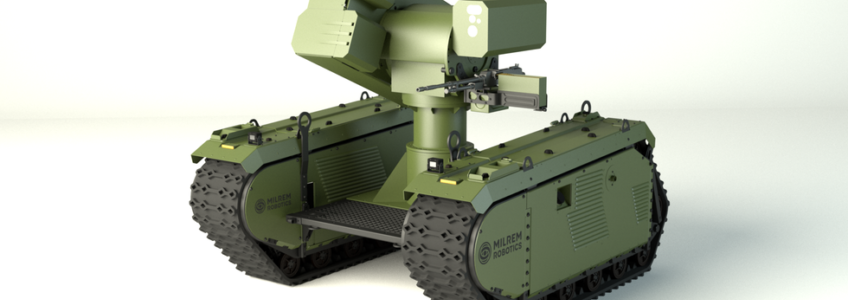
While the implications of robotic military vehicles on human society are yet to be fully realised, the technology is here and probably have been for longer than we think. Most recently an Estonian defence firm, Milrem, launched the world’s first modular unmanned ground vehicles (UGV) doubling as a tank-destroyer. The modular, multi-purposed vehicle intends to provide support for dismounted troops in the shape of a transport platform, remote weapon station, IED detection and a UAV carrier among others.

The race to build the perfect military vehicle is an ongoing slog-fest and defence contractors around the globe have their hands full. More specifically, tank designers and anti-tank weapon designers are constantly pushing the envelope for better technology.

6 Jul 2018

While Industry 4.0 is all about automation and digitisation, the future of manufacturing is in personalisation. Manufacturing 5-0, or the Fifth Industrial Revolution, will focus on the co-operation between humans and robots. Although the focus remains on automation and advanced manufacturing, the human element is more important than ever. We’ll take a closer look at what this means for manufacturing but first, let’s recap our journey up to now.

22 Jun 2018

The latest monthly CBI Industrial Trends Survey reports that UK Manufacturing output looks promising. They suggest that output has increased strongly and faster since the end of 2017. According to CBI, growth was broad-based, with output increasing in 14 out of 17 sub-sectors. Among the top performers are food, drink and tobacco and mechanical engineering.

Total order books show similar, healthy levels resembling that of December 2017. Exports remained stable, well above average and in line with the past 16 months. Output price expectations for inflation softened to the weakest in almost a year while stock levels moved below average. It hasn’t been smooth sailing as the UK Manufacturing sector faced some serious challenges.

While the CBI believes manufacturers will continue to benefit from robust external demand and the lower exchange rate, overall economic growth is expected to remain subdued. This comes as a result of weak consumer income growth and the continuous uncertainty stemming investments.

Events

June 2026
M T W T F S S
1234567
891011121314
15161718192021
22232425262728
2930